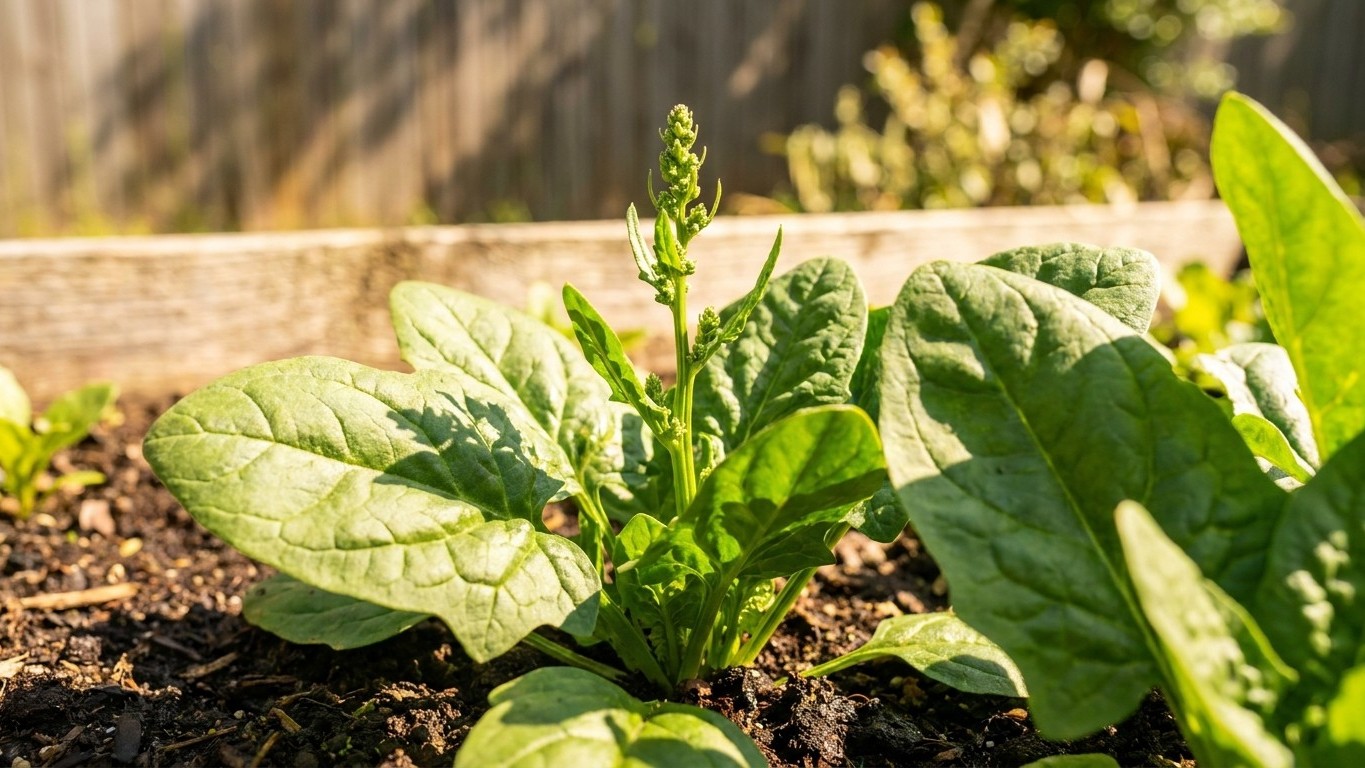

Cut spinach when the outer leaves reach about the size of your palm and the center of the plant is still a flat rosette, with no stalk lifting. In a low valley like Boise’s, that usually means May into early June for a spring sowing, then late September until a hard freeze for a fall sowing. After cutting, spinach keeps up to two weeks under ideal cold, and a home fridge rarely delivers ideal. The details below start with growing spinach in Idaho and end at the crisper drawer.
When spinach is ready in Idaho
The plant tells you before the calendar does. Spinach is ready when the outer leaves are big enough to eat and the center is still a tight, low cluster. Once a stem starts rising from that center, the leaves turn coarse and the crop is finishing. Dates only give you a rough window, and every garden in the state will shift it. Utah State University Extension advises timing a fall crop by counting back from the date you want to harvest.
When is spring spinach ready to cut?
NOAA’s National Centers for Environmental Information (NCEI) climate normals put the last spring freeze at the Boise station between April 23 and May 7. Spinach is sown directly in the ground as soon as the soil can be worked, which in a valley is often a few weeks before that window. The first cutting then comes in late spring, typically May into early June. Boise is a low valley. Most of Idaho sits higher and colder, so a garden at elevation sows later and cuts later, sometimes by weeks. Seed packets count days from sowing, and your first cutting follows the same count, so check the packet for the variety you chose. Check with your local county extension office for spinach varieties suited to your area.
The window closes with heat and daylight at the same time. Utah State University Extension says spinach bolts during long days and warm temperatures, and grows best where temperatures stay at or below 75 F. At Boise’s latitude the longest day carries 15 h 15 of daylight, so a cool summer does not buy extra weeks, because the day length alone pushes the plant toward flowering. Heat adds to it, with about 47.5 days a year reaching 90 F or more at the Boise station. That same 75 F is where leaves also turn bitter. A cut made just before that point is sweeter than one made after. For more on why plants run to seed early, see Will Spinach Bolt Early in Idaho?
When is fall spinach ready to cut?
The first fall freeze at the Boise station falls between October 7 and October 21. The obstacle is warm soil, not cold. Utah State University Extension reports that seed germination is reduced when soil is above 80 F, and valley soil in August is often warmer than that. Wait until the soil has cooled, or shade the row and keep it watered, before the seed goes in. Cutting then runs from early autumn until the plants stall in the cold.
Keeping it, and for how long
The UC Davis Postharvest Technology Center, which publishes produce fact sheets for growers and shippers, gives the target in plain numbers: an optimum temperature of 32°F (0°C) and an optimum relative humidity of 95-98%. Its description of the crop is blunt. Spinach is highly perishable and will not maintain good quality for more than 2 weeks. That is a ceiling under ideal conditions, and a kitchen is rarely ideal.
How cold and how humid does stored spinach need to be?
The humidity number matters as much as the temperature. At 95-98%, leaves hold their water instead of drying out and wilting. A refrigerator that is cold but dry will still leave you with limp spinach. The same UC Davis sheet notes that wilting, yellowing of leaves and decay are likely to increase following storage beyond 10 to 14 days, and that the decline runs faster at common distribution conditions of 5 to 10°C (41 to 50°F). Those distribution conditions are close to what many home fridges hold, especially near the door.
| Storage condition | What UC Davis reports |
|---|---|
| 32°F, 95-98% relative humidity | Optimum. Quality still does not last beyond 2 weeks. |
| Beyond 10 to 14 days | Wilting, yellowing and decay are likely to increase. |
| 41 to 50°F | Common distribution conditions. Deterioration is faster. |
Read the two weeks as the outer limit for spinach cut at peak and kept at 32°F from the moment it leaves the garden. Plan on less. Spinach that sat warm in a basket for an afternoon, or one that went into a fridge running above the optimum, has already used up part of that time. For the plan that holds up, eat the harvest within the first week, and treat anything older as a bonus.
The full fact sheet is at UC Davis Postharvest Technology Center, Spinach, for anyone who wants the original wording.
Where in the house that actually is
A home refrigerator runs warmer than 32°F, and the door runs warmer still because it swings open and meets room air each time. The door shelves are the worst place for spinach. The coldest zone is generally the back of the bottom shelf, away from the door and, in most models, away from the warm air that comes in when it opens. That spot comes closest to the optimum, and it is where the harvest belongs.
High humidity in a fridge takes a bit of arranging. A crisper drawer helps, but a sealed container or bag does more. You have three practical options for holding moisture around the leaves:
- A loosely closed bag with a barely damp paper towel or cloth tucked inside.
- A lidded container lined with a damp towel, with the leaves laid on top.
- For a whole bunch with the stems still attached, the cut ends set in a little water, with a bag draped loosely over the leaves.
The damp towel should feel moist, not wet. Dripping water at the bottom of the bag speeds decay. Cold and moisture together slow the loss. Wrap the leaves loosely in a damp towel inside a bag and put them at the back of the bottom shelf; skipping that step is how a bag of spinach goes from fresh to yellow in the time it takes a fridge door to open a few dozen times.
Sorting the leaves matters too. Pull out any yellowing or bruised leaf when you put the harvest away, because decay spreads from one damaged leaf to its neighbors. Wash the spinach right before you use it, since wet leaves packed tightly in a bag turn slimy faster than damp-wrapped dry ones.
Common questions
Can you cut spinach more than once?
Yes, if the plant has not started to bolt. Cut the outer leaves and leave the center growing, and the plant sends up new ones. Once a stem rises from the center, that cutting is the last.
What if a freeze is coming and the leaves are ready?
Cut what is ready before a hard freeze. At the Boise station the first fall freeze falls between October 7 and October 21, and higher, colder parts of Idaho see it earlier. Your county extension office can tell you the typical dates for your elevation.
How long does cut spinach keep in the fridge?
UC Davis says it will not maintain good quality for more than 2 weeks, and that was at 32°F with 95-98% relative humidity. Wilting, yellowing and decay are likely to increase beyond 10 to 14 days, and faster at 41 to 50°F. In a home fridge, use it sooner.
Can spinach grow through an Idaho summer?
Rarely. The longest day brings 15 h 15 of daylight at Boise’s latitude, and long days trigger flowering whether the weather is cool or hot. Warm weather speeds it up, and 75 F is also where the leaves turn bitter. Spring and fall are the seasons that work.