
Mississippi gardeners get one climate lever working against them at the top end of summer and a second one that doesn’t show up in any weather almanac: heat load. With 71.1 days a year hitting 90 F or hotter at the Jackson reference station, pepper flowers can abort before fruit ever forms. Pair that with the right variety choice and a transplant date tied to your own soil, not a calendar page, and a full crop is realistic. The trick is timing seed starts backward from your last frost and watching your own nighttime lows all summer.
The short answer

Start with the number that matters most for pepper growers in this state: 71.1 days a year at or above 90 F, measured at the Jackson reference station over the 1991-2020 period, according to NOAA NCEI Climate Normals. That’s not a stretch of hot afternoons here and there. That’s roughly ten weeks scattered across a Mississippi summer where daytime highs push past the threshold where pepper flowers stop setting fruit reliably. A plant can look perfectly healthy, covered in blossoms, and still drop them one after another during a heat spell, because pollen becomes less viable and the flower’s internal chemistry falls apart above that mark.
This is why a pepper plant set out in April can bloom heavily in May, stall through the hottest weeks of July and August, then suddenly load up with fruit again once temperatures ease in September. That’s not the plant failing. That’s the plant waiting out a stretch of days it can’t work with. Gardeners who don’t expect this dip sometimes assume a nutrient problem or a pest issue when the real cause is simply the thermometer.
The other failure point runs the opposite direction, and it matters just as much even though it gets less attention in a state known for summer heat. Nights that drop below 55 F also stop pepper fruit set, according to Utah State University Extension. That threshold is easy to overlook here because Mississippi summer nights are generally warm, but it becomes relevant at the shoulders of the season, in early spring right after transplant and again as fall approaches. A pepper plant set out too early, before nights have settled into the mid-50s and above, can sit and sulk for weeks with no new fruit even though the days feel plenty warm.
Here’s the part that requires your own observation rather than a chart: this site tracks days at or above 90 F for Mississippi, but it does not carry summer night minimum temperatures. There’s no substitute for stepping outside after dark or checking an evening reading during the first few weeks after transplant and again as the season winds down. Don’t guess at your nighttime lows based on how far south you live or what the coldest month of the year looks like on paper. Latitude tells you almost nothing about a specific August night in your own yard, especially with how much local terrain, tree cover and humidity shift real conditions from one county to the next.
When to start seed here
Working out your seed-starting date is arithmetic, not guesswork, once you know your reference points. Here’s how to build the calendar for your own garden.
- Start with your last spring frost window. At the Jackson reference station, the 32 F freeze probability falls between March 6 and March 22, based on NOAA NCEI 1991-2020 Climate Normals. That’s a range, not a single date, and it comes from an airport weather station. Suburban and rural gardens typically see their last frost later than the airport figure, often by one to two weeks, and more if you garden at higher elevation. Treat the airport window as a starting reference and adjust later based on your own county’s pattern.
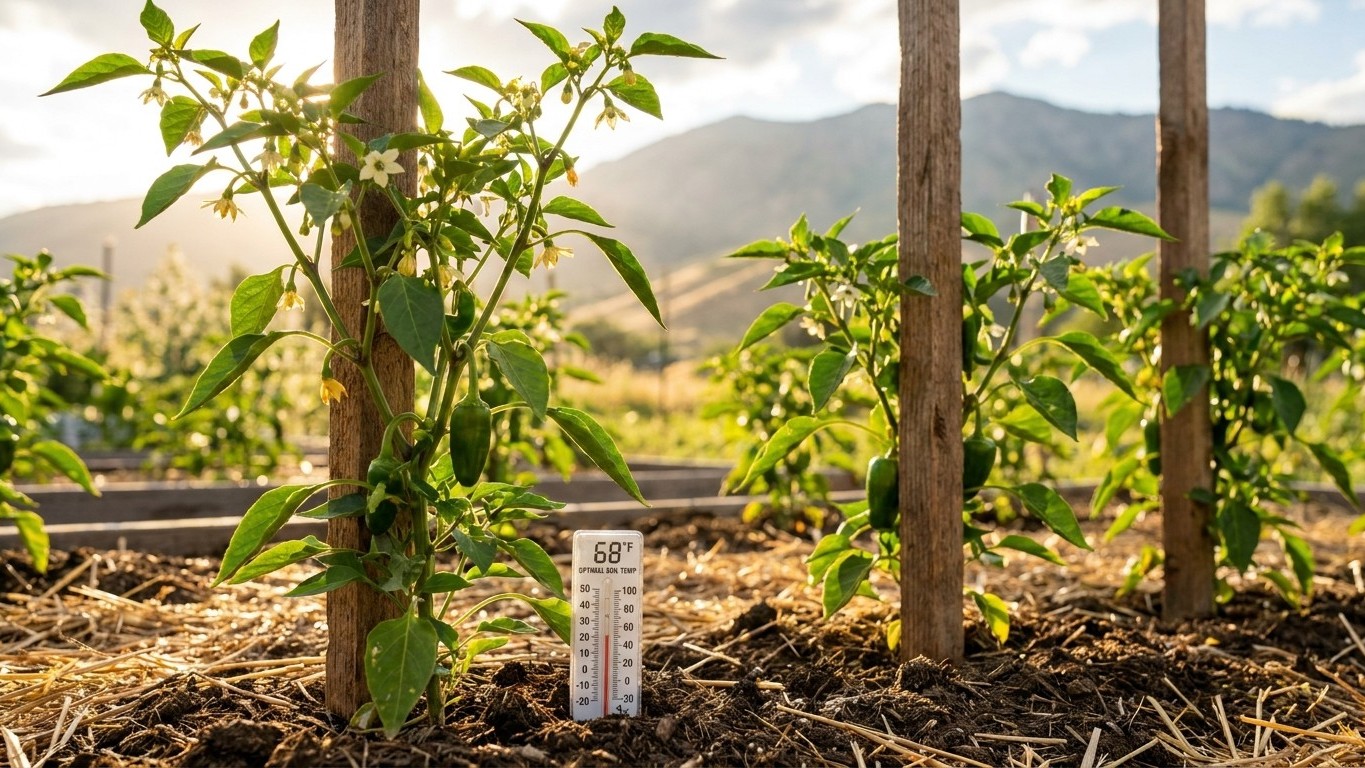
- Add the soil temperature requirement on top of frost. Utah State University Extension notes that peppers should go into the ground after frost has passed and once the soil has warmed to 60 F, whichever comes later. Air temperature and calendar dates don’t tell you soil temperature directly. A cheap soil thermometer pushed a few inches into the bed on a sunny morning gives you a real answer instead of an assumption.
- Count backward 8 to 10 weeks for your indoor seed-starting date. That’s the window Utah State University Extension gives for how long pepper seedlings need indoors before they’re ready to go outside. If your working transplant date lands in early April, for instance, counting back 8 to 10 weeks puts your seed-starting date somewhere in late January to early February. Adjust the math to whatever transplant date you land on for your own property.
- Recheck against the cool-night threshold before you actually move plants outside. Even once frost has passed and soil has hit 60 F, fruit set won’t start firing until nights are reliably above 55 F. If a late cold snap is forecast even after your calculated transplant date, holding seedlings indoors or under cover another week costs far less than losing early blossoms to a chilly night.
Run this same four-step math with your own county’s frost data rather than the airport figure alone, and you’ll have a transplant date that fits your actual yard instead of a generic zone map.
What goes wrong here
- Blossom drop from a hot spell. When daytime highs push into the 90s, and Mississippi logs 71.1 such days a year on average at the Jackson reference station, pepper flowers can abort before pollination completes. There’s no fix that makes the plant tolerate the heat better in the moment, but afternoon shade cloth over the hottest stretch of summer reduces the stress load, and keeping soil evenly moist (never bone dry, never soggy) helps the plant hold onto the blossoms it does have.
- Blossom drop from a cool night. Less expected in a state known for its summer heat, but real: nights that dip below 55 F, particularly right after transplant in spring or as fall approaches, can stall fruit set just as effectively as a heat wave. Since this site doesn’t track summer night minimums for Mississippi, the only reliable fix is watching your own outdoor thermometer in the evenings during those shoulder weeks and holding off on transplant, or protecting plants with row cover, if a cool night is forecast.
- Sunscald on exposed fruit. Strong Mississippi sun can scald pepper fruit that isn’t shaded by enough foliage, showing up as a pale, papery patch on the side facing direct light. This tends to follow pruning that removes too many leaves, or a plant that’s been stressed and dropped foliage on its own. Leaving natural leaf cover in place, and avoiding heavy pruning during the hottest weeks, keeps fruit shaded without extra work.
- Blossom-end rot on developing fruit. A dark, sunken patch at the bottom of the fruit signals uneven water delivery to the plant, which disrupts calcium uptake even when there’s enough calcium in the soil. Consistent watering, rather than a soak-then-drought cycle, is the practical fix, along with a layer of mulch that keeps soil moisture from swinging as widely between waterings.
Common questions
How many pepper varieties should I grow to spread out the risk?
There’s no single figure published here for variety counts, and Utah State University Extension’s guidance names several pepper varieties suited to home gardens without ranking them by heat tolerance, days to maturity, or fruit size. Rather than betting on one variety, many gardeners plant a few different types and let the season show which ones handle the local heat and cool-night stretches best.
Can I just transplant earlier to dodge the worst summer heat?
Not without running into the cool end of the problem instead. Transplanting before soil hits 60 F, or before nights settle above 55 F, stalls fruit set just as effectively as a 90-degree afternoon does later in summer. The safer move is transplanting on schedule and using shade cloth or extra watering to manage the hottest weeks once they arrive.
Does the 71.1 days figure mean every year will be that hot?
It’s a 30-year average from the 1991-2020 NOAA NCEI Climate Normals at the Jackson reference station, so individual years will run above or below that count. It’s a planning benchmark for how much heat stress to expect over a typical season, not a forecast for any single year.
Why does fruit take so long to ripen after the flowers appear?
Pepper fruit doesn’t ripen on the same timeline as flowering. The maturation window that gardeners often see referenced runs from the point of flowering, not from when seed was started or the plant was transplanted, so a plant that blooms heavily in June won’t necessarily hand you ripe fruit the same week. Counting from bloom date, rather than from planting date, gives a more accurate read on when to expect a harvest.