
Peppers can absolutely finish a full season in Virginia, but the finish line moves depending on where you garden. Coastal areas get a longer, hotter stretch with an earlier start; inland and mountain counties compress the window on both ends. The variety list matters less than matching your transplant date and your summer heat to what the plant can actually tolerate.
The short answer

Start with the heat, because that’s the number this region actually measures. The reference station at Virginia Beach logs an average of 26.0 days a year at or above 90 F, based on NOAA NCEI Climate Normals covering 1991 to 2020. That’s not a handful of scorching afternoons scattered through July. It’s close to four weeks, cumulative, when the air itself works against fruit set.
Pepper flowers don’t handle that kind of heat well. Utah State University Extension notes that pepper fruit set fails at both ends of the temperature scale, and the hot end is the one Virginia growers run into most often in mid to late summer. When daytime highs push past 90 F for a run of days, pollen becomes less viable and blossoms drop instead of setting fruit. A plant can look perfectly healthy, covered in flowers, and still produce almost nothing during a heat spell. That’s not a disease or a pest. It’s biology responding to temperature, and it usually corrects itself once the weather breaks.
Twenty-six days doesn’t mean twenty-six days in a row. In most of coastal and Piedmont Virginia, those hot days cluster in patches: a string in July, another in August, sometimes a shorter one in early September. Each cluster is a window where blossom set stalls. Growers who watch the forecast can sometimes work around this by not expecting a harvest during the hottest stretches and instead counting on the cooler days before and after to carry the crop.
The other end of the failure range is nights below 55 F, and this is where the record gets thinner. Fruit set also fails when nighttime temperatures drop into the mid-50s or lower, because the plant needs warm nights to hold pollen viability and complete pollination. This site tracks daytime heat load for Virginia, not summer night minimums, and there’s no reliable way to back into that number from latitude or from a single cold-month average. Nighttime lows depend on elevation, distance from water, and local topography in ways that vary block by block, let alone county by county. If you garden somewhere with cool summer nights, a minimum-recording thermometer on your own patio will tell you more than any regional average could.
When to start seed here
The timing question has a clean answer once you know your local frost date, and the math works the same whether you garden in Virginia Beach or out past Roanoke. Here’s how to build your own calendar.
- Find your last spring frost date. At the NAS Oceana station near Virginia Beach, NOAA NCEI’s 1991-2020 normals put the 32 F freeze probability window between March 20 and April 3. That’s the mild end of the state. The Blue Ridge and southwest Virginia run weeks later in spring, so if you garden inland or at elevation, use your county extension office’s frost data instead of the coastal figure.
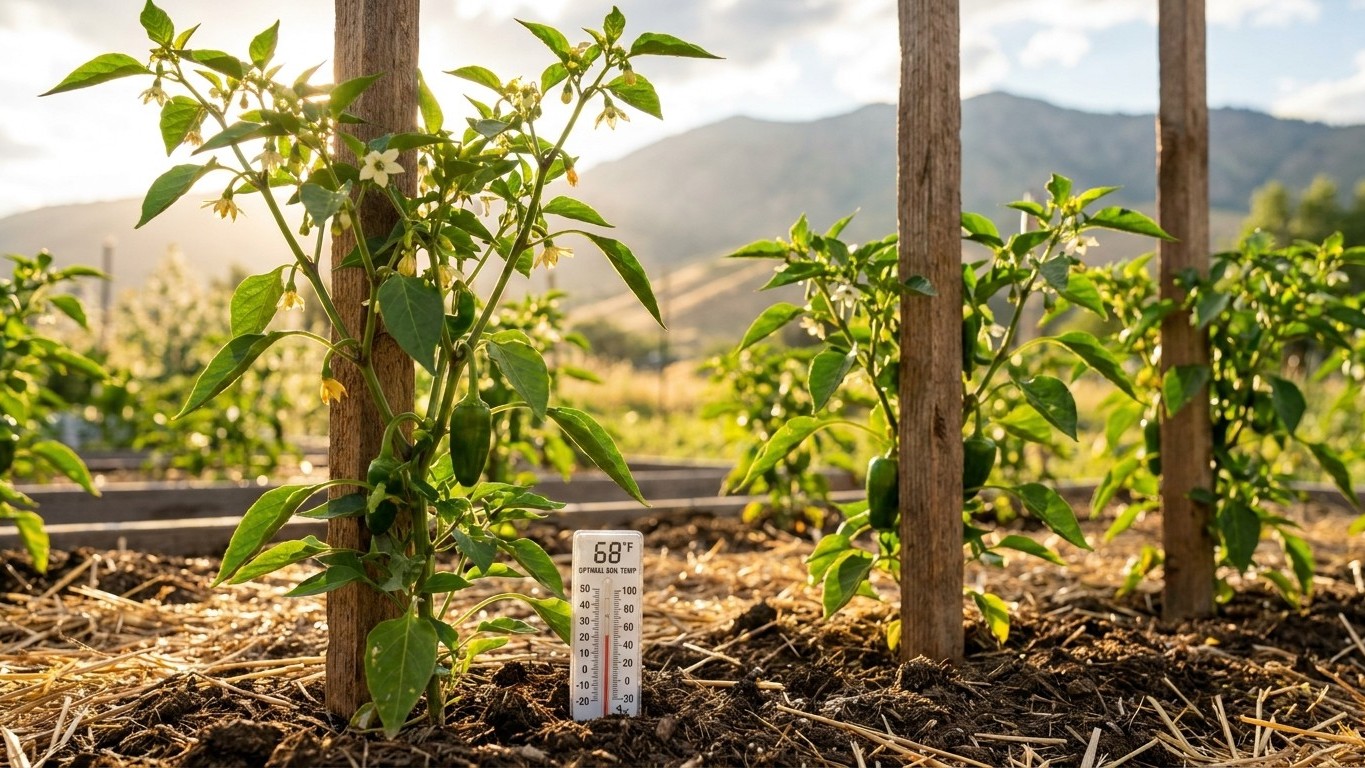
- Add the soil-temperature check. Frost date alone isn’t enough. Utah State University Extension advises transplanting peppers only after frost has passed and once soil has warmed to 60 F. Air can feel mild while soil is still cold from winter, especially in shaded or heavy clay beds, so a simple soil thermometer pushed a few inches down is worth the five dollars it costs.
- Count backward 8 to 10 weeks for indoor sowing. If your transplant date lands around the first week of April on the coast, seed goes into trays roughly 8 to 10 weeks earlier, putting the sowing date somewhere in late January to early February. Inland growers with a later frost date push that sowing window back to match.
- Watch for the flowering-to-harvest gap separately. Once transplants are in the ground and flowering starts, the fruit itself needs its own stretch of time to mature, and that clock starts at flowering, not at sowing or transplanting. This is a separate count from the indoor-growing math above, and conflating the two is a common source of disappointment when peppers seem “late.”
- Recheck the calendar against your microclimate. A south-facing bed against a brick wall warms faster than an open row; a low spot that collects cold air holds frost longer than a slope. Adjust the transplant date a few days either direction based on what you’ve observed in past seasons at that exact spot.
None of this requires guesswork once the frost date and soil temperature are in hand. It’s arithmetic, not intuition, and it holds up whether the goal is an early jalapeño harvest or a late-season batch meant for drying.
What goes wrong here
- Blossom drop during a hot spell or an unusually cool night. This is the direct result of the fruit-set failure described above: flowers open, look fine, then drop without setting fruit once daytime highs climb past 90 F or nighttime lows fall below 55 F. There’s no product that fixes this. The remedy is patience and light afternoon shade during the hottest stretches (a simple shade cloth propped over the row cuts leaf and flower temperature without blocking pollinators), then letting the plant resume setting fruit once temperatures moderate.
- Sunscald on exposed fruit. Peppers that lose leaf cover, whether from disease, pruning, or wind damage, expose their fruit directly to strong sun, and the skin develops a pale, blistered patch that can turn leathery or moldy. The fix is keeping foliage intact through the hottest part of the season and avoiding heavy pruning in midsummer. If a plant has already thinned out, a loose shade cloth over the exposed side buys time for new leaf growth to catch up.
- Blossom-end rot on developing fruit. A dark, sunken patch at the blossom end of the pepper signals inconsistent watering, which disrupts calcium uptake even when the soil has enough calcium to spare. The remedy is even soil moisture: a deep watering schedule with mulch to hold that moisture, rather than letting beds swing between bone-dry and soaked. Raised beds and containers dry out faster in Virginia’s summer heat and need more frequent checking than in-ground rows.
Common questions
Can I still get a harvest if a heat wave hits during peak flowering?
Yes, in most cases. Blossom drop from a hot spell is usually temporary. The plant typically resumes setting fruit once daytime highs drop back under that 90 F threshold, so a harvest delayed by a week or two of heat isn’t necessarily a lost season, just a shifted one.
Does the 90 F day count apply the same way inland as it does at the coast?
The 26.0-day figure comes specifically from the Virginia Beach reference station. Inland and Piedmont locations often run hotter in summer, while higher-elevation areas in the Blue Ridge typically see fewer days at that threshold. Check local extension data for your specific area rather than applying the coastal number statewide.
What if I don’t know my overnight summer lows?
Don’t estimate them from your region’s winter cold or from general latitude assumptions. Overnight lows depend heavily on elevation, water proximity, and local terrain. A minimum-recording thermometer left outside over a few summer nights gives a far more reliable answer than any regional guess.
Is there a fixed number of days from flowering to ripe fruit?
That figure isn’t published in the sources behind this article, so it isn’t stated here as a specific number. What is established is that the countdown to harvest starts at flowering, not at sowing or transplanting, which is the detail most likely to throw off a home gardener’s expectations.