
New Brunswick almost never hits pepper-killing heat: the province’s climate record shows an average of 0.0 days a year at or above 90°F. That removes one whole failure mode gardeners in hotter states fight every July. The season’s real limit sits at the other end, a frost date that lands, on average, May 23, and a short window afterward for soil to warm and fruit to set. Pick varieties and timing with that cool-season math in mind, not with heat tolerance.
The short answer

Start with the number that matters most: 0.0 days a year at or above 90°F, the mean recorded at the Moncton reference station over the 1981-2010 period tracked by Environment and Climate Change Canada. That isn’t a rounded-down estimate. It’s the actual average for the region. For pepper growers, this figure matters because fruit set fails at both ends of the temperature range, and one of those two failure points is almost absent here.
According to Utah State University Extension, pepper fruit set fails when nights drop below 55°F or when days climb above 90°F. With this territory averaging zero days that hot, the heat-driven half of that equation rarely comes into play. Blossoms that open in a New Brunswick garden have decent odds of setting fruit once pollination happens, weather-wise, because the plant isn’t fighting off heat stress on a normal summer afternoon.
The cool end is where attention needs to go. This site’s climate data for New Brunswick tracks the day-heat count and the frost dates, but it does not carry summer night minimums for the province. That means there’s no published number here to check against the 55°F threshold on any given July or August night. Growers need to watch their own overnight lows through the flowering and pollination window, especially in low spots, valley floors, or anywhere cold air tends to settle after sunset, even mid-summer.
One more figure worth holding onto: Utah State University Extension notes that peppers typically need 35 to 45 days from flowering, not from sowing or transplanting, before fruit ripens. That distinction changes how a grower counts toward harvest. A plant that blooms in early July, in a season this short, is still 5 to 6 weeks from a ripe pepper, regardless of how early it went into the ground.
| Threshold | Effect on fruit set | Status in New Brunswick |
|---|---|---|
| Days at or above 90°F | Blossoms drop, fruit set fails | 0.0 days a year on average |
| Nights below 55°F | Blossoms drop, fruit set fails | Not tracked here; monitor locally |
When to start seed here
Working backward from transplant day is the only reliable way to time pepper seed starting, and the arithmetic holds up in any county once you plug in local numbers.
- Find your last spring frost date. For the Moncton station, the average is May 23. That’s a mean, not a guarantee. In one year out of two, frost actually falls later than that date. Treat it as the midpoint of a window, not a safe line to plant by. It’s also worth remembering that a single station doesn’t describe an entire province; northern and upland districts typically run weeks behind Moncton’s average.
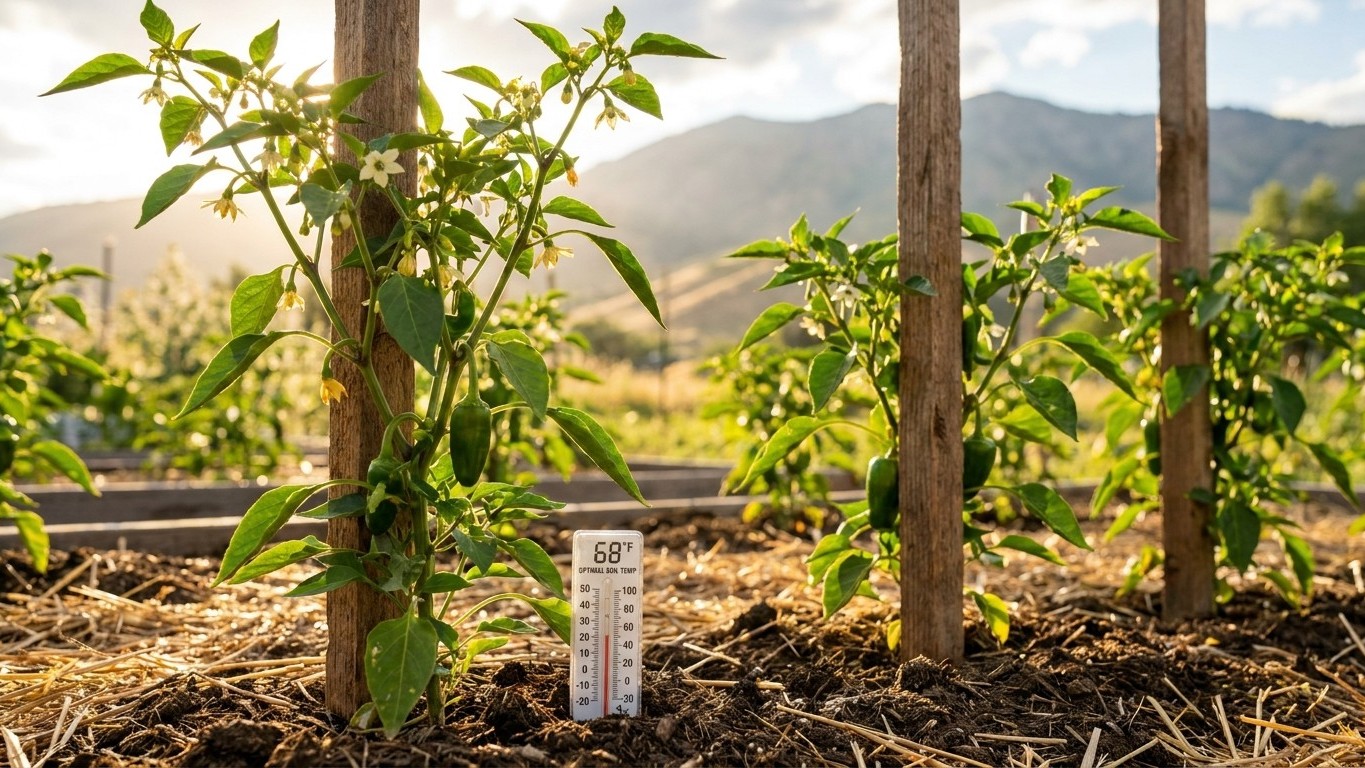
- Wait for two conditions, not one. Utah State University Extension is clear that peppers go outside only after frost has passed and once soil has warmed to 60°F. Air temperature charts alone won’t tell you this. A soil thermometer pushed a few inches into the bed, checked over several mornings, gives a better answer than guessing from the calendar.
- Count back 8 to 10 weeks for indoor starting. That’s the range Utah State University Extension gives for how long pepper seedlings need under cover before they’re ready to go outside. If your working transplant target sits somewhere in late May or early June, once frost has cleared and soil has caught up, seed starting falls roughly 8 to 10 weeks earlier, which lands in the second half of March for a lot of gardens tied to Moncton’s average.
- Rerun the math for your own county. Swap in your local frost record, watch your own soil temperature, and shift the start date accordingly. A garden that historically runs a week or two behind Moncton needs its indoor start pushed back by the same margin, not held to a fixed calendar date.
What goes wrong here
- Blossom drop from a temperature swing. Even in a territory that averages zero days above 90°F, an unusual hot spell or, more likely here, a stretch of nights dipping under 55°F can knock blossoms off before they set fruit. Since summer night lows aren’t tracked on this site for New Brunswick, the remedy is simple observation: keep a thermometer near the pepper bed through the flowering weeks and don’t count on a “normal” season protecting every night.
- Sunscald where exposure is strong. Fruit left without leaf cover on a bright day can develop soft, pale patches from direct sun. The fix is mostly about not stripping foliage. Leave the canopy intact rather than pruning hard for airflow, since the leaves that shade developing peppers are doing real work.
- Blossom-end rot from uneven watering. This shows up as a dark, sunken spot on the bottom of the fruit and traces back to inconsistent soil moisture rather than a soil nutrient shortage most gardeners assume it is. A steady watering routine, rather than long dry stretches followed by a heavy soak, keeps this from developing on plants that are otherwise healthy.
Common questions
Do I need heat-tolerant pepper varieties for New Brunswick?
Not for the reason growers in hotter states worry about it. With an average of 0.0 days a year at or above 90°F, heat stress rarely threatens fruit set here. Season length and cold tolerance during establishment matter more than heat rating when choosing what to plant.
How many weeks before transplanting should I start pepper seeds indoors?
Utah State University Extension puts the indoor window at 8 to 10 weeks before transplant, and transplant itself waits until after frost and until soil reaches 60°F, whichever comes later.
Why did my pepper blossoms fall off without producing fruit?
Fruit set fails at both ends of the temperature range, according to Utah State University Extension: nights below 55°F or days above 90°F. Since New Brunswick’s day-heat count runs near zero, a cool night is the more likely culprit here, and it’s one this site doesn’t track for you, so local observation is the only check.
How soon after flowering will peppers actually ripen?
Utah State University Extension gives a range of 35 to 45 days from flowering, not from the sowing or transplant date. A plant that blooms in early July is still weeks away from a ripe fruit, which matters when planning around a short season.