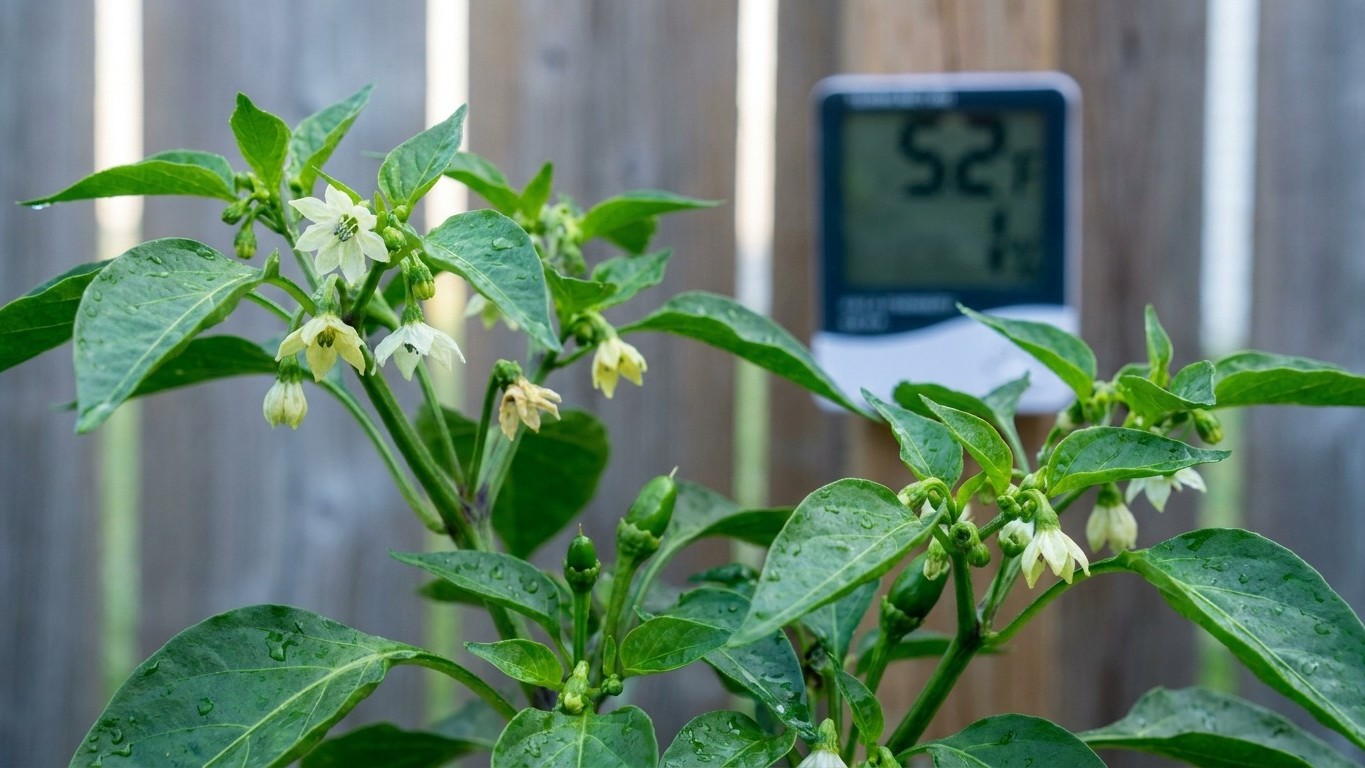

New Brunswick almost never gets hot enough to stop pepper fruit set on the heat side. The real risk here runs the other way: cool nights that shut pollen down before a single fruit forms. Get the seed-starting arithmetic right and keep an eye on your own thermometer after dark, and pepper fruit set stops being a mystery and becomes a matter of counting.
The short answer

Start with the number that matters most for heat stress: New Brunswick, measured at the Moncton reference station, averages 0.0 days a year at or above 90 F, according to Environment and Climate Change Canada’s Canadian Climate Normals covering 1981-2010. That is not a rounded figure or an estimate. It means that in a typical year, the province simply does not produce the kind of sustained heat that causes pepper flowers to abort on the hot end. Growers in much of the southern United States spend July and August watching for that 90 F threshold because pepper fruit set collapses once daytime highs push past it for any stretch. In New Brunswick, that particular failure mode is close to a non-issue in most seasons.
But pepper fruit set has two failure points, not one, and the cooler one is the one that actually applies here. Utah State University Extension is blunt about it: fruit set fails when nights drop below 55 F, just as it fails when days climb above 90 F. Cool coastal air, a clear night that radiates heat away fast, or a late-season cold snap can all push overnight lows under that mark even while the days feel warm and pleasant. Why Peppers Fail to Set Fruit in New Brunswick often comes down to exactly this mechanism: pepper flowers can look perfectly healthy and still drop or fail to set fruit because the pollen simply did not perform overnight.
This is where the data most growers want simply is not published on this site, and it would be worse to guess than to say so plainly. This site carries days at or above 90 F for New Brunswick, but it does not carry summer night minima. There is no reliable way to infer how cold your garden gets after dark from the province’s latitude, from its coldest winter month, or from any other proxy figure. Those shortcuts produce wrong numbers more often than right ones, because local terrain, elevation, distance from the Bay of Fundy, and even how open or sheltered a particular yard is can shift overnight lows by several degrees from one township to the next.
The practical move is to put an actual min-max thermometer in the pepper bed for a few weeks in early and late summer, when nights are most likely to dip. If you see readings drift toward 55 F on clear, calm nights, that is your signal that fruit set may stall even if daytime conditions look ideal. No provincial average will tell you that. Only your own reading will. Pairing that data with a smart choice from the Pepper Varieties That Ripen in a New Brunswick Season can help hedge against the nights that dip too cool for fruit set.
When to start seed here
Utah State University Extension recommends starting pepper seed 8 to 10 weeks indoors before transplanting, and transplanting only after frost has passed and the soil itself has warmed to 60 F. Counting backward from those two conditions, rather than from a calendar date alone, is what makes the timing work in any specific county.
- Anchor the calculation to the average last spring frost for the reference station: May 23, per Environment and Climate Change Canada’s Canadian Climate Normals for Moncton, covering 1981-2010. This is a mean date, not a guarantee. In roughly half of all years on record, frost has actually occurred later than May 23, so treat it as the middle of a window rather than a safe cutoff.
- Wait for soil, not air. Soil temperature lags behind air temperature, sometimes by a meaningful stretch, so the date the thermometer clears freezing outdoors is not the date the ground under your pepper bed reaches 60 F. A soil thermometer pushed a few inches into the bed is the only way to know for certain rather than assuming a fixed number of days after frost.
- Pick a realistic transplant target inside that post-frost, 60 F-soil window rather than pinning one exact date on the calendar, since both frost timing and soil warming vary from one yard to the next even within the same county.
- Count back from that target: 8 weeks for the earliest reasonable seed-starting date, 10 weeks for a safer margin that gives seedlings more size and root development before they go outside.
- As a worked example, if your transplant target lands in early June once frost has cleared and soil has warmed, counting back 8 weeks lands seed-starting in early April, and counting back 10 weeks lands it in late March. Shift the whole sequence earlier or later based on how your own frost and soil timing compare to the Moncton average.
Redo this arithmetic for your own address rather than borrowing someone else’s dates. A garden in a low frost pocket or at higher elevation within the province can run well behind the Moncton figures, and starting seed on the Moncton schedule in a colder microclimate can mean transplanting into soil that has not yet reached 60 F.
What goes wrong here
- Blossom drop from a temperature swing. Flowers form, look fine, then fall off without setting fruit. In most of New Brunswick this is far more likely to come from a night under 55 F than from a hot spell over 90 F, given how rare that heat threshold is here. The remedy is monitoring, not guessing: track nighttime lows in the bed itself during flowering, and if a cold snap is forecast during peak bloom, cover plants overnight with row cover to hold in a few extra degrees.
- Sunscald on exposed fruit. Sunscald happens when fruit is left without leaf cover and takes direct sun on bare skin, showing up as a pale, blistered, or papery patch on the shoulder of the pepper. It does not require the kind of extreme heat New Brunswick rarely sees; it just requires bare fruit in strong sun, which can follow storm damage, aggressive pruning, or disease that strips foliage. The remedy is keeping a full canopy of leaves over developing fruit and avoiding heavy pruning once peppers start sizing up.
- Blossom-end rot from uneven watering. This shows up as a sunken, leathery brown-black patch on the bottom of the fruit, and it traces back to calcium not reaching the fruit tissue, which usually happens when soil moisture swings between too dry and too wet rather than staying steady. The remedy is consistent watering on a schedule, plus a layer of mulch to even out soil moisture between waterings rather than reacting only when plants look stressed.
Checking this against your own county
Every figure here comes from a single reference station and a provincial-scale average, and neither one describes your specific yard. Frost timing, soil warming, and overnight lows all shift with elevation, distance from the coast, and even how sheltered or open a particular property is. Before locking in a seed-starting date, check current, local guidance through Agriculture and Agri-Food Canada. It is the federal department’s own site, verified working, and a reliable starting point for finding county- or region-specific growing information when a provincial page is unavailable.
Use it alongside your own soil thermometer and a min-max thermometer in the pepper bed itself. Together, those two simple tools will tell you more about your actual fruit-set risk, on both the hot and cool ends, than any provincial average ever can.
Common questions
Does New Brunswick ever get hot enough to stop pepper fruit set?
Rarely. The Moncton reference station averages 0.0 days a year at or above 90 F, per Environment and Climate Change Canada’s Canadian Climate Normals for 1981-2010, so the heat-side failure point for pepper fruit set is close to a non-factor in most seasons here.
How do I know if my nights are too cold for fruit set?
Put a min-max thermometer in the pepper bed during flowering. Utah State University Extension puts the cool threshold at nights below 55 F. This site does not carry summer night minima for New Brunswick, so a direct reading in your own garden is the only reliable check.
When should I start pepper seed indoors for New Brunswick?
Work backward from your local transplant window, which should fall after frost and once soil hits 60 F. Utah State University Extension recommends starting seed 8 to 10 weeks before that transplant date, so count back from your own realistic target rather than a fixed calendar day.
Is the May 23 frost date safe to plan around?
Treat it as a midpoint, not a guarantee. It is the average last spring frost at the Moncton station from Environment and Climate Change Canada’s 1981-2010 Climate Normals, meaning frost has fallen later than that date in roughly half of the years on record.