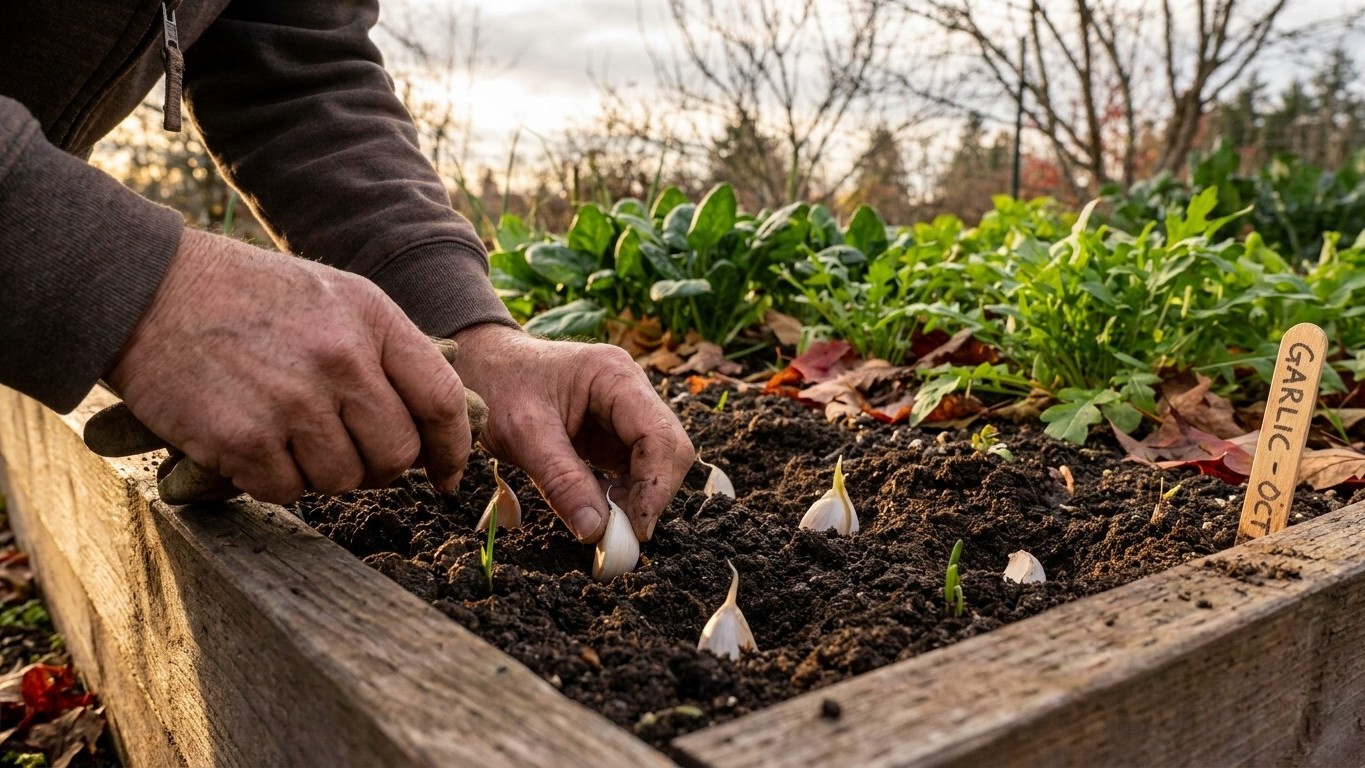

October in British Columbia still runs frost-free on the coast, with the average first fall frost at Vancouver International Airport landing around November 10. That gives coastal gardeners a real few weeks to get garlic, overwintering greens, fava beans and spring bulbs into the ground, while inland and upland districts may already be past their first frost and working with a shorter, colder version of the same month.
What goes in the ground in October

The calendar says October everywhere in the province, but the ground doesn’t agree. Soil temperature and the frost window decide what survives, not the date on the wall. At the reference station used for this page, Vancouver International Airport, the average first fall frost falls around November 10, and that’s a mean, not a guarantee. In roughly half of all years frost arrives later than that; in the other half, earlier. Treat it as the midpoint of a window, not a safe cutoff, and shift your own timing earlier if you garden away from the immediate coast.
With that window still open through most of October in Metro Vancouver, Vancouver Island and the lower Fraser Valley, this is prime time for garlic and shallots. Cloves and bulbs planted now root before the ground cools further and push up strong in spring. It’s also a solid window for overwintering onion sets, cold-hardy greens like spinach, mâche and arugula, and fava beans sown for an overwintered crop rather than a spring one.
Cover crops belong on this list too. Crimson clover and winter rye sown now have enough weeks left to establish roots before growth slows, protecting bare soil through the wet season and adding organic matter come spring. Spring-flowering bulbs, tulips, daffodils, crocus, also go in through October while the soil is still workable and cool enough to trigger proper rooting.
In the Okanagan, the Kootenays, the Cariboo and other interior and upland areas, frost often arrives well ahead of the coastal average, sometimes weeks earlier. If a frost has already hit your garden, skip anything tender and lean on garlic, shallots and cover crops, all of which tolerate a light frost without damage. Don’t gamble on greens or favas once the ground has started to firm up overnight.
What to start under cover
Starting anything indoors in October runs against the season rather than with it in most of British Columbia, since the coastal frost window is still weeks away and there’s little daylight advantage to gain by rushing seedlings now. The more useful arithmetic is counting backward from the average first frost, around November 10 on the coast, and asking what could realistically mature before then. For most transplant crops, tomatoes, peppers, squash, the answer is nothing: there simply isn’t enough season left.
Where cold frames or unheated hoop houses come in is for quick, cold-tolerant greens, not warm-season crops. Baby lettuce, mizuna, tatsoi and similar fast growers can still be sown under cover in early October in coastal zones, since they only need three to four weeks to reach a harvestable size and tolerate cool nights once established. Sow later than the first week or two of the month and germination slows enough that plants stall before they’re worth eating.
The two failure modes both show up now. Start too early, before the last of the summer heat has faded, and greens under cover can bolt or become leggy reaching for light through shortening days. Start too late, past the point where four weeks of growth still fits before frost and the deep dark of November, and you end up with seedlings that never size up, sitting stalled until they eventually rot from cold, wet soil. In the interior, where frost may already be a memory of September rather than a November event, cut that sowing window shorter still or skip it and shift to cold frame protection of what’s already growing.
What is ready to pick
October is a harvest month across British Columbia, not a lean one. Winter squash and pumpkins come off the vine now, and the test is the stem: it should be dry, corky and hard, with the skin resisting a fingernail press. Apples and pears in coastal orchards are finishing their run, and both keep for months in a cool, dark space if picked before they drop on their own.
Root vegetables, carrots, beets, parsnips, potatoes, are at or near peak size, and many gardeners leave carrots and parsnips in the ground under a thick mulch to sweeten further after light frost rather than pulling everything at once. Brassicas, kale, Brussels sprouts, cabbage, actually improve in flavor once cool nights arrive, converting starches to sugars, so there’s no rush to harvest them all in one pass.
Storage crops from earlier in the season deserve a check now too. Go through cured onions, garlic and winter squash in storage and pull anything showing a soft spot, a sprout, or a sweet smell of early rot, since one turning squash can spread mold to its neighbors in a bin or crate. In the interior, where frost has often already cut down tender crops, this storage check matters even more: what’s in the root cellar or garage shelf is doing more of the feeding than what’s still outside.
The jobs that matter this month
Beds, mulch and cleanup
Beds finishing their season need attention before wet weather sets in for good. Pull spent tomato and squash vines, especially anything showing mildew or blight, and get it into the trash rather than the compost pile, since home compost rarely reaches temperatures high enough to kill fungal spores. Once beds are cleared, a thick layer of mulch, leaves, straw, compost, protects soil structure through the winter rains and gives earthworms cover to keep working.
Garlic beds planted this month benefit from mulch immediately after planting, both to buffer temperature swings and to suppress the first flush of winter weeds. If you’re overwintering favas or hardy greens, mulch around the base rather than over the crowns to avoid smothering new growth.
Pruning, tools and planning
Dormant pruning on fruit trees typically waits until deeper into winter once leaves have fully dropped, but October is the right time to assess structure while leaves are thinning and plan the cuts. Berry canes that fruited this season, raspberries in particular, can be cut back now once they’ve finished producing.
Seed catalogs for the coming season start circulating in fall, and ordering garlic and popular vegetable varieties early avoids the disappointment of a sold-out listing come January. This is also a sound month to test soil pH and nutrient levels, since amendments like lime take months to fully react with soil and adjust pH before spring planting. Clean and sharpen pruners, hoes and shears before they sit unused through winter rust season, and check stored crops weekly rather than once and forgetting.
What not to do in October
The classic October mistake in British Columbia’s mild coastal climate is reading a stretch of sunny, mild days as license to plant warm-season crops. Air temperature is not soil temperature, and a tomato or pepper transplant put into cooling October soil will sit stunted rather than grow, then get taken out by the first real frost regardless of how warm the afternoons felt.
A second common error is nitrogen timing. Feeding beds, lawns or overwintering crops with a high-nitrogen fertilizer this late pushes soft, leafy growth right when plants should be hardening off for cold. That new growth is the most frost-tender tissue on the plant, and a fertilizer application in early October can do more damage than the frost itself would have without it. If beds need amending, favor compost or a balanced, lower-nitrogen feed instead.
Garlic timing runs both ways. Planted too early, while soil is still warm from summer, cloves can sprout excessive top growth before winter that then gets damaged by cold. Planted too late, after soil has thoroughly cooled and firmed, roots don’t establish before winter dormancy sets in, weakening the crop. Early to mid-October, while soil is cool but still workable, is the safer middle ground for most of coastal BC.
Uncovering cold frames or removing mulch after a mild stretch is another trap. A few warm days don’t mean winter has backed off, and stripping protection too early leaves tender greens or garlic shoots exposed to the next cold snap with no buffer left.
Checking this against your own county
A province-wide October is a starting point, not an instruction. British Columbia spans coastal rainforest, interior desert, alpine valleys and northern boreal country, and elevation, lake effect and simple latitude shift frost windows by weeks in either direction from the Vancouver Airport figures used here. A garden in Kelowna, Prince George or the Kootenays should not assume the coastal timeline applies.
For local frost data and planting guidance specific to your region, check the BC Ministry of Agriculture and Food’s agriculture and seafood resources, which cover regional growing conditions across the province in more detail than any single station can.
Common questions
Is October too late to plant garlic in British Columbia?
Not on the coast. With the average first fall frost around November 10 at Vancouver International Airport, early to mid-October still gives garlic cloves several weeks to root before the ground cools further. In colder interior regions where frost arrives earlier, aim for the first half of the month or earlier.
What hardiness zone is British Columbia’s coast in?
The reference city used for this page sits in Canadian hardiness zone 9a, based on Natural Resources Canada’s Plant Hardiness Site using 1991-2020 normals. This is the Canadian system, built on seven climate variables, and it does not convert directly to a USDA zone. Don’t compare it on the same scale as USDA figures used elsewhere.
Can I still start vegetable seeds outdoors in October?
Direct-sown vegetables at this point are limited to cold-hardy types: fava beans, overwintering spinach, and fast greens like mizuna under cold frame protection in the first half of the month. Warm-season crops sown now won’t mature before frost.
Should I harvest all my root vegetables before frost?
Not necessarily. Carrots and parsnips often sweeten after a light frost and can stay in the ground under a heavy mulch layer well into the cooler months, provided the soil doesn’t freeze solid, which is uncommon on the immediate coast but a real risk in colder interior areas.