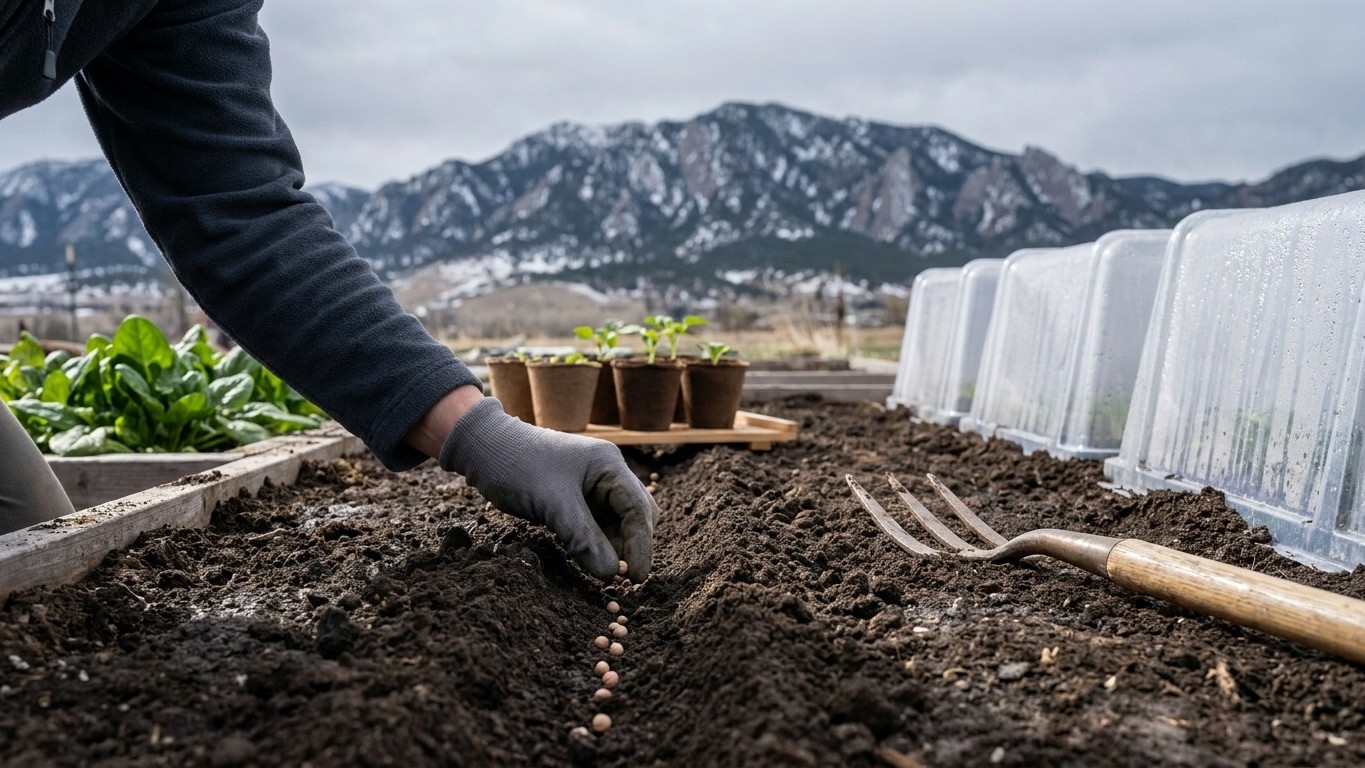

In most of Colorado, March sits eight to ten weeks ahead of the last frost window, so bare soil is still too cold for the tender crops most people picture when they think “spring garden.” The direct answer: hardy greens, peas, alliums, and bare-root plantings can go in now if the ground is workable, while everything else waits under cover or on the calendar for later.
What goes in the ground in March

Soil temperature decides this month, not the date on the wall. NOAA’s 1991-2020 climate normals put Denver’s last spring frost between May 1 and May 11, which means most of the Front Range and eastern plains are still weeks from that window when March arrives. Cold soil, not cold air, is what kills seeds and stunts roots — a 60-degree afternoon does nothing for a 38-degree seedbed six inches down.
What tolerates this? Peas top the list. They germinate in soil as cool as 40 degrees and actually sulk in heat, so pushing them in as soon as the ground can be worked with a fork, rather than crumbling around a shovel, is standard practice at lower elevations. Spinach and other hardy greens follow the same logic if given the shelter of a cold frame or a low tunnel. Garlic and shallots that missed a fall planting can still go in where the ground has thawed, though fall-planted cloves will always outperform a March scramble. Onion sets can go into open ground toward the tail end of the month at the lowest elevations, but this is closer to a gamble than a rule.
Bare-root fruit trees, brambles, and dormant perennials are a genuine March job wherever the ground isn’t frozen solid. Planting them while they’re still dormant, before buds swell, gives roots a head start with none of the transplant shock a leafed-out plant would suffer.
Everything else, tomatoes, peppers, squash, beans, stays indoors or on paper this month. Colorado’s hardiness zones run from 3b up to 7b across the state, according to the USDA Plant Hardiness Zone Map, and that spread matters enormously here: a Denver planting decision and a mountain-town planting decision are not the same decision. Reference your own elevation before trusting any state-wide list, this one included.
What to start under cover
Seed-starting math runs backward from the frost window, not forward from today. With Denver’s last frost falling between May 1 and May 11, peppers and eggplant, which need eight to ten weeks indoors before they’re sturdy enough to transplant into warm soil, should already be under lights by early-to-mid March in most low-elevation counties. Tomatoes need a shorter runway, six to eight weeks, so a mid-to-late March start still lands them at transplant size right around the frost date, with the extra week or two of soil-warming that tomatoes appreciate anyway.
Onions grown from seed rather than sets need the longest lead time of anything in the home garden, ten to twelve weeks, which puts a hard deadline on getting them started if they haven’t gone in already. Broccoli, cabbage, and other cole crops fall in the middle, six to eight weeks, and because they tolerate a light frost, they can be hardened off and moved outside a little ahead of the last-frost date rather than dead on it.
The two ways this goes wrong are mirror images of each other. Start too early, and warmth-loving seedlings outgrow their pots weeks before the ground is ready, turning leggy and rootbound on a windowsill. Start too late, and a plant that needed eight weeks to size up only gets four, going into the ground small and behind schedule for the entire season. Counting backward from your local frost range, rather than from a fixed date on a seed packet, is the only way to hit the window reliably.
What is ready to pick
Honestly, not much is coming out of open ground in Colorado in March. That’s the nature of a state where the growing season on the plains doesn’t really open until May. But “nothing outdoors” doesn’t mean an empty kitchen.
Kale, leeks, and other cold-hardy crops that were left in the ground through winter, especially under a layer of snow or mulch, often come through fine and can still be harvested as the ground softens. A cold frame planted the previous fall with spinach, mâche, or arugula can keep producing small pickings right through this month, since those greens are built to survive far colder conditions than most gardeners assume.
Indoors, sprouts and microgreens are the fastest fresh food a Colorado gardener can produce this time of year, ready in a week to ten days with nothing more than a tray and a sunny sill. Meanwhile, this is the month to walk the root cellar or pantry shelf and check stored squash, potatoes, and onions for soft spots, sprouting eyes, or the give-away smell of one going bad in the back. Culling the failing ones now protects everything stored next to them.
The jobs that matter this month
March carries more real deadlines than its short harvest list suggests. Dormant pruning of fruit trees, grapevines, and cane berries needs to happen before buds swell and sap starts running; cut after that point and the plant bleeds energy it needed for the coming season. This is also the last practical window to get bare-root stock and seed orders in before nurseries sell out of the better varieties, a problem that gets worse every year as home gardening has grown more popular.
Soil is worth real attention now. A soil test through Colorado State University’s extension system tells you what the previous season actually left behind, and amending based on results beats guessing with a bag of generic fertilizer. Turning the compost pile, now that it’s thawing enough to work, speeds up the breakdown that will feed spring beds. It’s also the moment to plan crop rotation on paper before planting decisions get made in a rush, moving nightshades and brassicas to new ground each year to break up the pest and disease cycles that build up in one spot.
Tool maintenance belongs on this list too, not as an afterthought. A pruning saw or hoe sharpened now saves an hour of frustration later, and cleaning last season’s dirt and sap off blades cuts down on disease spreading bed to bed. Raised bed frames, fencing, and trellis hardware that took a beating over winter should get repaired while there’s still time before planting crowds the schedule. None of this is filler. Skip it in March, and it either doesn’t get done at all or gets done in a rush once the real planting season arrives.
What not to do in March
The most common mistake is planting by the feel of the air rather than the temperature of the soil. A string of 65-degree afternoons convinces a lot of Colorado gardeners that it’s safe to set out tomato starts, but soil six inches down often sits twenty degrees colder than the air above it, and a cold-shocked transplant rarely recovers its full vigor even if it survives.
Pulling mulch or row cover off beds too early after a mild stretch is the second trap. Colorado’s spring weather swings hard, and a bed uncovered during a warm week can take a hard freeze the following week with no protection at all. Leave winter mulch in place until the weather pattern, not one lucky afternoon, has actually turned.
Feeding nitrogen at the wrong moment is the third classic error. Fertilizing dormant trees, shrubs, or beds before roots are actively growing does little for the plant and mostly ends up leaching away with spring melt and rain, wasting the product and, in enough volume, adding to runoff nobody wants. Wait until real growth is underway before applying nitrogen, and lean on a soil test to know how much is actually needed rather than fertilizing on a fixed schedule.
Checking this against your own county
Everything above is a state-wide starting point, not a set of instructions for a specific yard. Colorado’s hardiness zones span 3b to 7b, and elevation alone can shift a planting window by weeks between a Denver-area garden and a mountain town an hour away, where frost can arrive in July. The western slope runs on its own pattern again, distinct from both the plains and the high country.
For a planting calendar tuned to your actual county, the Colorado State University Extension service is the reliable next stop, with local offices that track conditions specific to your elevation and region.
Common questions
Can I plant tomatoes outside in Colorado in March?
No. Denver’s last spring frost falls between May 1 and May 11 according to NOAA climate normals, and tomatoes need warm soil on top of frost-free air. March tomato starts belong indoors under lights, not in open ground.
What’s the earliest thing I can plant outdoors this month?
Peas are the safest bet where soil is workable, since they germinate in cool soil and tolerate a light frost. Garlic, shallots, and bare-root fruit trees or canes are the other reliable options for open ground in March.
Is it too late to start seeds indoors in March?
For most crops, no. Peppers and eggplant, needing eight to ten weeks before transplant, should already be started, but tomatoes and cole crops, needing six to eight weeks, still fit comfortably within a March start given Denver’s early-May frost window.
Why does my mountain town frost so much later than Denver’s dates suggest?
Denver’s May 1 to May 11 frost window comes from a plains station at 5,280 feet. Higher mountain towns sit at far greater elevation and run shorter, later seasons, sometimes with frost risk into July, which is why a local extension office check matters more than a state-wide date.