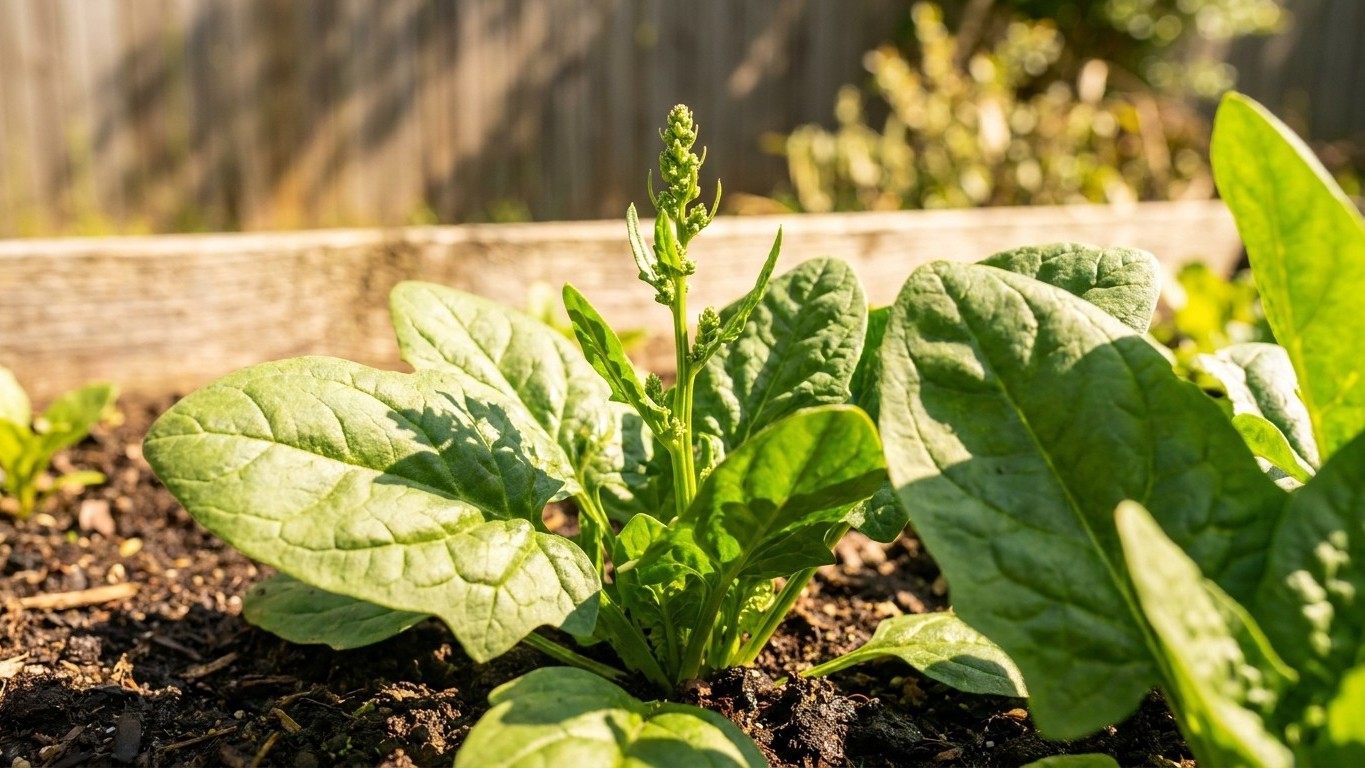

Cut spinach when the outer leaves are full-sized and the center of the plant is still a flat, leafy rosette. Along Colorado’s Front Range that means spring into early June, then again in October from a fall sowing. Once it is in the kitchen, the best case is two weeks at 32°F. A home fridge usually does worse, so plan on eating it sooner. This is the cutting and keeping side of Growing Spinach in Colorado.
When spinach is ready in Colorado
Look at the plant before the calendar. A rosette with a ring of broad, hand-sized outer leaves is ready, and so is one with a center that still sits low and tight. On the plains around Denver, a spring sowing reaches that stage in May into early June, and a fall sowing reaches it through October. A center that starts to rise and thin out means the plant is about to flower. Cut everything that day.
The spring end of the window comes from the frost dates. NOAA’s NCEI climate normals put the mean last 32°F freeze at the Denver station between May 1 and May 11. Spinach sown ahead of that date is already growing when the last frost arrives, so the first cutting lands soon after it. Mountain towns and the western slope run on different clocks. A garden at 8,000 feet may not see a cuttable rosette until the plains crop is long gone.
The closing end comes from heat and daylight together. Utah State University Extension says spinach grows best where temperatures stay at or below 75°F, and the same number is where the leaves turn bitter. Denver averages 39.6 days a year at 90°F or hotter, so a hot spell can arrive well before summer officially starts. Day length adds a second push. The longest day of the year at Denver’s latitude has 14 h 50 of daylight, and long days alone trigger flowering. A cool June does not rescue the crop. For a closer look at what sets it off, see Will Spinach Bolt Early in Colorado?
Fall works backward. Utah State University Extension advises planting 50 to 75 days before the date you want to harvest. Counting back from the mean first fall freeze at the Denver station, September 30 to October 12, points to a sowing window of roughly mid-July to late August. That window has a catch. Seed germination drops once soil climbs above 80°F, and late-summer beds on the plains often sit above that. Warm soil blocks the fall crop, and cold does not. The window really opens when the soil cools, so shade the row and keep it watered to bring the temperature down.
When it is time to cut, you have two ways to do it. Take the outer leaves and leave the center, and the plant keeps producing for a while. Or cut the whole rosette just above the crown when the heat is closing in. Bloomsdale, Melody, Teton and Olympia are the varieties you will see most often, and the same plant signals apply to all of them. Check the rows for chewed leaves before you cut. What Eats Spinach in Colorado, and When covers who is likely to have been there first.
Keeping it, and for how long
UC Davis Postharvest Technology Center gives the storage conditions for spinach as an optimum temperature of 0°C (32°F) and an optimum relative humidity of 95-98%. Put it in a reader’s notebook as 32°F with 95-98% relative humidity. Both numbers matter. Cold slows the leaf’s metabolism, and near-saturated air stops the leaf from drying out.
The same UC Davis sheet is blunt about duration. It calls spinach highly perishable and says it will not maintain good quality for more than 2 weeks. Two weeks is a ceiling under ideal conditions. A home fridge does not meet them. The sheet adds that wilting, yellowing and decay are likely to increase after 10 to 14 days of storage, and faster at the 5 to 10°C (41 to 50°F) common in distribution. The fridge door at home sits in that range too.
| Storage temperature | What UC Davis reports |
|---|---|
| 32°F, 95-98% humidity | Optimum. Good quality will not hold beyond 2 weeks, and wilting, yellowing and decay rise after 10 to 14 days. |
| 41 to 50°F | Decline comes faster than at the optimum. |
Why the garden is the best storage
Fall spinach has one advantage no fridge can match. When October nights are cool, leaves left on the plant stay fresh and you can cut what you need. The plant is a living crisper drawer, so harvest in small batches and leave the rest standing. Cut in the morning, while the leaves are cool and full of water, and get them to the fridge quickly.
Spring spinach has no such luxury. The heat that ends the season on the plains is the same heat that cuts storage life short, because warm leaves go into the fridge already stressed. This is why a bag that survives a long week in October can look tired in three days in late May. If you have more than you can eat, cut less per picking, or finish the row on a cool morning and share it with neighbors the same day.
Where in the house that actually is
The 32°F figure belongs to a commercial cold room. A domestic fridge runs warmer, and the door runs warmest of all, in the 41 to 50°F band where spinach yellows in days. Anything you tuck into the door shelf is on the fast end of the UC Davis range before you close it.
The closest match to the optimum is the back of the bottom shelf, where the air is coldest and steadiest because it sits farthest from the door. A crisper drawer set to its high-humidity position does a similar job and holds the moisture in. If your fridge has no humidity control, you can build the effect yourself.
High humidity in practice means keeping the leaves from drying out without leaving them soaked. There are three ways to do it:
- Seal the leaves loosely in a bag or lidded container so the air inside stays moist.
- Wrap them in a damp (never dripping) cloth or paper towel.
- Stand whole cut bunches with the cut ends in a little water, with a loose bag over the tops.
Put the spinach on the back of the bottom shelf, wrapped loose and damp, within the hour you cut it, because every hour it spends on the counter or in the door uses up part of those two weeks. Check the bag every couple of days and pull out any yellowing leaves before they spoil the rest. If a batch is near the 10-day mark and still looks good, use it that day rather than waiting. That is the point where quality starts dropping.
Common questions
How do I know spinach is ready to cut?
Look for a full ring of broad, hand-sized outer leaves and a center that is still flat. If the center is thickening or pushing upward, the plant is about to bolt, and you should cut it all right away.
Can I keep cutting the same plants?
Yes, for a while. Take the outer leaves and leave the center so the plant can make new ones. The harvest ends when the plant starts to rise, and in a Colorado spring that usually happens as the days lengthen and the heat arrives in early summer.
How long does cut spinach last in the fridge?
UC Davis says spinach will not hold good quality beyond 2 weeks, even at the ideal 32°F. Decline picks up after 10 to 14 days, and it comes faster at 41 to 50°F, so use it well before the two-week mark.
When should I sow fall spinach on the Front Range?
Utah State University Extension says to plant 50 to 75 days before the date you want to harvest. For the Denver area that falls roughly in the second half of summer. Wait until the soil is below 80°F, since germination drops above that, and check with your county extension office if you garden at higher elevation or on the western slope, where the dates run earlier.