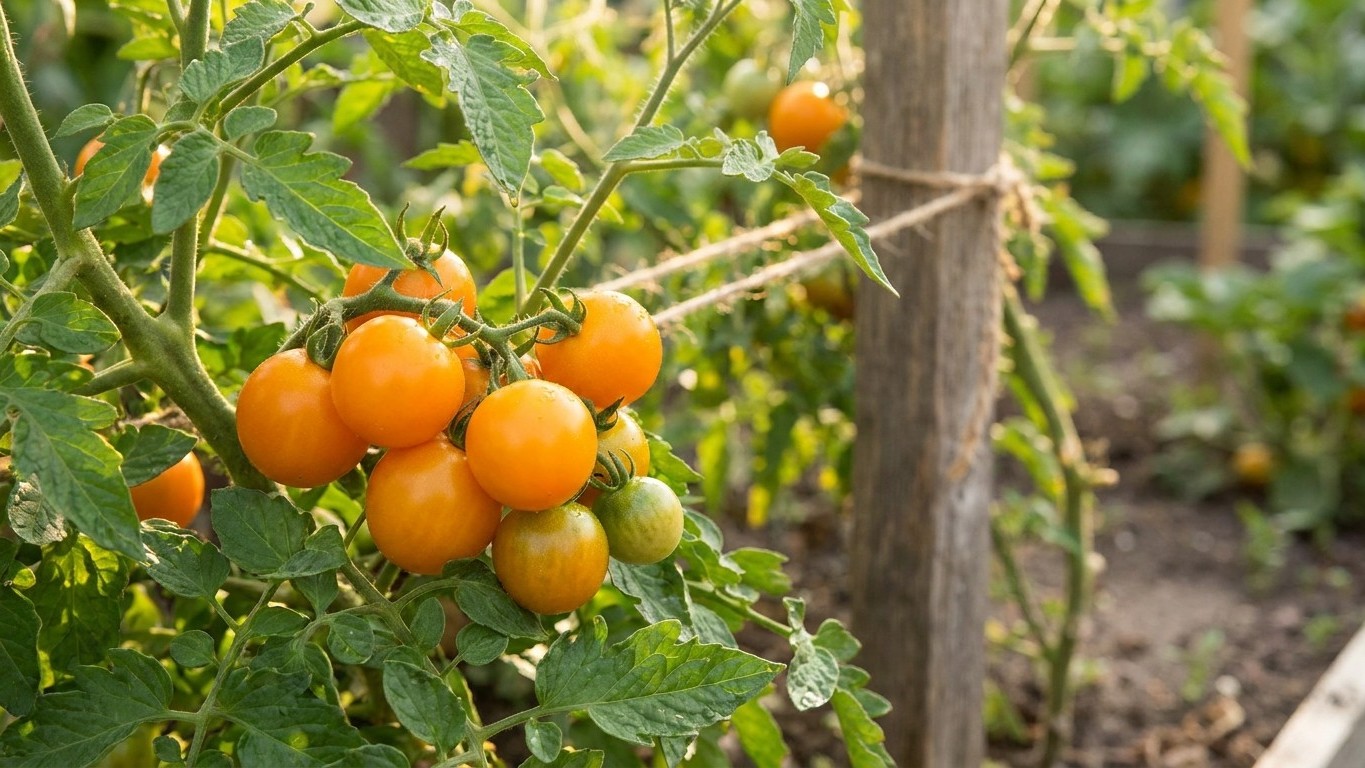

Citrine is an indeterminate orange cherry tomato that reaches harvest in about 60 days from transplant, carries catalogue-rated High resistance to Fusarium Wilt races 1 and 2, and is grown mainly for fresh eating: salads, snacking, a bowl on the counter. Its short cycle and tall, sprawling vine change what it needs from a gardener more than most cherry types do.
What Brandywine actually is

Citrine is a cherry tomato, orange when ripe, with fruit described as an exceptional snacker: rich, balanced flavor, a meaty bite, and resistance to the splitting and cracking that plague thinner-skinned cherries after a rain. That last trait matters more than it sounds. A cherry tomato that holds together through an inch of rainfall is one you can leave on the vine a day longer without losing the fruit to a burst skin.
The vine is indeterminate, which means it does not stop growing once it sets its first flush of fruit. It keeps extending, flowering, and ripening fruit until frost cuts it down. That single fact decides the support question before anything else: an indeterminate cherry vine on a short cage will outgrow it by midsummer and collapse under its own weight, taking the fruit down into the mud with it. A tall cage or a stake, five to six feet, is not optional here.
Days to maturity is listed at 60, and that figure is counted from transplant, not from the day the seed goes into starting mix. That distinction usually adds another five to seven weeks to the calendar if you are starting from seed indoors, since most tomato seedlings need that long before they are ready to go into the ground. For anyone buying a started plant at a nursery, the 60-day clock begins the day it goes into the soil.
Where it ripens in time, and where it is a gamble
Sixty days from transplant is short by tomato standards, which is exactly what makes Citrine forgiving in places where the growing season runs tight. The arithmetic a gardener needs is simple, even without a specific weather station to plug into it: take the length of your frost-free window, subtract roughly two weeks for the soil to warm enough to accept a tomato transplant without stalling it, then subtract the 60 days to maturity. Whatever is left is your picking window, not your growing window.
In regions where the frost-free season runs short, commonly the case across the northern tier of states and at higher elevations inland, that subtraction leaves little room for a slow variety. It leaves considerably more for a 60-day cherry. A gardener in a region with a frost-free season in the neighborhood of 100 to 120 days can lose two weeks to soil warm-up, spend 60 days waiting on the first ripe fruit, and still have several weeks of harvest left before the first fall frost shuts things down. That is a comfortable margin for a fast cherry tomato, and it is a margin most beefsteak and paste varieties, which often run 80 days or more, simply do not have in those same regions.
Move into a region with a long, frost-free season, the Gulf Coast and much of the Deep South, where frost-free stretches can run well past 200 days, and the arithmetic stops being the limiting factor entirely. There the margin is generous enough that timing shifts from a frost problem to a heat problem, which the next section covers. In the broad middle of the country, a frost-free season commonly cited in the range of 150 to 200 days, the margin sits comfortably in between: enough room to transplant a little later if a cold snap lingers, and still get a long harvest.
None of these figures are a substitute for checking your own dates. Frost timing varies by more than a month within a single state depending on elevation and distance from water, and the only reliable numbers are the local ones, available through a county extension office or NOAA’s climate normals. What the 60-day figure buys a gardener, wherever they live, is a wider margin for error than almost any other tomato type on the market.
The two ways a season goes wrong
A long frost-free window on paper does not guarantee a good tomato season, and two limits that never show up on a frost date table can still wreck one.
The first is cold nights, and it hits northern and high-elevation gardens hardest. Tomato flowers will not set fruit reliably once nighttime temperatures fall below 50F, even if the days are warm and the frost is still weeks away. A short-season region can have a frost-free window that looks adequate on the calendar while still delivering a stretch of cool nights early or late in the season that stalls fruit set for a week or two at a time. For a fast, 60-day variety like Citrine, this is the limit that matters most, because gardeners choosing it are usually choosing it precisely for those tighter, cooler-leaning regions where a slow-maturing variety would not finish at all.
The second limit runs the opposite direction. Once daytime temperatures climb above roughly 86F, tomato pollen goes sterile and flowers drop without setting fruit, regardless of how long the season runs. This is why growers in hot southern climates typically split their tomato year into two crops, an early spring planting that finishes before the worst heat arrives and a second planting timed to fruit after the heat breaks in early fall, rather than expecting one vine to produce steadily from May through September. Because Citrine matures quickly, it fits this two-crop pattern well: a spring transplant can complete its 60 days and produce before the heat shuts pollination down, and a second, later transplant has time to mature again once nights cool.
What it resists, and what it does not
The published resistance for Citrine covers Fusarium Wilt races 1 and 2, rated High. That rating means something specific: it indicates strong, reliable resistance to those two races of the fungus, which infects through the roots and shows up as yellowing and wilting that climbs one side of the plant before the whole thing collapses. High resistance is a meaningfully stronger claim than the intermediate resistance some other varieties carry for the same disease, where the plant slows the pathogen’s progress without stopping it. Here, the catalogue is not hedging.
What the catalogue does not list matters just as much. No resistance is published for Verticillium Wilt, for early blight, for late blight, or for the various leaf-spot diseases that circulate in humid gardens, Septoria leaf spot. That is not a knock against the variety; most tomatoes carry resistance to only a handful of named pathogens, and an unlisted disease is not automatically a certainty, just an unprotected risk. In practice it means a gardener growing Citrine in a wet, humid climate still needs the standard defenses against foliar disease: airflow between plants, mulch to keep soil from splashing onto lower leaves, and a fungicide program if late blight is active in the area that season. Fusarium resistance buys real protection against one serious soil-borne disease. It buys nothing against the leaf diseases that show up from the air and from splashing water.
Growing it without the usual mistakes
Because the vine is indeterminate, it needs a plan built for the long haul rather than a single flush. Space plants at least two to three feet apart to give a vine that will keep extending all season room to spread without shading its neighbors, and set the stake or cage at planting time rather than adding it later, since driving a stake through an established root system does more damage than doing it early. Prune selectively rather than aggressively: removing a few of the lowest suckers improves airflow, but stripping the plant hard cuts into the very growth that keeps a 60-day cherry producing new fruit clusters well past its first harvest.
Feeding follows a different rhythm than for a determinate tomato that ripens in one flush and finishes. Because Citrine keeps setting fruit until frost, it benefits from a lighter, steadier feeding schedule rather than one heavy early dose, with nitrogen tapered back once fruiting is underway so the plant does not put all its energy into vine growth at the expense of ripening clusters.
The mistake its timing invites most often is impatience at the other end of the season. Because it matures fast, gardeners sometimes assume the vine is finished once the first big flush ripens and let watering and feeding slide. An indeterminate vine that stops receiving consistent moisture midseason is far more likely to produce the very splitting and cracking this variety is bred to resist, since irregular watering, not the tomato’s genetics, is the usual cause of a skin that suddenly can’t keep up with a growth spurt after a heavy rain.
Common questions
Does Citrine need a cage or will a stake alone work?
Either can work, but the vine is indeterminate and keeps growing all season, so whichever support is used needs to reach five to six feet and be anchored well before the plant fills out. A short tomato cage sized for a determinate bush will not hold it.
Is 60 days enough time to grow it from seed?
The 60 days is counted from transplant, not from seed. Add the five to seven weeks most tomato seedlings need indoors before they are ready to go into the garden, and the true seed-to-harvest timeline runs closer to four months.
Will Fusarium resistance protect it from other tomato diseases?
No. The published resistance covers Fusarium Wilt races 1 and 2 only. Nothing is listed for Verticillium Wilt, blight, or leaf-spot diseases, so those still need to be managed through spacing, mulch, and airflow.
Why would fruit stop setting in the middle of summer?
Once daytime highs pass roughly 86F, tomato pollen goes sterile and flowers drop without producing fruit. This is a heat effect, not a disease or a watering problem, and it typically resolves once temperatures cool again in late summer.