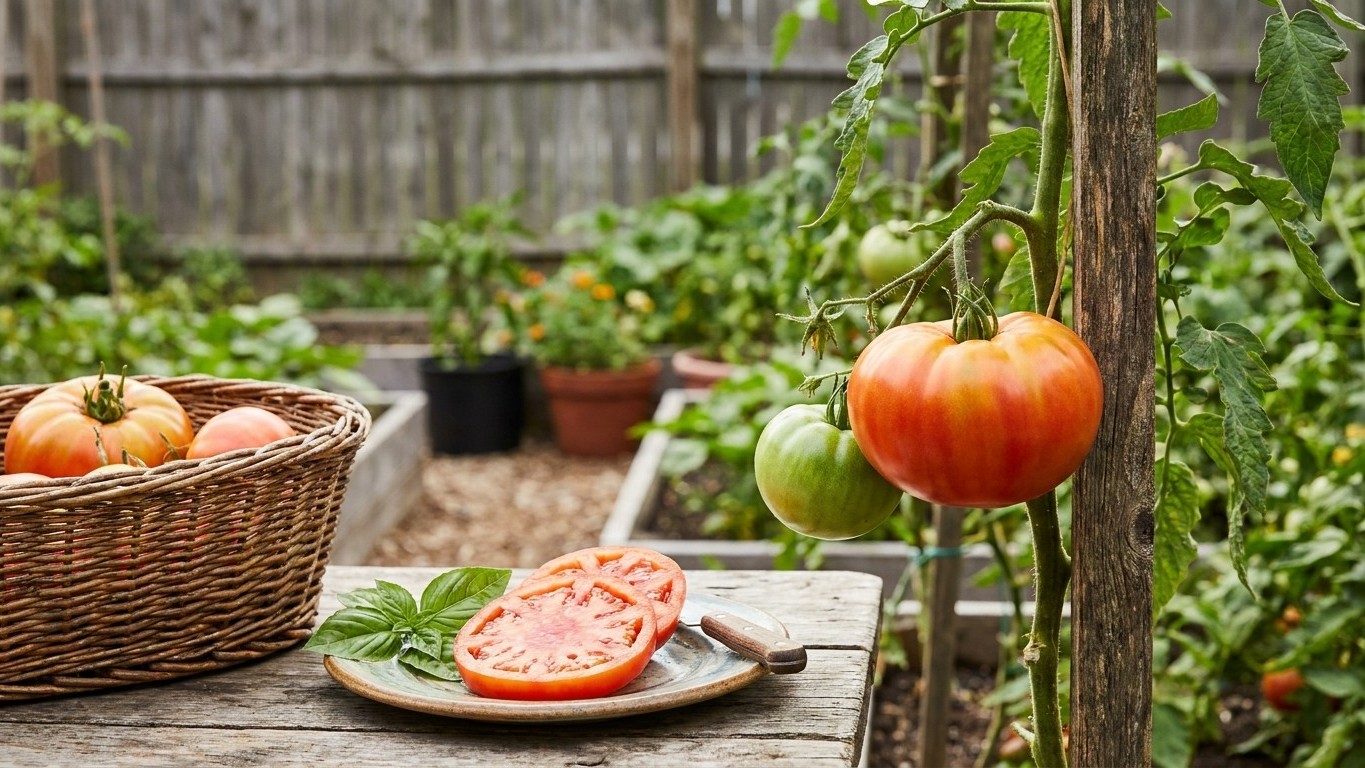

Firebird is a hybrid beefsteak tomato bred for a big, meaty fruit in the 10 to 12 ounce range, and most seed catalog listings put it at about 72 days from transplant to first ripe fruit, not from the seed packet’s sowing date. That maturity window is short enough to work through much of the country if the plant goes into the ground on schedule. Check your region’s average last spring frost date before you set a transplant date, since Firebird’s clock only starts once the plant is in the soil.
What Firebird actually is

Firebird is a hybrid slicing tomato built around one job: a full-size beefsteak fruit, typically 10 to 12 ounces, on a plant compact enough to manage without a jungle of stakes. Seed catalog listings put its days to maturity at about 72 days, and that figure is counted from transplant, not from the day seed goes into a tray indoors. A grower who starts seed eight weeks before the last frost and counts 72 days from that sowing date will be disappointed. Count it from transplant, and expect the real number in the garden to run a week or so either side depending on how warm and sunny the season turns out.
Habit and fruit
The plant habit is determinate to semi-determinate: it grows to a set size, sets most of its fruit in a concentrated window, and then tapers off rather than climbing and cropping all summer the way an indeterminate heirloom like Striped German does. A stake or a sturdy cage is enough support, and the harvest arrives more as a wave than a trickle, which suits a gardener who wants to can or freeze a batch rather than pick a handful every evening.
The fruit itself is what the name promises: a red beefsteak, slightly flattened, with the dense meaty flesh and small seed cavities that make a slicing tomato good on a sandwich rather than in a jar of whole tomatoes. It is not a paste tomato, and it is not bred for the sauce yield of something like Plum Regal.
What Firebird is good for
A 10–12 ounce beefsteak like Firebird is built for the cutting board, not the stockpot. Beefsteak flesh carries more water and larger open seed cavities than a paste tomato, and that structure is exactly what makes it good raw: a thick, flat slice holds together on a sandwich, covers a burger patty edge to edge, and gives a BLT enough substance that the bread doesn’t just soak through. Cut one open and you get real slices, not the wedge-shaped lobes you’d get from a smaller round tomato.
That same water content works against it on the stove. Cooked down in a pan, a beefsteak releases its liquid quickly and needs time to reduce, so it will make a passable sauce only with patience, and it will never behave like a paste tomato that collapses into a thick sauce with only rendering, not evaporation. If the goal is a jarred sauce or a rich reduction, Firebird isn’t the shortcut for that job; it’s the tomato for the plate, not the pot.
The determinate habit reinforces this. Because the plant sets its fruit in a concentrated flush rather than trickling out all season, a gardener gets a run of ripe, full-size slicers arriving together, which suits someone planning a run of sandwiches, a summer of caprese salads, or a weekend of slicing and freezing individual portions rather than someone who wants a tomato every evening for a garnish.
Beyond size and category, no specific flavor profile, sugar level, or acidity has been published for Firebird, so nothing more precise than “typical meaty beefsteak texture” can be stated with confidence. What is documented is the use it’s suited for: fresh, sliced, and eaten as-is, where its size and structure do the work rather than any claimed sweetness or tang.
Where it ripens in time, and where it is a gamble
The arithmetic
The math that matters for Firebird is simple to state and easy to skip: take the length of your frost-free window, subtract the two weeks or so that soil needs to warm before a tomato transplant will actually grow rather than sit, then subtract Firebird’s roughly 75-day run to first ripe fruit. What is left is the margin, the number of days between the first tomato you pick and the first frost that ends the season. A margin under thirty days means one flush of fruit, and a cool year takes the harvest before it properly starts.
Where the frost wins
That math turns brutal fast at high latitude. In Yukon, Whitehorse’s frost dates leave Firebird with a negative margin: the earliest realistic ripe fruit lands after frost already would have hit, by about five days. No amount of careful timing closes that gap outdoors; a greenhouse or high tunnel is not optional there, it is the only way the plant sees enough season at all. Nunavut is barely better: Rankin Inlet’s numbers put the margin at zero days, meaning the plant would ripen fruit on almost the same day frost arrives, and a single cool summer erases the crop entirely.
The picture improves once you move into Canada’s prairie provinces, though it stays tight. Northwest Territories, measured at Yellowknife, gives Firebird about a 30-day margin with a set-out in early June and first ripe fruit around mid August. Alberta, at Calgary, is close behind at 32 days. Manitoba (Winnipeg) and Saskatchewan (Saskatoon) both land in the mid-30s. All four are workable for Firebird, but they belong to the season-extension side of the ledger: a greenhouse, a tunnel, or at minimum a warm microclimate against a south wall, plus black plastic mulch to push soil temperature up faster in spring.
Where the margin is wide open
Head south and the constraint disappears entirely, replaced by a different one. Washington, measured at Seattle, gives Firebird a comfortable 154-day margin with transplants going out mid March to early April and first fruit by mid June. Further south the margins stretch past 150 days everywhere it matters: South Carolina (Charleston) at 162 days, Texas (Houston) at 189 days, Nevada (Las Vegas) at 224 days, and Louisiana (New Orleans) at 226 days. None of these gardeners are racing a frost. Their limiting factor, as the next section explains, is heat.
The two ways a season goes wrong
A long frost-free window is not the same as a good tomato season, and Firebird’s 75-day maturity sits close enough to the middle that both failure modes are worth knowing.
Not enough heat, even with enough days
In the far north, the frost-free count can look adequate while the accumulated warmth behind it is not. Growing degree days, the running total of heat units a plant accumulates through the season, measure this directly, and in places like Northwest Territories and Alberta that total runs low even though the calendar shows a usable number of frost-free weeks. Below roughly 50F at night, tomato flowers stop setting fruit regardless of how many days remain until frost, which is why a plant can sit in bloom for weeks in a cool prairie summer without a single fruit forming. For Firebird at these latitudes this matters more than the frost date itself: a tunnel or greenhouse buys warmth as well as extra weeks, and that is the part doing the real work.
Too much heat, in the other direction
Further south, the opposite limit shows up. Above roughly 86F, pollen becomes sterile and blossoms drop without setting fruit, which is why growers in South Carolina, Florida, Texas, Nevada, and Louisiana run two separate tomato crops, a spring planting and a fall one, rather than treating the long frost-free window as one continuous season. Firebird’s short 75-day run suits this pattern well: it can complete a spring crop before the hottest stretch of summer shuts pollination down, then go back in for a second planting once nights cool enough in early autumn for flowers to set again.
What it resists, and what it does not
Firebird’s seed packet lists disease resistance the way most hybrid slicers do: letters after the name that correspond to specific pathogens the breeder tested against. Typical listings for this type of hybrid beefsteak carry V for verticillium wilt and F for fusarium wilt race 1, sometimes with an N for root-knot nematodes. Check the actual packet or catalog listing you buy from, since resistance codes are cultivar-specific and a supplier occasionally sells a slightly different strain under a similar name.
A resistant rating on a packet is not the same as immunity. It means the plant slows the pathogen and usually keeps producing through an infection that would stunt or kill a susceptible variety outright. It does not mean the plant is untouched, and in a season with heavy disease pressure a resistant Firebird can still show some yellowing or reduced vigor even while it keeps setting fruit.
What is not on the list
Resistance codes for verticillium, fusarium, and nematodes say nothing about late blight, early blight, or septoria leaf spot, three fungal diseases that spread by wet foliage and splashing soil rather than through the roots. Firebird carries no built-in protection against any of them, which makes garden hygiene, air circulation, and a fungicide rotation the real defense against foliar disease on this variety, not the resistance letters on the packet. Its large fruit size also makes it a candidate for blossom end rot in an uneven watering season, a calcium-uptake problem tied to soil moisture rather than to any pathogen the resistance codes address.
Growing it without the usual mistakes
Firebird’s determinate-to-semi-determinate habit changes the plan compared with an indeterminate slicer covered in our broader guide to tomato varieties, which runs all season and needs pace-yourself feeding. Because Firebird sets most of its fruit in one concentrated window rather than trickling out tomatoes from midsummer to frost, the plant needs its nutrition front-loaded rather than sustained. Feed it well at transplant and again as flowering begins, then cut back on nitrogen once the first fruit sets, since excess nitrogen late in the cycle pushes leafy growth at the expense of the fruit load the plant is already carrying.
Support it with a sturdy cage or a single stake driven in at transplant time, before the root ball fills the space and a stake risks spearing it. A determinate plant does not need the aggressive suckering that an indeterminate heirloom demands, but removing a few of the lowest suckers below the first fruit cluster keeps air moving through the plant and cuts down on the soil-splash diseases mentioned above.
The mistake its timing invites
Because Firebird’s 72 days run out fast, the most common mistake is transplanting too early to chase that short season, before the soil has actually warmed. A tomato set into cold soil does not grow faster once the weather turns. It sits, stalls, and often ends up ripening fruit no earlier than a plant set out two weeks later into warm soil, while carrying more disease risk from the cold, wet spring it sat through. The two-week soil-warming allowance used in the margin arithmetic above exists for exactly this reason: skipping it does not buy real days, it only adds risk.
Once the main flush is picked, expect the plant to taper rather than continue cropping. Gardeners used to an indeterminate variety sometimes assume a slow harvest means the plant is struggling. For Firebird it usually just means the concentrated flush is over, which is the habit working as intended, not a plant in decline.
Common questions
Is Firebird tomato determinate or indeterminate?
Firebird grows as a determinate to semi-determinate plant, meaning it reaches a set size and ripens most of its fruit in one concentrated flush rather than climbing and producing all season. A stake or cage is enough support; it does not need the height management an indeterminate variety like Striped German requires.
How many tomatoes does one Firebird plant produce?
Seed catalogs do not publish a reliable per-plant fruit count for most hybrid Beefsteaks, since yield swings with soil fertility, spacing, and how much of the growing season the plant actually gets before frost or heat cuts it short. Expect a concentrated harvest of large fruit rather than a steady weekly trickle, given the determinate habit.
Can I grow Firebird in a container?
A determinate beefsteak this size needs a large container, at minimum something in the 15 to 20 gallon range, because the root system supporting 10 to 12 ounce fruit is bigger than what a patio-sized pot can sustain. A smaller container will produce a stunted plant with undersized fruit even if the resistance and timing are otherwise right.
Why are my Firebird tomatoes cracking?
Cracking on a large-fruited beefsteak like Firebird almost always traces back to uneven watering, usually a dry spell followed by a heavy soak that swells the fruit faster than the skin can stretch. Mulching to hold soil moisture steady and watering on a consistent schedule through ripening does more to prevent it than any variety trait.