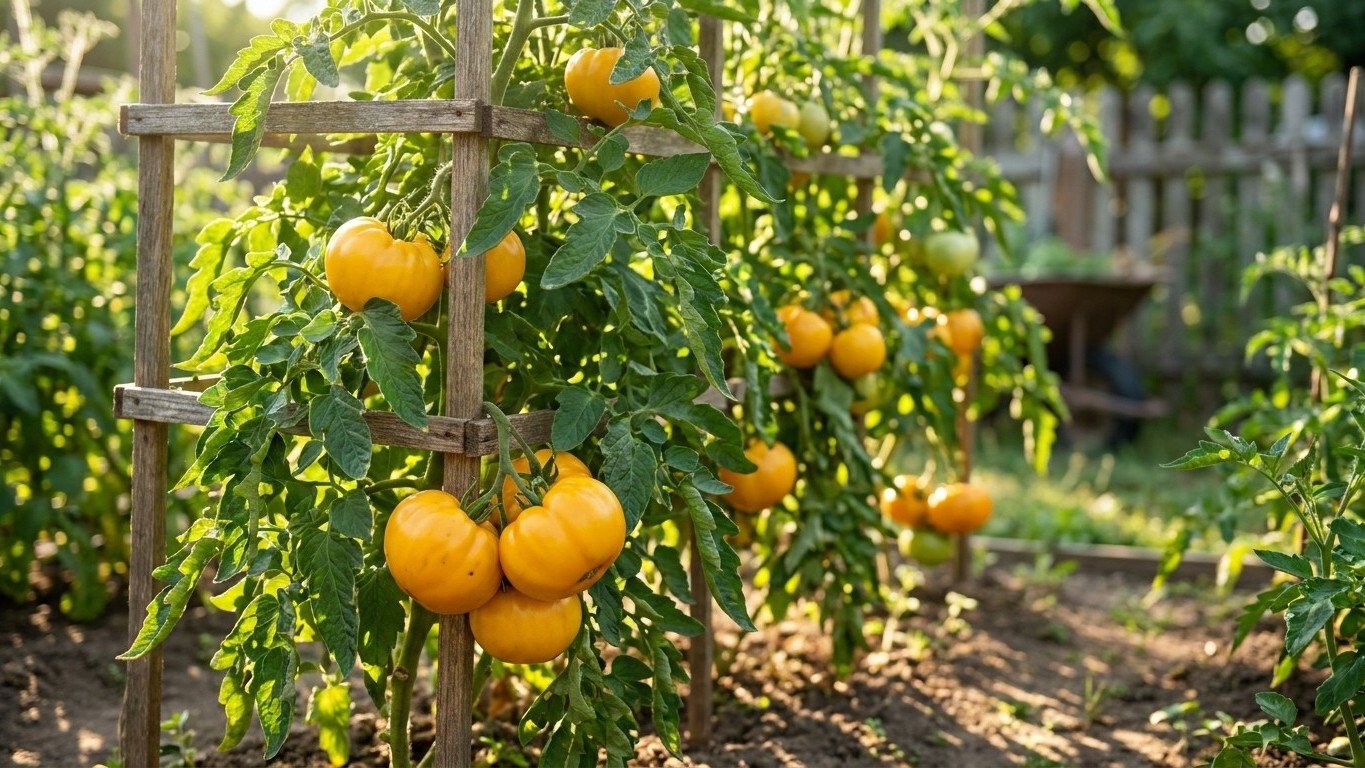

Dr. Wyche’s Yellow Tomato is a golden heirloom slicer that needs about 75 days from transplant to first ripe fruit, and because it’s indeterminate, it keeps setting new fruit until frost kills the vine. That maturity window fits comfortably into most of the country’s growing season, but the plant’s continuous bloom means it will run straight into summer heat wherever you garden, and no seed catalogue lists a disease resistance to fall back on if things go wrong.
What Brandywine actually is

Three facts decide whether this tomato belongs in a given garden. First, the days-to-maturity figure: 75 days, counted from transplant into the garden, not from the day you sowed seed indoors. That distinction matters because a gardener who starts the clock at sowing will misjudge their harvest date by several weeks, and misjudging it in a short-season climate can mean a plant that never finishes.
Second, the growth habit. Dr. Wyche’s Yellow is indeterminate, meaning the vine doesn’t stop at a set height or produce one flush of fruit and quit. It keeps growing, flowering, and setting tomatoes all season, right up until frost ends it. That habit demands a tall cage or a sturdy stake from the start, not the short tomato ring that works fine for a compact bush variety. Skip the tall support and you get a sprawling, tangled plant that’s harder to harvest and more prone to fruit rot from soil contact.
Third, the fruit itself. It’s a heirloom type, golden in color, described with a robust flavor, and grown specifically for slicing rather than canning or sauce work. That combination, thin-walled golden flesh meant to be eaten fresh, shapes a few of the care decisions later in this piece, particularly around watering consistency and when to stop feeding the plant nitrogen.
Where it ripens in time, and where it is a gamble
The arithmetic here is straightforward, and it’s worth doing with your own numbers rather than someone else’s. Start with your area’s frost-free window: the average stretch between the last spring frost and the first fall frost. That figure is available free for the nearest official weather station through NOAA’s National Centers for Environmental Information. From that window, subtract about two weeks, because tomato transplants set into soil that hasn’t warmed past roughly 60F simply sit and sulk instead of growing. What’s left is the real clock this tomato runs on, and the 75-day maturity figure needs to fit inside it with room left over, since first ripening isn’t the finish line for an indeterminate plant, it’s the starting gun for weeks more of picking.
In short-season country, the upper Midwest, northern New England, and the mountain valleys of the Rockies, that frost-free window often leaves barely more room than the 75 days this variety needs once the soil-warming buffer is subtracted. There’s little slack for a cool, wet spring or an early autumn cold snap. Gardeners in those regions commonly start seedlings indoors six to eight weeks before their expected last frost date to buy a head start, and some extend the season further with row cover or a high tunnel rather than relying on the open-air window alone.
Along the Gulf Coast, the Southeast, and coastal California, frost is rare enough, and late enough in the year, that the frost-free window comfortably clears the 75-day requirement with weeks to spare. In those places the limiting factor stops being autumn cold and becomes something else entirely, covered in the next section.
Most of the country sits in between those two extremes: the Mid-Atlantic, the Ohio Valley, and the lowland Pacific Northwest. There, the 75 days fit without much drama, but the margin for a strong second wave of fruit before frost shuts things down is thinner than the calendar suggests, especially if the transplant goes in a week or two later than planned.
The two ways a season goes wrong
A long frost-free window on paper doesn’t guarantee a good tomato season, and two limits explain why. In the north, accumulated warmth can run short even when the calendar window looks generous, because tomato flowers need nights that stay above 50F to set fruit reliably. A stretch of chilly nights in early summer, even with frost still months away, can knock out a round of blossoms before they ever become tomatoes. That’s a heat-accumulation problem, not a frost problem, and a frost date alone won’t warn you about it.
In the south, the opposite failure shows up at the peak of summer. Once daytime temperatures push above roughly 86F, tomato pollen loses viability and flowers drop without setting fruit at all. That’s why experienced southern growers plan around two crops rather than one continuous season, a spring planting that finishes its main harvest before the worst heat arrives, and a second planting timed to fruit as temperatures ease in early fall.
For a variety like this one, indeterminate and blooming continuously for months, the southern heat limit matters more than the northern cold-night limit. A short determinate tomato can be timed to dodge the hottest weeks entirely. This one can’t; its ongoing bloom cycle guarantees it will be flowering exactly when a southern summer peaks, which is the real reason southern gardeners treat it as a two-season crop rather than a single long run.
What it resists, and what it does not
No disease resistance is published for Dr. Wyche’s Yellow Tomato. That’s not a gap in this article, it’s the catalogue data itself: where a modern hybrid often carries a printed code for resistance to verticillium wilt, fusarium wilt, or nematodes, this heirloom carries none. Saying otherwise, or implying some baseline protection exists because it’s a popular variety, would cost a gardener a crop they didn’t need to lose.
That absence of listed resistance is common among heirloom tomatoes, most of which predate the breeding programs that built resistance traits into modern hybrids. The practical response isn’t panic, it’s ordinary vigilance: rotate tomato beds so the same soil doesn’t host tomatoes (or peppers and eggplant, in the same family) year after year, space plants for airflow rather than crowding them to save room, and watch the lower leaves for the yellowing and spotting patterns typical of early blight, since heirlooms without resistance genetics tend to show foliar disease earlier in the season than resistant hybrids planted alongside them.
Mulching under the plant to keep soil-borne fungal spores from splashing onto lower leaves during rain or overhead watering does more real-world work here than any product claim, precisely because there’s no genetic backstop if disease pressure builds.
Growing it without the usual mistakes
Because the plant is indeterminate, it needs a different plan from a determinate bush that sets one flush and finishes. A tall cage, at minimum five to six feet, or a stake with regular tying as the vine climbs, isn’t optional here the way it might be for a compact patio variety. Space plants generously, since a vine left to grow all season gets wide as well as tall, and crowding invites the fungal problems the previous section flagged.
Feeding needs a clear cutoff. Heavy nitrogen early helps the plant establish, but continuing it once fruit sets pushes the plant into leafy growth at the expense of flowering and fruit set, a mistake that’s easy to make with a vine this vigorous since it never visibly “stops” growing the way a determinate plant does. Switching to a lower-nitrogen feed once the first fruit clusters appear keeps the plant’s energy where it belongs.
The timing mistake specific to this variety is treating the 75-day figure as the end of the job rather than the start of a long harvest. Because it fruits continuously until frost, consistent watering matters more here than for a one-flush tomato, since irregular moisture on thin-walled slicing fruit like this one is a common cause of cracking right as tomatoes ripen. Even watering, mulch to hold soil moisture steady, and picking promptly once fruit colors up all matter more for a long-season indeterminate than for a tomato that ripens once and is done.
Common questions
How many days does Dr. Wyche’s Yellow Tomato take to ripen?
About 75 days, counted from the day the transplant goes into the garden, not from when seed was started indoors.
Is Dr. Wyche’s Yellow Tomato determinate or indeterminate?
It’s indeterminate. The vine keeps growing and setting fruit until frost, which is why it needs a tall cage or stake rather than a short tomato ring.
Does Dr. Wyche’s Yellow Tomato resist disease?
No disease resistance is published for this variety. Gardeners should rely on crop rotation, spacing, and mulching rather than assuming any built-in protection.
What does Dr. Wyche’s Yellow taste like, and how is it used in the kitchen?
It’s described as having a robust flavor, and it’s grown for slicing, meant to be eaten fresh rather than canned or cooked down into sauce.