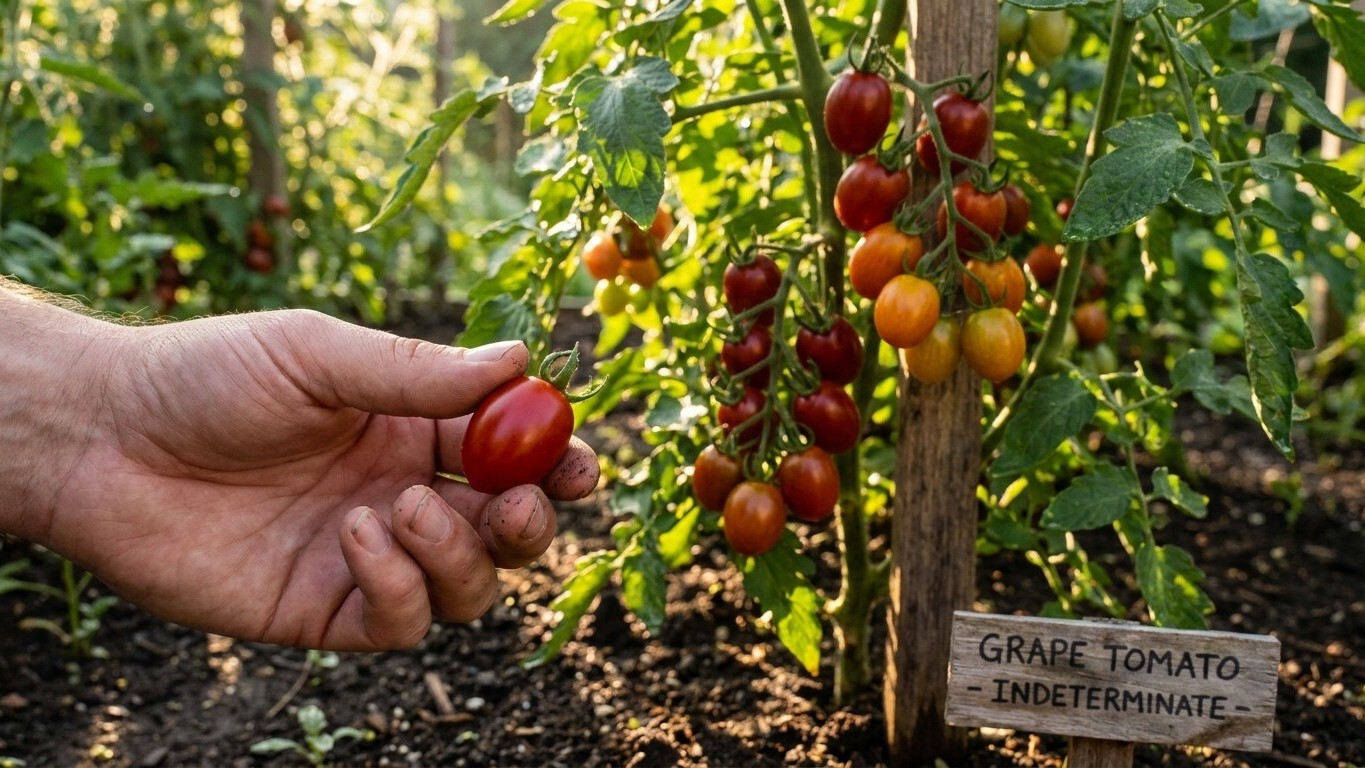

Five Star Grape Tomato is an indeterminate grape tomato that starts ripening about 62 days after you set transplants in the ground, and it keeps producing sweet, meaty, low-seed fruit right up until frost takes the vine down. That combination, fast start plus a long finish, makes the planting-date question less about “can I grow this” and more about “how much of the season will I actually get to use.”
What Five Star Grape Tomato actually is

Five Star Grape Tomato is an indeterminate grape tomato bred for salads and snacking, and its first fruit typically ripens around 62 days from transplant. That figure matters as much for what it doesn’t measure as for what it does: it’s counted from the day a started plant goes into garden soil, not from the day you sow seed indoors. Anyone starting from seed needs to add their own indoor growing period on top of that 62-day clock before it even starts ticking.
The growth habit is indeterminate, which means the vine doesn’t stop at a set height or a single flush of fruit. It keeps growing new stems and setting new clusters until the cold shuts it down, which is exactly why it needs a tall cage or a sturdy stake from day one rather than a short tomato cage bought as an afterthought.
In the kitchen, this is a salad-and-snacking tomato through and through. The fruit is described as having excellent, sweet flavor with a firm, meaty texture, few seeds, and little juice, which is the profile home cooks want for tossing into a bowl or eating straight off the vine rather than cooking down into sauce. It’s not bred for canning volume; it’s bred for the tomato you grab walking past the garden.
Where it ripens in time, and where it is a gamble
The math behind any tomato’s planting window is the same three-step subtraction, and it’s worth doing on paper before you buy a single plant. Start with your local frost-free window, the stretch of days between your last spring frost and your first fall frost. Subtract roughly two weeks off the front end, because tomato roots sulk in cold soil and most gardeners wait until the ground has warmed before transplanting rather than setting plants out the day frost risk technically ends. Then subtract the variety’s days to maturity, in this case 62. Whatever number is left is your actual harvest window, the stretch of weeks you get to pick fruit before the season closes back down.
Run that arithmetic and Five Star Grape Tomato comes out ahead of most tomatoes on the market, simply because 62 days is short. A grape tomato with a maturity date in the mid-70s or 80s eats up a much bigger chunk of a short-season garden’s calendar before the first fruit even shows color. This variety’s speed is its main structural advantage, and it’s the reason it shows up so often in recommendations for gardeners working with a compressed growing season.
The exact number of frost-free days varies enormously by location, and that data isn’t something to guess at here. What can be said plainly: the shorter a region’s frost-free season runs, the more that 62-day figure matters, and the longer it runs, the less the maturity date is the limiting factor at all. A gardener in a region with a long, warm season has room not just to grow one crop of this tomato but to stagger two plantings a few weeks apart, stretching the “keeps coming until frost” trait even further by having a second wave of vines just hitting their stride as the first wave slows.
For anyone unsure exactly how their own location stacks up, the honest move is to check local average frost dates through a state extension office or a regional climate resource, then run the subtraction above with their own numbers rather than relying on a generic zone map. A 62-day tomato is forgiving almost everywhere with a normal growing season; it only turns into a real gamble in the handful of places where the frost-free window itself is unusually short, and in those spots, the two-week soil-warming buffer is often the number gardeners shave down first, accepting a bit more transplant risk to buy back growing days.
The two ways a season goes wrong
A long frost-free window on paper doesn’t guarantee a good tomato season, and two limits explain why. The first is accumulated warmth. Some regions have a frost-free period that looks generous on a calendar but stays cool for much of it, and tomatoes simply won’t set fruit once nighttime temperatures drop below 50°F. A vine can sit there green and healthy, blooming away, and produce nothing usable because the nights never got warm enough to hold the fruit set. This is the northern failure mode: plenty of days, not enough heat in them.
The second limit sits at the opposite end of the thermometer. Once daytime temperatures push above roughly 86°F, tomato pollen itself becomes sterile, and blossoms drop without setting fruit at all. This is why growers in hot southern climates don’t plan for one long unbroken tomato season the way a northern gardener does. They run a spring crop that finishes before the worst heat arrives, accept a dead middle stretch of summer where the plants may survive but stop producing, and then bring on a second, autumn crop as temperatures ease back down.
For Five Star Grape Tomato specifically, the fast 62-day maturity tips the balance toward the northern concern mattering more, not less. A short-season grower gets real benefit from that speed, because it’s the difference between a viable crop and a wasted garden bed. A hot-climate grower, meanwhile, can actually use the fast maturity to their advantage: get plants in early enough that fruiting is well underway before the 86°F pollen-sterility window shuts things down, then count on a second planting timed for the cooler edge of fall to catch a repeat harvest. Either way, the maturity number is doing real work in the planning, not just sitting there as a catalogue detail.
What it resists, and what it does not
Five Star Grape Tomato carries no published disease resistances. That’s a plain, useful fact, not a gap in this article: some tomato varieties are bred and graded specifically for resistance to diseases like fusarium wilt, verticillium wilt, or various blights, and those resistances get listed with codes on seed packets and in catalogues. This variety carries none of those codes, which means it leans on general growing conditions and good cultural practice rather than built-in genetic defense.
That distinction matters more than it might seem. Even where a resistance code does exist for a tomato variety, it usually comes in two flavors: high resistance, meaning the plant strongly suppresses a disease, and intermediate resistance, meaning it merely slows the disease down rather than blocking it. Growers who see any resistance code and assume the plant is immune are setting themselves up for disappointment even with a resistant variety. With Five Star Grape Tomato, there’s no such code to misread in the first place, so the practical takeaway is simpler: assume no protection at all against common soil-borne wilts or foliar blights, and lean on rotation, airflow, and mulching instead of genetics to manage disease pressure.
In practice, that means treating this variety the way a gardener would treat any unprotected tomato: avoid planting in soil that grew tomatoes or related nightshades the previous year, keep foliage dry when watering, and space plants so air moves freely between them. None of that is unique to this variety, but it carries more weight here precisely because there’s no seed-bred backup plan if disease pressure shows up mid-season.
Growing it without the usual mistakes
The single most common mistake with an indeterminate variety like this one is under-building the support structure at planting time, then trying to retrofit a taller cage or stake once the vine is already sprawling. Because Five Star Grape Tomato keeps growing and fruiting until frost rather than stopping at a set height, a short tomato cage bought for a compact determinate variety won’t hold it. Set a tall stake or a heavy-gauge cage in place the same day you transplant, before the root system is established enough to make driving a stake risky.
Feeding schedule is the second place this variety differs from a one-flush determinate tomato. A determinate plant sets nearly all its fruit in a short window and can be tapered off nitrogen once fruit is developing, since there’s little vegetative growth left to fuel. An indeterminate variety like this one is doing both jobs at once for months, growing new stems while ripening older clusters, so it needs steadier feeding through the middle of the season rather than an early cutoff. Easing off nitrogen too soon, mistaking the first harvest for the finish line, is a common way gardeners shortchange the second half of a season this variety is specifically built to deliver.
Spacing deserves attention too. An indeterminate vine that’s still growing in August needs more elbow room than the tag on a garden-center six-pack usually suggests, both for airflow (relevant given the lack of disease resistance discussed above) and for the sheer physical bulk of a plant that never stops adding stems. Given the 62-day maturity, the other timing mistake to avoid is planting too late and assuming the speed will bail you out; a fast maturity date buys margin, it doesn’t erase the need to get transplants in as soon as soil and air conditions genuinely allow.
Common questions
Is Five Star Grape Tomato determinate or indeterminate?
It’s indeterminate, meaning the vine keeps growing and setting new fruit continuously until frost stops it, rather than producing one concentrated flush and finishing.
How many days does Five Star Grape Tomato take to ripen?
About 62 days, and that count starts from the day of transplant into the garden, not from the day seed is sown.
Does Five Star Grape Tomato resist common tomato diseases?
No disease resistances are published for this variety, so it should be grown with the assumption that it has no built-in genetic protection against wilts or blights.
What does Five Star Grape Tomato taste like?
It’s described as having excellent, sweet flavor with a firm, meaty texture, few seeds, and little juice, which makes it suited to salads and eating fresh off the vine rather than to cooked sauces.