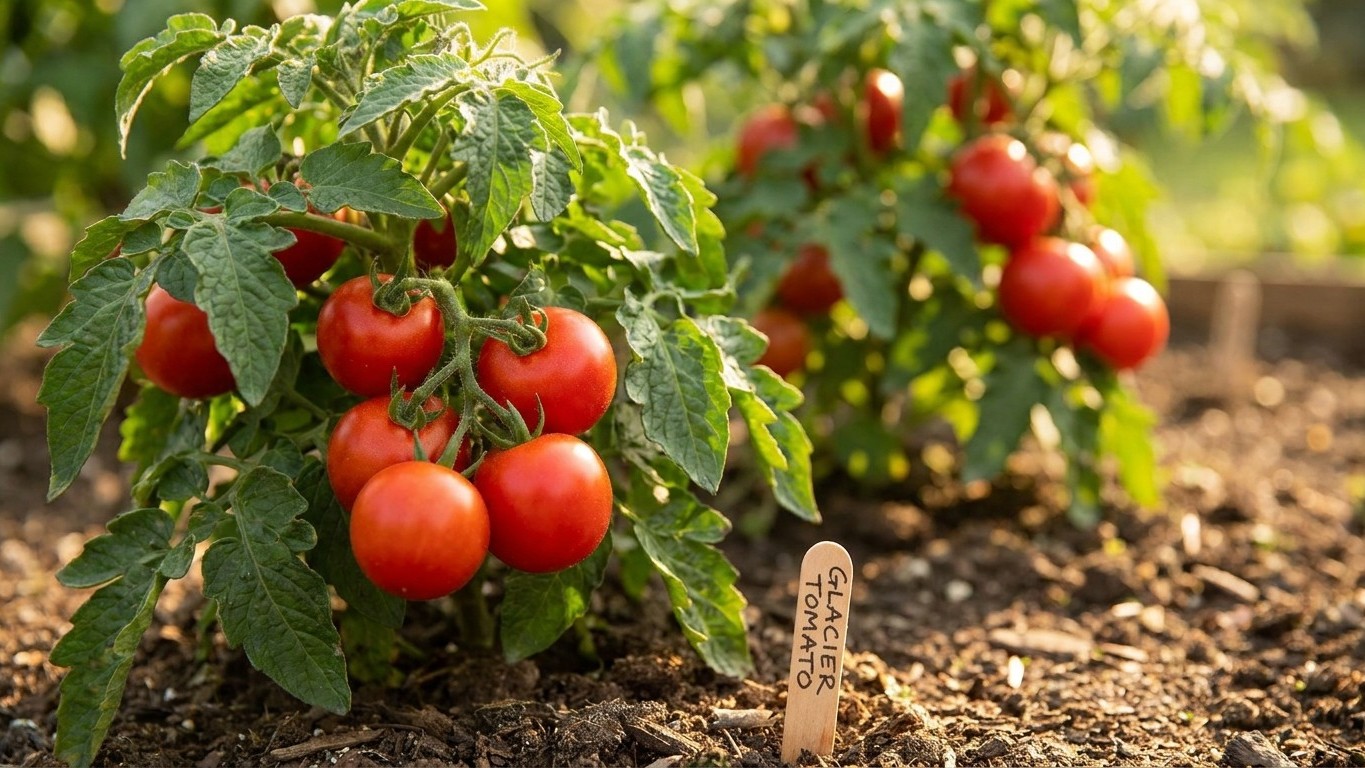

Glacier is a red heirloom slicing tomato built for speed: a determinate plant that sets a compact crop of 2-inch fruit in about 55 days from transplant, with a flavor described as surprisingly sweet for such an early type. That maturity figure, and the fact that it’s determinate rather than sprawling, are what decide whether it fits a short-season garden or a long, hot one.
What Brandywine actually is

Skip the romance for a moment and look at the three facts that matter for planning a bed. Glacier is a determinate heirloom, which means the plant grows to a set size, flowers along most of its branches within a short window, and then ripens the bulk of its fruit in one concentrated flush rather than trickling out tomatoes all summer. That habit shapes everything from staking to canning schedules, and it’s worth sitting with before the seed packet goes in the ground.
The fruit itself is small by slicing-tomato standards, about 2 inches across, red-skinned, and rated as a slicer rather than a paste or cherry type. The flavor is described as surprisingly sweet for an ultra-early variety, which matters because early tomatoes are often bred for speed at the expense of taste. Glacier appears to buck that trend, at least according to the catalogue description.
The number that does the real work here is 55 days to maturity, and it’s counted from transplant, not from the day the seed goes into starter mix. That distinction sounds pedantic until you’re trying to time a harvest around the first fall frost. A gardener who counts from sowing instead of from transplant will overestimate how much time they actually have in the ground by several weeks, since starting seed indoors and growing a transplant to setting-out size typically takes 5 to 7 weeks on its own. Get the basis wrong and the whole planning exercise falls apart before it starts.
Where it ripens in time, and where it is a gamble
Here’s the arithmetic every tomato grower should run before choosing a variety, and Glacier’s numbers make it a forgiving exercise almost everywhere. Start with your region’s frost-free window, the stretch between the last expected spring frost and the first expected fall frost. Subtract roughly two weeks, because tomato transplants shouldn’t go into the ground until the soil has warmed past the point where cold nights stunt root growth. Then subtract the 55 days Glacier needs to ripen its first fruit. What’s left is your margin, the cushion of extra days you have for a full harvest before frost ends the season.
In short-season regions, that margin is thin for most tomatoes but comfortable for Glacier. Northern growers in places like International Falls, Minnesota, or Fargo, North Dakota, work with frost-free windows that run roughly 100 to 120 days in a typical year. Subtract the two-week soil-warming buffer and the 55 days to maturity, and there’s still a month or more of harvest time left, something a 75- or 85-day tomato simply doesn’t offer in those same gardens. This is exactly the kind of climate where an ultra-early determinate earns its keep.
Move south and the math gets easier, but the constraint shifts from “will it ripen at all” to “how do I manage a plant that finishes fast in a long season.” A grower near Chicago or Kansas City, working with a frost-free window in the 180- to 200-day range, has so much slack that Glacier’s 55 days become almost a rounding error. The same is true across the Mid-Atlantic and much of the Ohio Valley. In these zones the question isn’t survival, it’s whether to stagger transplant dates so the single flush Glacier produces doesn’t all land in the same July week.
Along the Gulf Coast and in much of California’s Central Valley, frost-free windows stretch past 250 days, sometimes approaching year-round in the mildest pockets. There, Glacier’s short season isn’t a lifeline, it’s a tool: gardeners can fit in an early spring planting, let the plant finish before peak summer heat, and still have time left for a second crop later in the year. The variety’s speed becomes a scheduling advantage rather than a survival strategy.
Nowhere in the continental U.S. does the frost-free window run short enough to make Glacier truly risky on paper, given how little time it needs. The gamble, when there is one, comes from weather that a frost-date average doesn’t capture, and that’s worth its own look.
The two ways a season goes wrong
A long frost-free window on a chart doesn’t guarantee a good tomato season, and a short one doesn’t automatically doom it. Two limits sit outside the simple frost-to-frost math, and they matter more for fruit set than the calendar does.
In northern gardens, accumulated warmth can run short even when the frost-free window looks generous. Tomatoes need consistently warm nights to set fruit, and when overnight temperatures drop below 50 degrees Fahrenheit, pollen doesn’t perform well and blossoms drop without producing anything. A cool, cloudy stretch in June, common in the Upper Midwest and Northeast even well inside the frost-free window, can stall a plant for two or three weeks regardless of how many days are left before frost. For Glacier, this is the more relevant risk of the two. Because its 55-day maturity puts fruit set in the earliest, coolest part of the season for northern growers, a run of chilly nights right after transplant is the likeliest thing to slow it down.
In southern and hot-summer regions, the opposite problem takes over. Once daytime highs climb above roughly 86 degrees Fahrenheit, tomato pollen tends to go sterile, and fruit set drops off through the hottest weeks of summer. This is why gardeners across the Deep South and the desert Southwest plant in spring, harvest before the heat peaks, and then plant again in late summer for a fall crop, rather than expecting one tomato plant to produce continuously from May through September. Glacier’s short maturity actually helps here too, since a spring-planted crop can finish and get pulled before the worst heat arrives, clearing space for a second round later.
Between the two, cool nights at transplant time are the sharper concern for this particular variety, precisely because its speed pushes flowering into the part of the season when temperatures are least predictable.
What it resists, and what it does not
The catalogue listing for Glacier carries no published disease resistance codes at all. That’s a plain fact worth stating directly rather than glossing over: unlike hybrids bred with named resistance to Verticillium wilt, Fusarium wilt, or nematodes, Glacier offers no bred-in protection against any of the common tomato diseases. Growers shouldn’t read “heirloom” or “old variety” as a stand-in for toughness. Resistance and hardiness are separate things, and this variety simply hasn’t been bred or tested for the former.
In practice, that means the usual soil-borne and fungal threats, early blight, late blight, Septoria leaf spot, and the wilts, are all on the table without any genetic backup from the plant itself. The practical response is cultural rather than varietal: rotate tomatoes out of the same bed for two to three years, water at the soil line instead of overhead to keep foliage dry, and space plants generously so air moves through the canopy. None of that is unique to Glacier, but it matters more here than it would for a hybrid carrying built-in resistance, because there’s no fallback if a season turns wet and blight-prone.
None of this makes Glacier a fragile plant. Plenty of heirlooms with no listed resistance perform fine in home gardens that rotate beds and manage moisture reasonably well. It just means the disease-management work falls entirely on the gardener’s routine, not on anything bred into the seed.
Growing it without the usual mistakes
Because Glacier is determinate, it asks for a different setup than the sprawling indeterminate heirlooms most gardeners picture when they hear “old variety.” A determinate plant reaches a genetically set height, produces flowers along most of its branches within a short stretch, and then ripens the bulk of its fruit in one concentrated flush before tapering off. A cage or a single sturdy stake is usually enough support, since the plant won’t keep growing taller and heavier all season the way an indeterminate does. Skip the elaborate trellising built for six-foot vines; it’s unnecessary here and wastes effort.
That same determinate habit changes how pruning should be handled. Heavy pruning, the kind gardeners do out of habit on indeterminate varieties to control size and improve airflow, works against a determinate plant by removing the very branches that were going to flower and fruit. Light thinning for airflow is fine; aggressive suckering is not.
Feeding follows the same logic. Once the plant sets its first fruit cluster, back off on nitrogen. A determinate variety pushing out lush new leaf growth after fruit set is putting energy into foliage instead of ripening the crop it’s already carrying, which delays the harvest right when the whole point of choosing a 55-day variety was speed.
The single biggest planning mistake with Glacier is treating its one-flush harvest like a season-long trickle. Because nearly the whole crop ripens close together, gardeners who want tomatoes spread across more weeks should stagger transplant dates by two to three weeks rather than planting the whole row at once. For anyone planning to can or preserve, though, that concentrated flush is actually the advantage: a full basket ready on roughly the same week, rather than a handful of fruit dribbling in over two months.
Common questions
Is Glacier tomato the same as other early red heirlooms?
No. “Early” is a broad category covering many varieties with different maturity dates, growth habits, and fruit sizes. Glacier’s specific combination, a determinate habit, 55 days from transplant, and 2-inch red fruit, is what should guide comparisons, not the general label.
Can Glacier be grown in containers?
Its determinate, compact habit makes it a reasonable candidate for a large container, though no specific container guidance is published for this variety. A pot in the 15- to 20-gallon range is typically what’s needed for a determinate tomato of similar size, with good drainage and consistent watering.
Does the sweet flavor hold up compared to slower-ripening heirlooms?
The catalogue describes the flavor as surprisingly sweet for an ultra-early type, which is a comparison against other fast tomatoes, not a claim that it matches a 90-day heirloom bred purely for flavor. Treat it as good for its speed class rather than a direct rival to slow-ripening classics.
Why doesn’t Glacier list any disease resistance when many modern tomatoes do?
Heirloom varieties are generally open-pollinated lines preserved for traits like flavor, earliness, or historical interest, not bred through the modern trialing process that produces resistance codes. The absence of a resistance listing here reflects that history, not a defect in the variety.