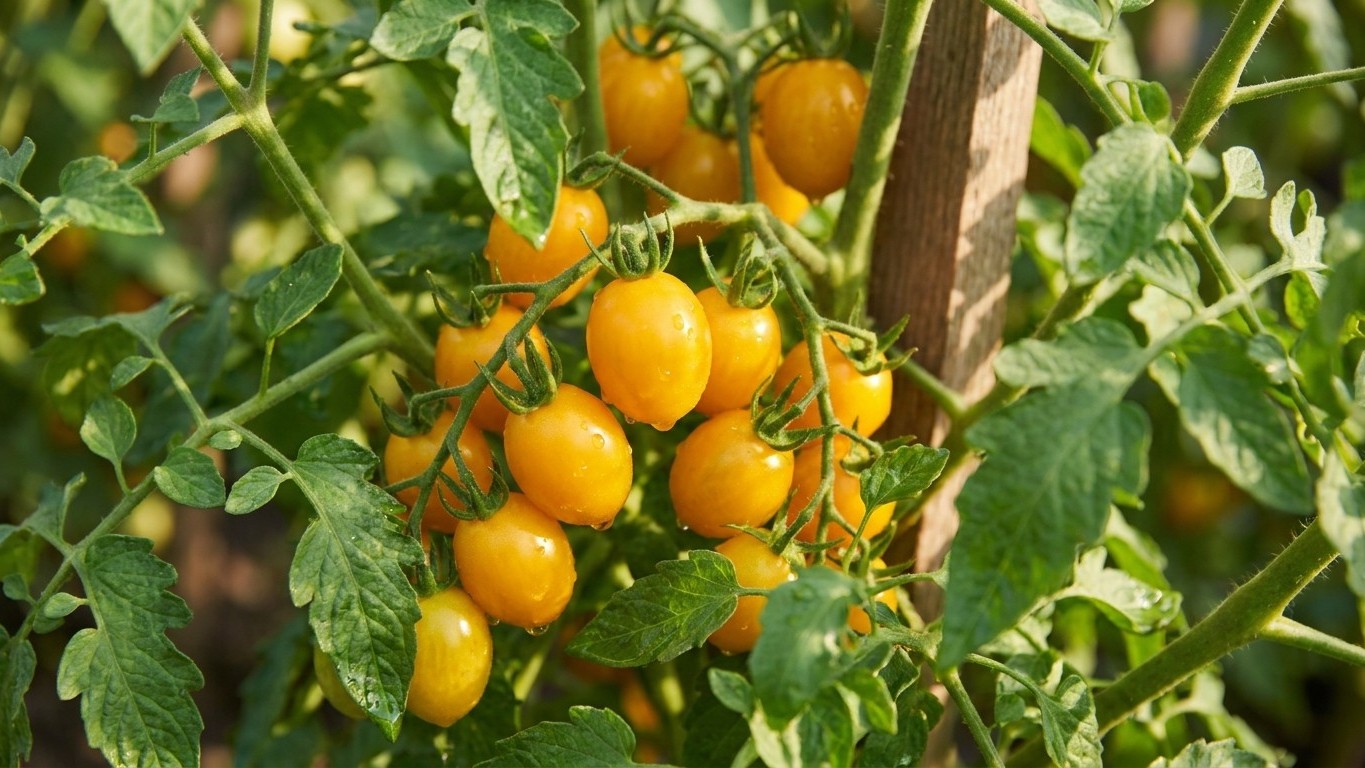

A 60-day tomato from transplant is fast enough to fit almost any U.S. frost-free window, which is what makes Golden Sweet a forgiving choice for gardeners who don’t have a long summer to spare. The catch isn’t ripening time. It’s the indeterminate vine that keeps producing until frost, and the narrow nighttime temperature band that decides whether those yellow grapes actually set fruit.
What Brandywine actually is

Golden Sweet is a grape-type tomato, yellow-skinned, with small fruit weighing 15 to 20 grams each, roughly the size of a large grape or small olive. The flavor is described in catalogue terms as mild and sweet, which is why it shows up most often in salads and as a snacking tomato straight off the vine rather than in sauces or canning.
The plant habit is indeterminate. That single word changes the whole growing plan: unlike a determinate variety that sets one flush of fruit and stops, this vine keeps growing and setting fruit until frost kills it. It needs a tall cage or a stake tall enough to support a plant that doesn’t know when to quit.
Days to maturity is listed at 60, and that figure is counted from transplant, not from seed. That distinction matters because seed-to-harvest timelines run several weeks longer once you add germination and the weeks a seedling spends indoors before it goes into the ground. When a catalogue gives “60 days,” it assumes you’re already holding a transplant ready to go into warm soil. Anyone counting from the day they sowed seed indoors will land on a much later harvest date than the number suggests.
Where it ripens in time, and where it is a gamble
Sixty days is short by tomato standards. Plenty of popular slicing varieties run 75 to 90 days from transplant, and in a marginal climate that gap is the difference between a full harvest and a plant still loaded with green fruit when the first frost hits. Golden Sweet’s speed gives it slack almost everywhere in the continental U.S., but the arithmetic is still worth doing by hand, because “almost everywhere” isn’t “everywhere.”
Start with your local frost-free window, the stretch between the average date of last spring frost and average date of first fall frost. That figure varies enormously by region and is tracked at individual weather stations, not as a single national number, so the right move is to look up the frost dates for the station nearest your own garden rather than borrow a number from a different climate zone.
From that window, subtract roughly two weeks. Tomatoes don’t just need frost-free air, they need soil that has actually warmed up, and setting transplants into cold, damp soil right after the calendar clears of frost usually stalls growth rather than starting it. Two weeks of waiting for the soil to catch up is a standard cushion growers build in before they even start counting days to maturity.
Subtract the 60 days to maturity next. Whatever is left over is your margin, the number of extra days you have to keep harvesting grape tomatoes before frost ends the season. In a region with a long frost-free window, say one that stretches five or six months, that leftover margin can run into months, plenty of room for an indeterminate vine to keep cropping through late summer and into fall. In a short-season climate, where the frost-free window itself might only run 90 to 100 days, the same math leaves a much tighter margin, maybe four to six weeks of harvest before the vine gets cut down by cold.
No two gardens share the same frost dates, and the specific figures for last and first frost need to come from a local weather record, not a regional guess. But because 60 days is such a short maturity window compared to most tomatoes, Golden Sweet is one of the more reliable choices for gardeners working with a compressed season, and one of the least risky varieties to gamble a short growing region on.
The two ways a season goes wrong
A generous frost-free window doesn’t guarantee a generous harvest, because two other limits sit outside any frost calendar and neither shows up when you’re just counting days between spring and fall.
The first is accumulated warmth. A region can have a long frost-free stretch and still run cool through most of it, which matters because tomato flowers won’t set fruit once nighttime temperatures drop below 50°F. Blossoms can form and even look healthy, but pollination fails in that cold, and the plant drops them instead of setting fruit. A coastal garden with mild days and chilly nights can post a long frost-free season on paper while still struggling to fill out a tomato crop, because the nights never warm enough for consistent fruit set.
The second limit runs the opposite direction. Once daytime temperatures climb above roughly 86°F, tomato pollen itself turns sterile, and flowering all but stops producing fruit until things cool back down. This is the reason gardeners in the hottest parts of the country often plant tomatoes twice: a spring crop that finishes before the worst of summer heat, and a second planting in late summer that fruits once temperatures ease in early fall. Trying to run one continuous harvest straight through a brutal July and August usually means weeks of blossoms that never turn into tomatoes.
For a fast, 60-day variety like Golden Sweet, the heat ceiling matters more in practice than the cold-night limit. Because the plant matures quickly, it’s well-suited to squeezing in as a spring crop that finishes its main flush before the hottest weeks arrive, or as the second, late-summer planting that catches the cooler stretch heading into fall. Growers in short, cool-summer climates should watch nighttime lows instead; a fast tomato still won’t set fruit if nights stay under 50°F regardless of how quickly it could otherwise mature.
What it resists, and what it does not
The published resistances for Golden Sweet are specific and worth reading precisely rather than skimming. The variety carries high resistance to Fusarium Wilt race 1, and high resistance to Leaf Mold, covering strains A through E. Both are graded as “high” in catalogue terms, which is the stronger of the two resistance ratings typically used.
That distinction matters because plenty of tomato listings mix “high” and “intermediate” resistance without flagging the difference, and the two mean different things in the garden. High resistance means the plant is bred to fend off that specific disease effectively under normal pressure. Intermediate resistance, when a catalogue uses that word for a different disease, means the plant slows the disease’s progress and often shows milder symptoms, but it does not stop an infection outright. Golden Sweet’s published resistances are both graded high, not intermediate, so no such qualifier applies to Fusarium Wilt race 1 or Leaf Mold here.
What the variety is not listed as resisting matters just as much. No resistance to Late Blight, Early Blight, Verticillium Wilt, or root-knot nematodes appears in the published data, and none should be assumed. A garden with a history of any of those pressures needs its own management plan, whether that’s crop rotation, fungicide timing, or resistant rootstock for grafting, because Golden Sweet’s genetics offer no built-in defense against them. Resistance to two specific diseases is not the same as broad protection, and treating it that way is how a grower gets caught off guard by a disease the plant was never bred to fight.
Growing it without the usual mistakes
Because Golden Sweet is indeterminate, the support plan has to be built for the whole season, not just the first flush of fruit. A short tomato cage sized for a determinate bush variety won’t hold up once this vine is five or six feet tall and still climbing in August. A tall stake, at least six feet driven well into the ground, or a sturdy cage built for indeterminate growth, is the right call from the day of transplant rather than something to add later once the plant has already outgrown a smaller support.
Spacing needs the same forward planning. Indeterminate vines keep putting out lateral growth all season, so crowding plants close together to save space early on usually backfires by midsummer, when airflow drops and foliar disease pressure rises, undercutting the plant’s own resistance to Leaf Mold. Giving each plant real room from the start costs more space upfront but pays off in a cleaner canopy later.
Feeding follows the same logic as the support: since the plant fruits continuously rather than in one flush, nitrogen-heavy feeding needs to taper off once the first fruit sets, shifting to a lower-nitrogen, higher-potassium feed to keep pushing flowers and fruit instead of just vine growth. Growers who keep feeding heavy nitrogen all season often end up with a lush, leafy plant that’s slow to ripen fruit, exactly the wrong outcome for a variety valued for its speed.
The timing mistake specific to this variety is treating a fast maturity date as an excuse to plant late. Because 60 days sounds forgiving, it’s tempting to delay transplanting past the point when soil has properly warmed. But an indeterminate vine set out late doesn’t just delay the first harvest, it compresses the entire cropping window against the fall frost date, cutting short exactly the long, continuous harvest this variety is otherwise built to deliver.
Common questions
Is Golden Sweet the same as a cherry tomato?
No. It’s classified as a grape-type tomato, with fruit weighing 15 to 20 grams, generally smaller and more oblong than a typical round cherry tomato, though both types are used the same way in the kitchen, mainly salads and snacking.
How many days until Golden Sweet is ready to pick?
Sixty days from transplant, not from seed. Anyone starting seed indoors needs to add the germination and seedling-growing period on top of that 60-day figure to get an accurate seed-to-harvest timeline.
Does Golden Sweet need a cage?
Yes, and it needs a tall one. The vine is indeterminate and keeps growing and fruiting until frost, so a short cage built for a compact, determinate variety won’t contain it by midseason. A tall stake or a cage built for indeterminate growth, set up at transplant time, works better than adding support later.
Will Golden Sweet resist blight?
The published resistances cover Fusarium Wilt race 1 and Leaf Mold, both rated high. No resistance to Late Blight or Early Blight is listed, so gardens with a history of either disease need their own separate management plan rather than relying on the plant’s built-in genetics.