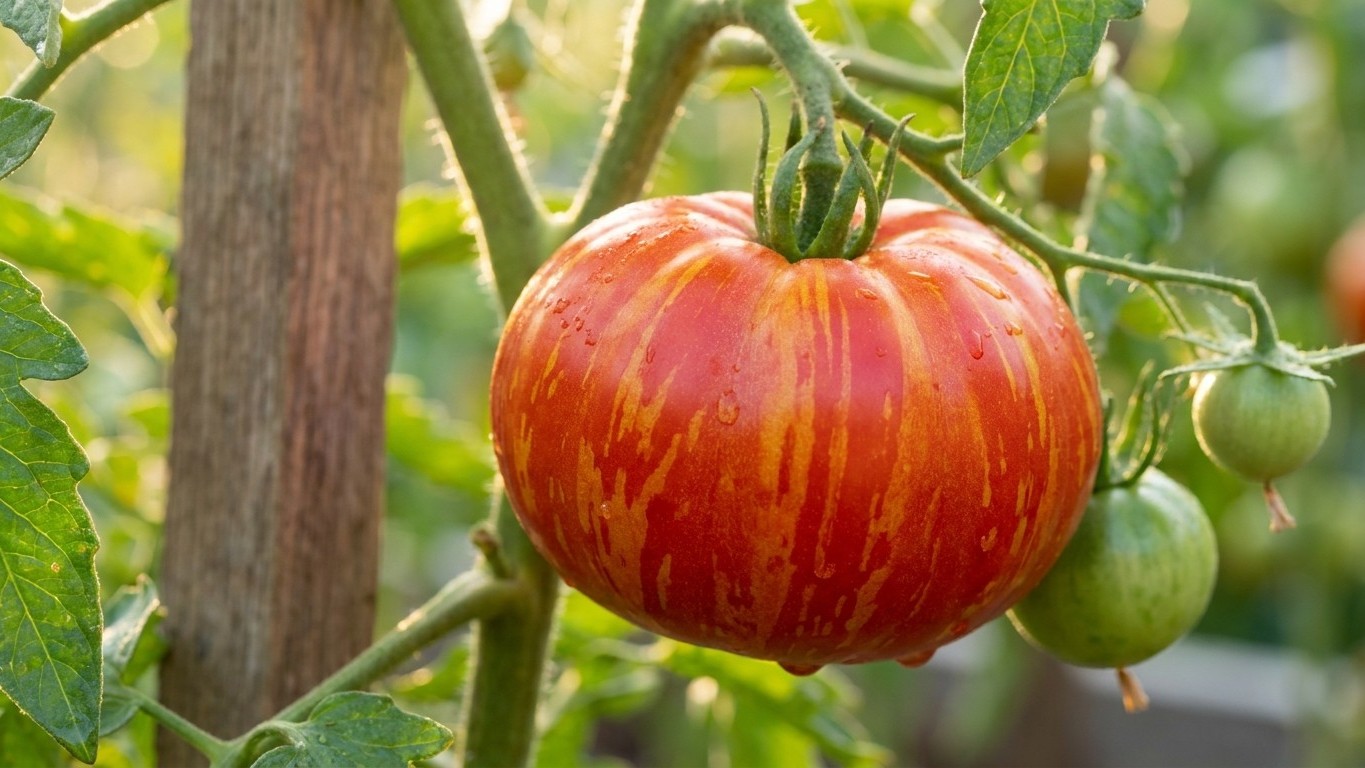

Hot Streak is a yellow beefsteak tomato that reaches maturity in 70 days from transplant, which puts it on the faster end of the beefsteak category. That speed matters most for gardeners in short-season climates, but it also changes how the plant behaves in the heat of a long southern summer. Here’s what decides whether it fits your garden.
What Hot Streak actually is

Hot Streak is a beefsteak-type tomato, which means large, meaty fruit built for slicing rather than canning or sauce work. The fruit runs 6 to 12 ounces, and the catalogue lists the color as yellow, though the variety description reads more specifically as firm red fruit with yellow stripes and outstanding flavor, so expect a bicolor look on the plate rather than a solid gold tomato.
Days to maturity is 70 days, and that figure is counted from transplant, not from seed. This distinction matters more than it sounds. A gardener who starts seed indoors typically spends another five to seven weeks growing a transplant-ready seedling before that clock even starts. If you’re planning a garden calendar, the 70-day figure only applies once the seedling goes into the ground, not the day you sow the seed packet.
The plant habit is indeterminate. The vine keeps growing and setting fruit until frost kills it, rather than ripening in one flush and stopping. That’s the reason a tall cage or a sturdy stake isn’t optional here. A short tomato cage built for a determinate bush variety will not contain a Hot Streak plant by midsummer; the vine will outgrow it and flop, which invites rot and makes fruit harder to find under the foliage.
In the kitchen, this is a slicing tomato, meant for sandwiches and salads where the meaty texture and low seed count matter, not a paste tomato meant for cooking down into sauce.
Where it ripens in time, and where it is a gamble
The question that actually matters for a beefsteak tomato isn’t “can I grow it,” it’s “does my season leave room for it to finish.” The math is simple enough to run for your own yard. Start with your local frost-free window, the number of days between your average last spring frost and your average first fall frost. Subtract about two weeks, because tomato transplants shouldn’t go into ground that hasn’t warmed enough, planting into cold soil stalls the plant and can erase any head start you thought you had. Then subtract the 70 days to maturity. Whatever is left over is your harvest window, the stretch of time you actually get to pick ripe fruit before frost ends the season.
No specific frost-date figures for named weather stations are published on this page, so the numbers below are illustrative rather than a substitute for checking your own local averages, which your county extension office can provide. But the pattern holds across the country in a consistent way.
Short-season climates
In places like northern Minnesota, northern Wisconsin, or high-elevation parts of the Mountain West, a frost-free season commonly runs somewhere in the neighborhood of 100 to 120 days. Run the arithmetic: subtract roughly 14 days for soil warmup, subtract 70 for maturity, and you’re left with something like 16 to 36 days of actual harvest before frost shuts things down. That’s workable, but it leaves little margin for a cool, wet spring that delays planting, or a stretch of cloudy weather that slows ripening. Hot Streak’s relatively fast 70-day clock is exactly what makes it a reasonable choice in these regions, where a 90-day beefsteak would be a genuine gamble.
Moderate and long-season climates
Across most of the Midwest, the mid-Atlantic, and the Pacific Northwest’s warmer valleys, frost-free seasons tend to stretch well past 150 days, sometimes closer to 180. Here the arithmetic leaves 65 to 95 days of harvest window, which is comfortable room for one full flush and successive picking as the vine keeps producing. In the Deep South and coastal areas of the Gulf and Southeast, frost-free seasons often exceed 200 days, and here the limiting factor stops being frost altogether. It becomes summer heat, which the next section covers.
The two ways a season goes wrong
A long frost-free window on paper doesn’t guarantee a good tomato season, because a frost date table can’t show you two separate failure points that have nothing to do with frost itself.
In the north, the problem is accumulated warmth, not calendar days. A region can have a technically long frost-free window and still deliver cool nights that stall fruit development. Tomato flowers won’t set fruit reliably once nighttime temperatures drop below 50°F, regardless of how many frost-free days remain on the calendar. A plant sitting in a cool, damp Pacific Northwest June can look healthy and still fail to set much fruit until real summer warmth arrives.
In the south, the opposite limit kicks in. Once daytime temperatures climb above roughly 86°F, tomato pollen becomes sterile, and flowers drop without setting fruit at all. That’s why experienced growers in the Deep South and Texas don’t try to run one long season through the hottest months. They plant a spring crop that finishes before the worst heat arrives, accept a fruitless lull in the peak of summer, and then set out a second crop for fall.
For Hot Streak specifically, the 70-day maturity works in the grower’s favor on both fronts. It’s fast enough to dodge a chunk of a short northern season’s cool-night risk by finishing before autumn’s early chill sets in, and fast enough in the south to slip a spring crop in ahead of the July and August heat shutdown, which matters more here given how compressed a southern spring window can be before the pollen-sterility threshold arrives.
What it resists, and what it does not
The published resistances for Hot Streak are all rated High, with no intermediate grades in the mix, which simplifies the read here: Late Blight, Gray Leaf Spot, Tomato Mosaic Virus, Fusarium Wilt races 1 and 2, Fusarium Crown and Root Rot, and resistance to Leaf Molds A through E.
That’s a genuinely solid resistance package, particularly the Late Blight and leaf mold coverage, which are common headaches in humid climates where foliage stays wet longer. High resistance means the plant strongly suppresses these diseases under normal pressure, though it isn’t the same as immunity; a severe, sustained outbreak can still cause some damage, just far less than an unprotected variety would suffer.
What’s just as important is what isn’t on that list. No resistance to Early Blight is published, no resistance to Septoria Leaf Spot, no resistance to Verticillium Wilt, and no nematode resistance. These are common tomato problems in a lot of home gardens, and growers should treat this variety as vulnerable to all of them, using crop rotation, mulching to reduce soil splash, and normal foliar disease monitoring rather than assuming the resistance package covers everything.
Growing it without the usual mistakes
Because Hot Streak is indeterminate, the growing plan looks different from a determinate bush variety that ripens in one tidy flush and then quits. This plant needs a tall cage, at minimum 5 to 6 feet, or a stake with regular tying as the vine climbs, because it will keep producing new growth and new fruit clusters until frost stops it. Skimping on support here is the single most common mistake; an undersized cage gets outgrown by midsummer, and a sprawling vine on the ground means more fruit lost to rot and pests.
Feeding needs to match that extended timeline. Heavy nitrogen early is fine to build the plant, but once fruiting starts in earnest, back off nitrogen and lean toward a balanced or phosphorus/potassium-forward feed, since too much nitrogen late in the season pushes leafy growth at the expense of fruit set. Because the vine keeps fruiting for months rather than weeks, a single early feeding won’t carry it, plan on a light feeding every few weeks through the season rather than a one-time application.
Spacing matters more with an indeterminate beefsteak than gardeners expect. Give plants at least 24 to 36 inches apart to allow airflow around that sprawling, long-lived vine, since a plant that stays productive for months also stays exposed to disease pressure for months. And because the fruit is large and the vine indeterminate, expect a steady trickle of ripe Beefsteaks rather than one big harvest day, which means checking plants every couple of days rather than waiting for a single dramatic picking session.
Common questions
Is Hot Streak the same as a standard yellow tomato?
Not quite. The catalogue lists the color as yellow, but the fruit is described as firm red fruit with yellow stripes, so it’s a bicolor beefsteak rather than a solid gold one.
How many days does Hot Streak take from seed to harvest?
The published 70-day figure is measured from transplant, not from seed. Add the several weeks needed to grow a transplant-ready seedling before that clock starts.
Does Hot Streak resist all tomato diseases?
No. It carries High resistance to Late Blight, Gray Leaf Spot, Tomato Mosaic Virus, Fusarium Wilt races 1 and 2, Fusarium Crown and Root Rot, and Leaf Molds A through E. It has no published resistance to Early Blight, Septoria Leaf Spot, Verticillium Wilt, or nematodes.
Can I grow Hot Streak in a short-season climate?
Yes, more comfortably than many beefsteaks. Its relatively fast 70-day maturity gives it more margin than a 90-day beefsteak in regions with frost-free seasons around 100 to 120 days, though a cool, cloudy spring can still tighten that margin.