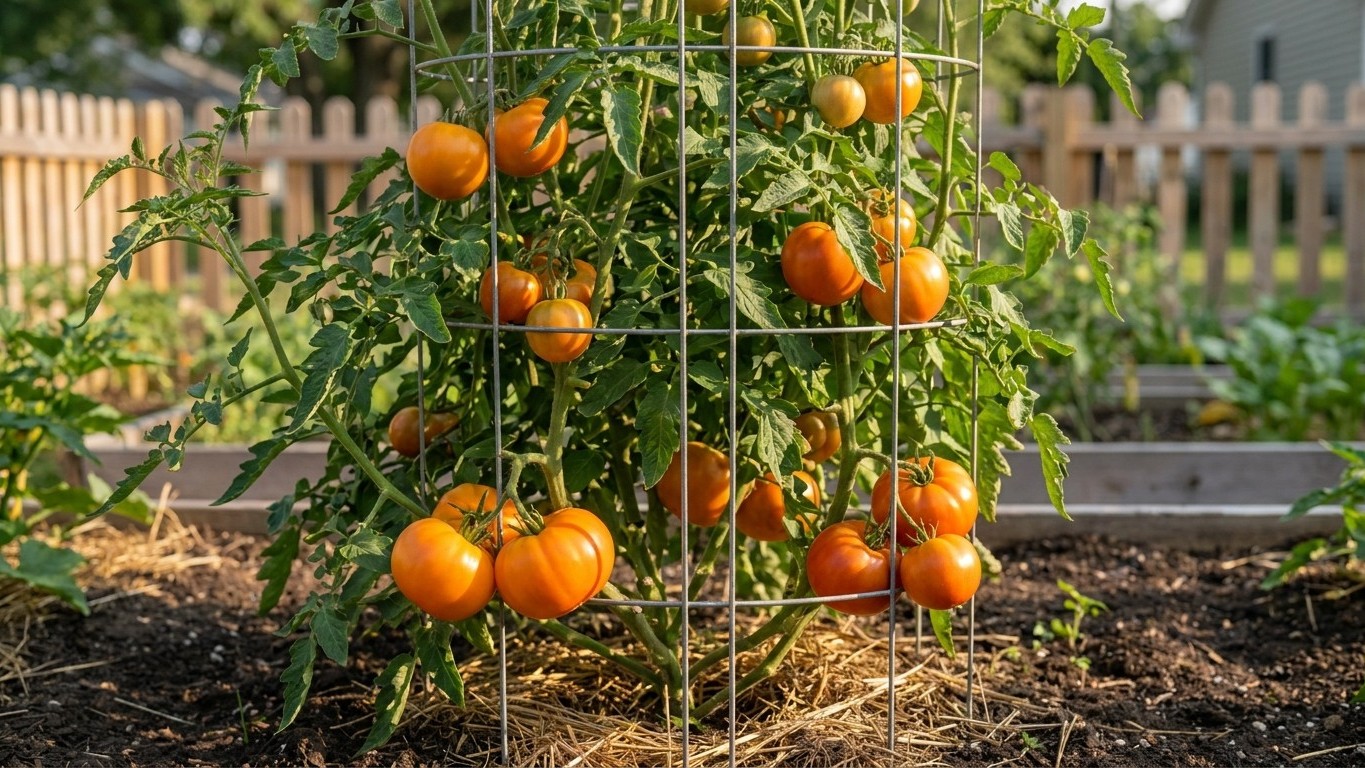

Marmango is an indeterminate beefsteak tomato with orange flesh, bred for the slicing plate rather than the sauce pot. It reaches maturity in about 70 days, counted from the day it goes into the ground as a transplant, not from seed. That single number, paired with its need for a tall cage, decides more about whether this tomato belongs in a given garden than any description of its taste ever could.
What Marmango actually is

Start with the shape of the plant, because that’s what determines the work ahead. Marmango is indeterminate, meaning the vine keeps growing and setting fruit right up until frost kills it. There’s no single flush of ripe tomatoes to plan around, no tidy harvest week. It also means the plant needs real support: a tall cage or a stake driven deep, not the flimsy wire cone sold for patio varieties.
The fruit itself is orange, in the 5 to 8 ounce range, and classified as a beefsteak. That size and shape point toward one job: slicing, for sandwiches and burgers, not canning or paste. The flavor is described as heirloom-type, with a longer shelf life than a lot of old open-pollinated orange varieties tend to offer, which matters if the picking window overlaps with a week of vacation or a farmers market delay.
The number that ties this all together is 70 days to maturity, and it’s counted from transplant. That basis matters more than it sounds. A seed catalogue that instead measured from sowing would push the real garden number out by another four to six weeks of indoor growing time before the plant ever sees the soil. Anyone reading a maturity number without checking which starting point it uses is comparing two different clocks.
Where it ripens in time, and where it is a gamble
The math a gardener actually needs isn’t complicated, but almost nobody writes it out. Take the length of the frost-free season where you live, subtract roughly two weeks for the soil to warm enough after the last frost to safely hold a tomato transplant without stalling it, then subtract the 70 days Marmango needs to reach a ripe fruit. Whatever is left over is the cushion: the number of days you can lose to a cool June, a slow-to-set plant, or simply the luxury of picking tomatoes for a month instead of two weeks before the first fall frost ends the run.
That cushion is not the same everywhere, and it isn’t only about how long the season runs on paper. Regions differ in how much slack sits between “frost-free” and “warm enough to actually push a tomato through its cycle without stalling.”
| Region type | What the frost-free season looks like | Margin for a 70-day tomato after the soil-warming delay |
|---|---|---|
| Short-season (Upper Midwest, northern New England, high-elevation Mountain West) | Often barely long enough to cover the plant’s full cycle once soil warm-up is subtracted | Thin. A late spring or an early fall cold snap can erase most of the harvest window |
| Transitional (Mid-Atlantic, Ohio Valley, Pacific Northwest) | Covers the full cycle with some room to spare | Adequate for a full harvest run, tight if trying to squeeze in a second planting |
| Long-season (Deep South, Gulf Coast, coastal California) | Extends well beyond what the plant strictly needs | Comfortable, often with room for staggered plantings through the season |
These are categories, not a substitute for the actual dates a specific garden sees. This page doesn’t hold city-by-city frost data, so the honest next step for anyone in a borderline zone is to pull their own last and first frost dates from local records, usually kept by a county extension office or a home weather station, and run the subtraction themselves. The arithmetic doesn’t change; only the starting numbers do.
One practical note for short-season growers: because Marmango is indeterminate, a tight cushion doesn’t mean zero harvest, it means a smaller one. The plant will keep setting fruit as long as it’s alive, so even a season that only allows for three or four weeks of ripe picking before frost still beats a determinate variety that dumps its entire crop in one week and then quits.
The two ways a season goes wrong
A long frost-free window on a map doesn’t guarantee a good tomato season, and this is where a lot of garden planning falls apart. In the north, a season can technically stay frost-free for months and still fail to deliver ripe fruit, because tomatoes need accumulated warmth, not just an absence of frost, to move from flower to ripe fruit. Nights that drop below 50°F stall pollination outright. A cool, cloudy stretch in a marginal climate can leave a plant loaded with green fruit that simply never finishes.
In the south, the failure runs the opposite direction. Once daytime temperatures push past roughly 86°F, tomato pollen goes sterile and flowers drop without setting fruit at all. That’s why growers in hot climates don’t treat summer as one long tomato season; they run a spring crop that finishes before the worst heat, then a second planting timed to fruit once temperatures ease in early fall, leaving the peak of summer as a dead zone for new fruit set.
For a variety with a 70-day cycle like Marmango, the southern heat window is the more immediate concern. A typical spring transplant timeline puts fruit set squarely in the hottest stretch of July across much of the Deep South and the Southwest, right where pollen sterility does the most damage. Northern growers, by contrast, mostly avoid the cold-night problem simply by waiting for the soil to warm before transplanting, since the plant’s relatively fast 70-day clock gets it through its cycle before the season’s coldest nights return in fall. The heat risk deserves more attention here than the cold one.
What it resists, and what it does not
The published resistance package for Marmango covers five things, all rated High: Verticillium Wilt, Tomato Mosaic Virus, Fusarium Wilt race 1, Fusarium Crown and Root Rot, and leaf molds A through E. High resistance is a strong grade, better than the “Intermediate” rating that shows up on plenty of tomato tags and that gets misread as full protection. Intermediate means the plant slows a disease down; it doesn’t mean the disease can’t take hold under heavy pressure. High resistance is a real step above that, but even High isn’t the same as immune, especially in soil that’s carried the same disease for years.
What matters just as much is what isn’t on that list. There’s no published resistance to Early Blight, Late Blight, Septoria leaf spot, bacterial diseases like speck or spot, or root-knot nematode. None of those are covered here, and a gardener working in soil known for any of them shouldn’t assume Marmango’s strong wilt and mold resistance extends that far. It doesn’t.
The practical takeaway is straightforward: this variety earns real trust in ground with a history of Verticillium or Fusarium problems, or in humid climates where leaf mold routinely wrecks a season. It earns none of that trust against blight, which still calls for the standard defenses, crop rotation, good airflow through pruning and spacing, and watching the lower leaves for the first dark spots that signal trouble.
Growing it without the usual mistakes
Because Marmango is indeterminate, the support has to be built for the long haul, not the first month. A tall cage, at least 5 to 6 feet, or a sturdy stake set deep before the roots fill in, keeps a vine that never stops growing from collapsing under its own weight by August. Waiting to add support until the plant looks like it needs it usually means driving a stake through roots that have already spread.
Spacing matters more here than on a compact determinate variety, since without published resistance to Early Blight or Septoria, airflow through the foliage is one of the few defenses a grower controls directly. Giving each plant 24 to 36 inches of room, and pruning some of the lower suckers to open up the base of the plant, cuts down the damp, still air where those diseases spread fastest.
Feeding is where a lot of indeterminate beefsteaks go wrong. Heavy nitrogen late in the season pushes the vine to keep producing leaves and stems instead of ripening the fruit already set, which is the opposite of useful on a plant that’s already going to keep growing until frost regardless. Easing off nitrogen once the first fruit clusters are sizing up, and switching to a lower-nitrogen feed, keeps the plant’s energy pointed at the beefsteaks already on the vine.
The mistake this particular variety invites, given its 70-day timeline in a hot climate, is transplanting on the same generic schedule used for slower 80- to 90-day heirlooms. Getting Marmango into the ground early enough that its fruit-set window lands before the worst of summer heat, rather than squarely inside it, is the single adjustment that does the most to protect the harvest in hot-summer regions.
Common questions
Is Marmango tomato determinate or indeterminate?
Indeterminate. The vine keeps growing and setting fruit until frost ends the season, which is why it needs a tall cage or a deep-set stake rather than a small tomato cage.
How many days does Marmango tomato take to ripen?
About 70 days, counted from transplant into the garden, not from when the seed is started indoors.
Does Marmango tomato resist blight?
No blight resistance is published for this variety. Its listed High resistances cover Verticillium Wilt, Tomato Mosaic Virus, Fusarium Wilt race 1, Fusarium Crown and Root Rot, and leaf molds A through E, but Early Blight, Late Blight, and Septoria leaf spot aren’t part of that package.
What does Marmango tomato taste like and how is it used?
It’s described as having heirloom-type flavor with a longer shelf life than many older orange heirlooms. The fruit runs 5 to 8 ounces, orange, beefsteak-shaped, and it’s grown mainly for slicing rather than sauce or canning.