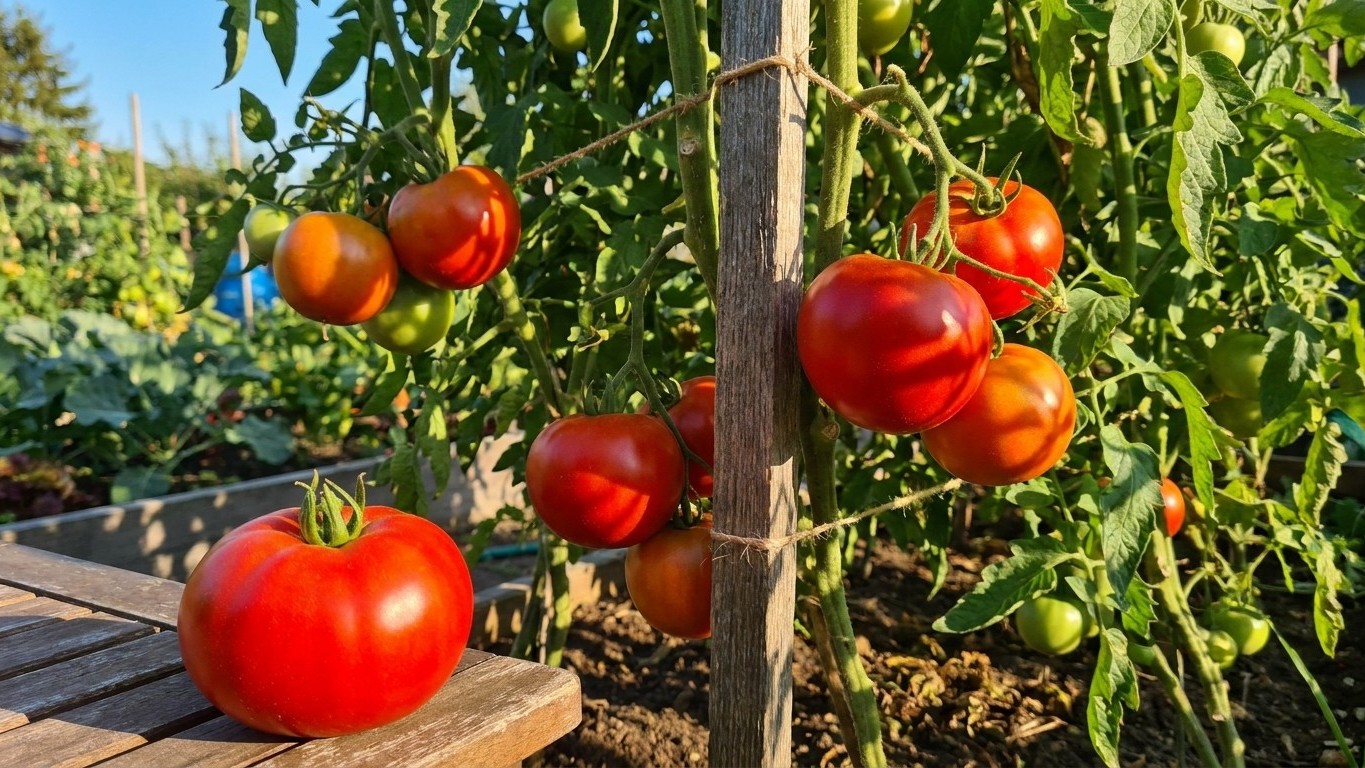

New Girl is a slicing tomato that reaches harvest in just 62 days from transplant, which puts it among the earliest full-size slicers a home garden can grow. That speed matters most in short-season climates, where a few weeks can decide whether a crop finishes before the first hard frost or gets cut off mid-harvest.
What Brandywine actually is

New Girl is an indeterminate slicing tomato, which means the vine keeps growing and setting fruit all season instead of ripening in one flush and stopping. Left unsupported, that habit turns into a sprawling mess of stems and rot-prone fruit sitting on wet soil, so it needs a tall cage or a stake driven in at planting time, not added later once the roots have spread.
The catalogue figure for this variety is 62 days to maturity, counted from transplant, not from the day the seed goes into a starter tray. That distinction is not a technicality. Seed started indoors typically needs another five to seven weeks before it is ready to go into the ground, so the real clock from sowing to first ripe tomato runs closer to 110 to 120 days. Gardeners who count from the seed packet date and expect fruit two months later are usually disappointed for no good reason.
In the kitchen, New Girl is bred as a straightforward slicer, the kind of tomato you cut into rounds for a sandwich or a burger rather than one built for sauce or canning. The catalogue describes its flavor as strong for an early variety, which is worth noting because most early tomatoes trade taste for speed. New Girl is positioned as an exception to that trade-off, though flavor claims are subjective and worth judging fruit by fruit in your own garden.
Where it ripens in time, and where it is a gamble
The question that actually matters for a home gardener is not whether New Girl is a good tomato. It is whether the growing season where you live gives it enough runway. That calculation is simple arithmetic, and it works the same way no matter where you garden.
Start with your local frost-free window, the stretch of the year between the average last spring frost and the average first fall frost. Subtract roughly two weeks from the start of that window, because tomato transplants set out into soil that hasn’t warmed sit still, sulk, and sometimes die back rather than grow; soil temperature, not the calendar, is what triggers root activity. Then subtract the 62 days New Girl needs from transplant to first ripe fruit. Whatever is left over is your actual harvest window, the stretch of weeks you get to pick fruit before the vines succumb to cold.
In a region with a long, mild growing season, that arithmetic leaves a comfortable margin. Warm the soil, transplant, wait 62 days, and there are still many weeks of harvest left before the season ends. That’s the kind of margin where a slow-ripening heirloom tomato is just as viable as a fast one, and the choice of variety comes down to taste rather than timing.
In a region with a short growing season, the math tightens fast. If the frost-free window itself is only modestly longer than the two weeks of soil-warming delay plus the 62 days New Girl needs, the harvest window shrinks to a handful of weeks, or vanishes into a race against the first frost. This is precisely the scenario where a 62-day slicer earns its keep: a slower-maturing tomato needing 80 or 90 days from transplant may never ripen a full crop in that same window, while New Girl still gets there with weeks to spare for actual picking.
Exact frost-free date figures vary station by station and year by year, and no single number applies to an entire state or region. The practical move for any gardener is to look up the average last and first frost dates for the nearest official weather station to their own address, run the subtraction above with the 62-day figure, and see what’s left. Local agricultural extension offices maintain that station-level data and can confirm it for a specific zip code, which is far more reliable than a rule of thumb pulled from a national map.
What the arithmetic makes clear without needing a single named city: New Girl’s advantage is entirely about margin. It doesn’t grow tomatoes that a slower variety couldn’t grow somewhere with a long season. It grows tomatoes reliably in places where a slower variety would leave the gardener still waiting for fruit when the vines go black with frost.
The two ways a season goes wrong
A frost-free window long enough on paper doesn’t guarantee a good crop, because two other limits sit outside what any frost table shows.
In cooler climates, the issue isn’t the length of the season so much as its warmth. Tomatoes need accumulated heat to grow and set fruit, and a region can have a technically long frost-free window that still runs cool the whole way through, especially at higher elevation or near a cold body of water. Below roughly 50°F at night, pollen doesn’t function properly and blossoms drop without setting fruit at all. A New Girl plant sitting through a string of cold nights in early summer can look healthy and flower heavily while producing almost nothing, simply because the nights never got warm enough to let pollination happen.
In hot climates, the opposite failure shows up in mid-summer. Above roughly 86°F, tomato pollen goes sterile, and blossoms drop for the same practical result: no fruit, regardless of how healthy the plant looks. This is why gardeners in the Deep South and other hot-summer regions typically run two separate tomato crops rather than one continuous season, a spring planting that finishes its fruiting before the worst heat arrives, and a second planting set out in mid to late summer to catch the cooler stretch of early fall.
For a variety with a maturity as short as New Girl’s, the heat-driven pause matters less than it does for a slow heirloom, because 62 days gives a real shot at finishing a full harvest cycle before peak summer heat shuts pollination down, then potentially starting a second round afterward. The cold-night limit is the one to watch more closely in short-season northern gardens, since it can silently erase the very margin the fast maturity date was supposed to buy.
What it resists, and what it does not
New Girl carries two published disease resistances, both rated High: Verticillium Wilt, and Fusarium Wilt races 1 and 2. A High rating is the strongest grade a catalogue assigns, meaning the plant is bred to withstand these two soil-borne fungal diseases far better than an unprotected variety would, even when the pathogen is present in the soil.
That’s the full published list, no more and no less. It does not carry resistance ratings for other common tomato threats such as early blight, late blight, or root-knot nematodes, none of which appear in its catalogue data. Resistance to Verticillium and Fusarium does nothing to protect against those other problems, so a gardener in a region where late blight is a regular pressure, for instance, gets no help from this variety on that front and needs to manage it the same way they would for any unprotected tomato, through crop rotation, spacing for airflow, and prompt removal of infected foliage.
Resistance itself, even at the High grade, is not immunity. It means the plant slows the progression of the disease and holds up better under infection pressure, not that it’s guaranteed to stay symptom-free in soil where Verticillium or Fusarium is present. Rotating tomatoes out of the same bed every year and avoiding densely-packed plantings still matters even with a resistant variety, because resistance buys margin, it doesn’t erase the underlying risk.
Growing it without the usual mistakes
Because New Girl is indeterminate, the plan for it looks nothing like the plan for a determinate tomato that ripens its whole crop in a short window and then stops. A determinate variety can get by with a modest cage and a simple, front-loaded feeding schedule. New Girl needs a tall cage or a sturdy stake set at transplant time, since the vine will keep adding height and side growth all season and a small cage installed later won’t contain it without damaging roots or breaking stems.
Feeding needs to continue in a way it wouldn’t for a one-flush plant. Because the vine is setting new flowers and fruit continuously rather than finishing in one wave, cutting off fertilizer early starves the later fruit even while earlier tomatoes are still ripening well. A steady, moderate feeding schedule through most of the season keeps that continuous production going, tapering off only as the plant nears the end of its productive window closer to frost.
The mistake its particular timing invites is treating the 62-day figure as the end of the story rather than the start of it. Gardeners sometimes plant a fast variety like this one expecting a single quick harvest and then let the plant go, skipping the ongoing pruning, tying, and feeding an indeterminate vine needs to keep producing for months. The whole advantage of pairing an early maturity date with an indeterminate habit is a long stretch of harvest, first fruit early, then a continuous supply until frost, and that payoff only shows up if the plant gets supported and fed as if it’s running a marathon, not a sprint.
Common questions
Is New Girl a determinate or indeterminate tomato?
It’s indeterminate. The vine keeps growing and setting new fruit until frost stops it, rather than ripening its whole crop in a single flush the way a determinate variety does.
How many days does New Girl take to produce ripe tomatoes?
62 days from transplant into the garden, not from the date seed is started indoors. Add roughly five to seven weeks of indoor growing time before transplant if starting from seed.
Does New Girl resist blight?
No blight resistance is listed in its catalogue data. Its published resistances cover only Verticillium Wilt and Fusarium Wilt races 1 and 2, both rated High; early blight and late blight aren’t part of that list.
What size cage or stake does New Girl need?
A tall cage or a sturdy stake set in the ground at transplant time. Because it’s indeterminate, the vine keeps growing all season, and a small cage added later won’t hold it once the plant is established.