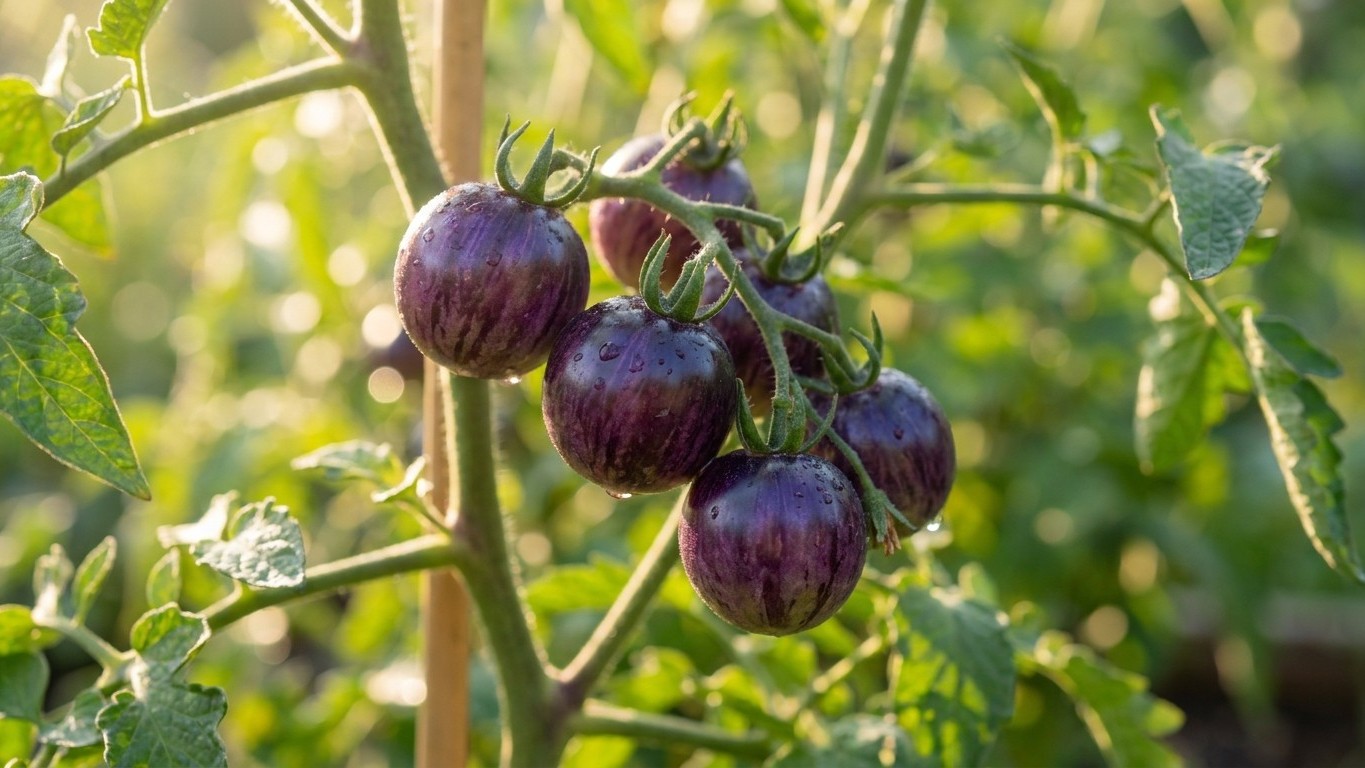

The purple bumble bee tomato is a specialty variety valued for its sweet flavor and striking purple skin, and it needs about 70 days from transplant to start ripening. That number by itself doesn’t tell you much. What matters is how it lines up against your local frost dates, your soil temperature in spring, and your summer nights, and that’s the arithmetic worth working through before you buy seed.
What Brandywine actually is

Before running any calendar math, get the basics straight. This is an indeterminate plant, which means the vine keeps growing and setting fruit until frost cuts it down rather than stopping after one flush. That habit decides how you build your support system from the start: a short tomato cage bought for a determinate bush will be outgrown by midsummer, and you’ll end up wrestling six feet of vine that should have had a tall cage or a sturdy stake from day one.
The fruit itself is purple-skinned, sold as a specialty type rather than a slicing standard, and described as sweet in flavor, the kind of tomato people grow for the plate rather than for canning volume. Days to maturity is listed at 70 days from transplant, and that basis matters. Seed packets sometimes blur the line between days from sowing and days from setting a seedling in the ground, and the two numbers can differ by several weeks. Here, the clock starts when the young plant goes into the garden, not when the seed goes into a tray indoors.
No named disease resistances come with this variety in the catalogue data behind this page. That’s a fact worth sitting with before the next sections, because it changes how much slack you should plan into a growing season and how closely you’ll need to watch the plant once the weather turns humid or wet.
Where it ripens in time, and where it is a gamble
The way to test whether a 70-day tomato fits your garden is simple arithmetic, and it works the same way no matter where you live. Start with your frost-free window, the number of days between your area’s average last spring frost and its average first fall frost. Subtract about two weeks, because tomato transplants shouldn’t go into ground that hasn’t warmed enough to support root growth, and setting them out too early stalls them rather than speeding them up. Then subtract the 70 days to maturity. What’s left over is your margin, the cushion of extra days you have for picking a real harvest before cold weather ends the season, not just for the first fruit to blush.
Long-season regions
Across the Gulf Coast, the Southeast, and much of California’s Central Valley, frost-free windows commonly stretch past 240 days a year, sometimes well beyond that in the warmest pockets of Florida and southern Texas. Run the math there: a 240-day window minus 14 days for soil warm-up minus 70 days to maturity still leaves over 150 days of harvest. That’s not a tight fit, it’s a season with room to spare, room enough in many of these areas to consider a second planting later in summer for a fall crop.
Moderate-season regions
The mid-Atlantic, much of the Midwest corn belt, and the Pacific Northwest’s milder valleys typically see frost-free windows in the range of 160 to 200 days. Take a 180-day window, subtract the two-week soil-warming buffer, subtract 70 days to maturity, and you land near 96 days of harvest window. That’s comfortable for a 70-day variety, but it doesn’t leave room for a late transplant date or a spring that runs cold longer than usual. Get the timing right and this is an easy region to grow this tomato in.
Short-season regions
Northern New England, the Upper Midwest, the high plains, and mountain valleys in the Rockies often work with frost-free windows closer to 100 to 130 days. Run the same subtraction on a 110-day window: minus 14 for soil warm-up, minus 70 to maturity, and the harvest margin shrinks to roughly 26 days. That’s still workable, a 70-day tomato is on the faster end of the specialty and heirloom spectrum, but it leaves little room for error. A late spring, a cool June, or a transplant that sits in the ground sulking for a week can eat that margin entirely. Gardeners in these zones do better starting seed indoors early and using row cover or wall-of-water protectors to push the effective transplant date earlier than the average last frost would allow.
None of this makes the purple bumble bee tomato impossible in a short-season garden. It makes it a variety where the calendar deserves real attention rather than a rough guess, and where season-extension tools aren’t optional extras but part of the plan.
The two ways a season goes wrong
A long frost-free window on paper doesn’t guarantee a good tomato season, and two limits that never show up on a frost date table can undo an otherwise workable calendar.
In northern gardens, the frost-free window can look adequate while the accumulated warmth across those weeks still falls short. Tomatoes don’t just need frost-free days, they need enough consistently warm days to push growth and ripening along, and a cool, cloudy stretch in a nominally long window can leave fruit sitting green far past when the calendar says it should be red. On top of that, tomato flowers won’t reliably set fruit once nighttime temperatures drop below 50F, which is a real risk at either end of a short-season calendar, in a chilly early June or a cooling September.
In hot southern gardens, the opposite problem shows up in the middle of the season rather than at the edges. Once daytime temperatures push above roughly 86F for extended stretches, tomato pollen becomes sterile and blossoms drop without setting fruit at all. That’s exactly why gardeners across the Deep South and the desert Southwest often plan two separate tomato pushes, a spring crop that finishes before the worst heat arrives and a second crop started in late summer to ripen once temperatures ease in fall, rather than expecting one unbroken harvest all season long.
For a 70-day variety like this one, the cold-night limit matters more than the heat-sterility limit in most of the country. Because it ripens on the faster side, it’s better positioned than a 90-day heirloom to dodge a hot midsummer stretch in warm regions, finishing part of its harvest before or after the worst heat. But that same speed doesn’t help much in a short-season garden fighting cool nights at both ends of the calendar, which is where growers need to lean hardest on transplant timing and protection.
What it resists, and what it does not
No disease resistances are published in the catalogue data for the purple bumble bee tomato. That’s a plain fact, not an oversight to read past. Some tomato varieties carry letter codes on their tags or seed packets, things like intermediate resistance to Verticillium wilt or Fusarium wilt, and those codes are worth understanding correctly when a variety does carry them: intermediate resistance means the plant slows disease progress and often produces a usable crop despite infection, it does not mean the plant is immune or that the pathogen never takes hold. Confusing intermediate resistance with full protection is a common mistake that costs gardeners a crop they thought was safe.
Here, though, there’s no such code to interpret. That means this variety should be treated as carrying no built-in protection against the common soil-borne wilts, foliar blights, or nematode pressure that affect tomatoes generally. In practical terms, that shifts more of the disease-management work onto the gardener: crop rotation, avoiding tomato-family beds two years running, watering at the soil line rather than overhead, and watching for early leaf spotting rather than assuming a resistance gene will do that job. In regions with a history of Fusarium or Verticillium in the soil, that absence of resistance is the single most important growing note in this whole page, and it changes where in the garden this variety belongs.
Growing it without the usual mistakes
Because this is an indeterminate vine, the single biggest planning mistake is undersizing the support. A basic wire cone cage sold for compact bush tomatoes will not hold this plant by August. Give it a stake driven at least five feet into the ground, or better, a tall cattle-panel trellis, and start tying or weaving the vine to it while the plant is still small rather than trying to wrangle a sprawling six-foot vine later in the season.
Spacing follows from the same habit. Indeterminate vines need airflow around their foliage to keep fungal problems in check, especially given that no disease resistance is backing the plant up here, so crowd it less than you would a compact determinate variety. Leave enough room between plants that leaves from neighboring vines aren’t touching by midsummer.
On feeding, stop pushing nitrogen once the plant sets its first good flush of fruit. Continued heavy nitrogen feeding on an indeterminate vine encourages more leafy growth at the expense of ripening fruit, which is the opposite of what you want from a variety that’s already earning its keep by finishing in a relatively fast 70 days. Switch to a lower-nitrogen, phosphorus-and-potassium-leaning feed once fruit is forming.
Because this variety keeps producing until frost rather than ripening in one determinate flush, plan your harvest expectations accordingly: it will give you a steady trickle across the back half of the season rather than one big pick-everything-at-once event, so budget garden time for regular picking rather than a single harvest day.
Common questions
Is the purple bumble bee tomato good for containers?
Its indeterminate habit means it will keep growing tall through the season, so a container needs to be large, at least 15 to 20 gallons, and paired with a tall, well-anchored stake or cage rather than the small pot and short cage combination that works for compact bush varieties.
How many plants should I grow for a family?
That depends on how the fruit will be used and isn’t covered by the catalogue data behind this page, but because the plant produces steadily rather than in one flush, two to three vines typically supply a household eating fresh tomatoes through the second half of the season.
Can I start this variety from seed indoors in a short-season climate?
Yes, and it’s the standard approach in short-season regions: starting seed indoors five to six weeks before the average last frost lets you set out a stocky transplant right at or slightly after that frost date, preserving as much of the harvest window as possible.
Does the purple bumble bee tomato need extra fertilizer because it lacks disease resistance?
No, disease resistance and fertility aren’t linked. What lacking published resistance changes is disease management practice, things like rotation and airflow, not the feeding schedule, which should follow the same reduced-nitrogen-after-fruit-set pattern used for any indeterminate tomato.