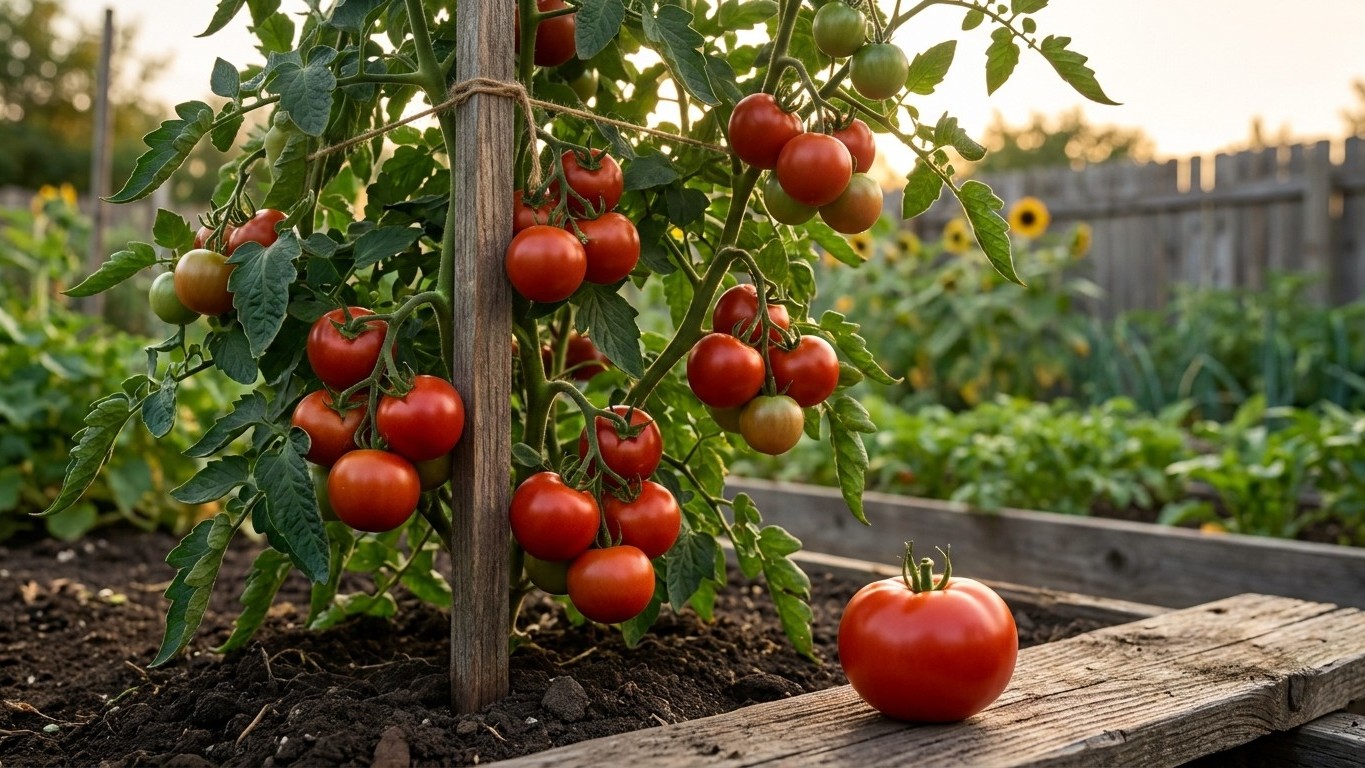

Rebelski is an indeterminate slicing tomato that reaches harvest in about 75 days from transplant, sets 7-8 oz red fruit built for sandwiches and salads, and carries one of the broader disease-resistance packages available in a slicing variety. Whether it ripens on schedule where you garden has less to do with the catalogue number and more to do with how you count your own frost-free window. Here’s what actually decides the outcome, and how to grow the plant once you’ve made that call.
What Brandywine actually is

Rebelski is an indeterminate tomato, meaning the vine keeps growing and setting fruit until frost stops it rather than ripening in one flush and quitting. That single fact drives most of the support decisions below: an indeterminate plant left on a short cage will topple under its own weight by midsummer, so a tall cage or a stake is not optional here, it’s the baseline.
The catalogue lists 75 days to maturity, and that figure is counted from transplant, not from the day you sowed seed indoors. If you started seed 6 weeks before your last frost, the 75-day clock only begins once the seedling goes into the ground outside. Confusing the two bases is the single most common reason a gardener thinks a variety “ran late” when it actually ran on schedule.
The fruit itself runs 7 to 8 ounces, red-skinned, and is graded for slicing rather than sauce or paste work, so this is a sandwich-and-salad tomato, not a canning one. The catalogue description credits it with combining flavor, texture, presentation, and strong plant vigor, which in practical terms means a productive vine that also produces fruit worth putting on a plate, rather than a heavy cropper with mediocre eating quality.
Where it ripens in time, and where it is a gamble
The arithmetic that matters is simple, even though the answer changes by ZIP code. Start with your local frost-free window (the number of days between your average last spring frost and your average first fall frost). Subtract roughly two weeks, because tomato roots stall in cold soil and most gardeners wait until the ground has warmed before transplanting, even after the air frost risk has passed. From what remains, subtract the 75 days Rebelski needs to reach first ripe fruit. Whatever is left over is your harvest cushion, the number of days you actually get to pick before the vine runs into fall frost again.
This page does not have station-level frost-date figures on hand to plug into that equation for specific cities, so the honest move is to point you to where those numbers actually live rather than guess at them. NOAA’s National Centers for Environmental Information publishes climate normals, including average first and last frost dates, for individual weather stations across the country, and finding the one nearest you takes a few minutes online. Once you have that number, the math above is yours to run.
What can be said without station data is the shape of the problem. A frost-free window under about 100 days leaves very little cushion once you subtract the soil-warming fortnight and the 75-day clock, and a grower in that situation is racing the calendar rather than coasting through it. A window well past 150 days turns the same math into a comfortable margin, with weeks of picking time rather than days. The variety itself doesn’t change between those two gardens. The number of days on either side of it does, and that’s the whole calculation.
One practical shortcut: if your frost-free window, minus the two-week soil-warming buffer, comes out anywhere close to 75 days, treat Rebelski as tight rather than comfortable. Starting seed a week earlier indoors, or using row cover to push the transplant date up, can turn a marginal window into a workable one without changing anything about the plant itself.
The two ways a season goes wrong
A long frost-free window on paper doesn’t guarantee a good season, because two limits sit inside that window that a frost table can’t show. The first is a cold-temperature problem that shows up at both ends of a short northern season: tomato flowers fail to set fruit once nighttime temperatures drop below 50°F, regardless of how many frost-free days remain on the calendar. A region can have technically adequate days-to-maturity room and still lose early or late fruit set to cool nights, which is a separate issue from frost itself.
The second limit sits at the opposite end of the thermometer. Once daytime temperatures climb above roughly 86°F, tomato pollen becomes sterile and flowers drop without setting fruit, which is why growers in hot climates typically don’t try to run one continuous season through the middle of summer. Instead they plant a spring crop that finishes before the heat peaks, then a second planting in late summer that ripens after temperatures ease off in fall.
For a variety carrying a 75-day maturity, the summer heat gap tends to be the more relevant risk. That’s a mid-length season, long enough that a single spring planting in a hot-summer region will often run straight into the sterile-pollen window before finishing its full harvest, making a split spring-and-fall approach worth planning for. Gardeners in shorter, cooler-summer regions should watch the 50°F night threshold at both ends of the season instead, since that’s the limit more likely to bite before frost ever does.
What it resists, and what it does not
The published resistance package on Rebelski is graded High across every line the catalogue lists, and it’s worth naming exactly which diseases that covers rather than treating “disease-resistant” as one vague label:
- Powdery Mildew (High)
- Verticillium Wilt (High)
- Tobacco Mosaic Virus (High)
- Fusarium Wilt, races 1 and 2 (High)
- Fusarium Crown and Root Rot (High)
- Leaf Molds A through E (High)
High resistance is not immunity. A plant with high resistance to Verticillium Wilt can still show symptoms under heavy soil pressure or stress, though it will typically handle exposure far better than a susceptible variety planted in the same bed. None of these ratings are described as intermediate here, which matters because intermediate resistance only slows a disease’s progress rather than blocking it, and the two grades shouldn’t be treated as interchangeable when deciding how much risk a garden can carry.
What the catalogue does not list matters just as much. There is no published resistance here for early blight, late blight, Septoria leaf spot, or bacterial spot, all common tomato problems in humid climates. Gardeners battling those specific pressures should not assume Rebelski’s strong resistance sheet covers them, because it doesn’t, and treating an unlisted disease as covered is how a season gets lost to something the plant was never bred to fight off.
Growing it without the usual mistakes
Because Rebelski is indeterminate, the support plan has to account for a vine that keeps climbing and fruiting until frost rather than finishing in one push. A short tomato cage designed for a compact determinate variety will not hold this plant upright through a full season; a tall stake driven deep, or a heavy-gauge cage built for indeterminate growth, is the baseline rather than an upgrade. Spacing needs to give that mature vine room too, since a crowded row on an indeterminate variety turns into a tangled mass by August that’s hard to harvest and slow to dry after rain.
Feeding follows the same indeterminate logic. Nitrogen pushed too heavily late in the season keeps driving leafy growth at the expense of fruit set, so easing off nitrogen once the first clusters are sizing up, and leaning on potassium instead, keeps the plant’s energy pointed at fruit rather than foliage. This matters more on an indeterminate vine than a determinate one, because the plant has months left to overcorrect into vegetative growth if fed like a young seedling all season long.
The timing mistake specific to this variety is treating the 75-day figure as a finish line rather than a starting gun. Because the plant is indeterminate, first ripe fruit at day 75 is the beginning of a harvest window that continues for weeks, not the end of the crop. Gardeners who plan their season around a single “harvest week,” the way they might for a determinate variety that ripens in one flush, end up leaving fruit on the vine into fall or missing the extended picking window this variety is actually built to deliver.
Common questions
Is Rebelski a determinate or indeterminate tomato?
Indeterminate. The vine continues growing and producing fruit until frost, rather than ripening in one concentrated flush the way a determinate variety does, which is why it needs a tall cage or stake rather than a short one.
How many days does Rebelski take to ripen?
About 75 days, counted from the date of transplant into the garden, not from the date you sowed seed indoors. Confusing the two bases is a common reason gardeners misjudge whether the variety is running on time.
What diseases does Rebelski resist?
The catalogue lists high resistance to Powdery Mildew, Verticillium Wilt, Tobacco Mosaic Virus, Fusarium Wilt races 1 and 2, Fusarium Crown and Root Rot, and Leaf Molds A through E. It carries no published resistance to early blight, late blight, Septoria leaf spot, or bacterial spot.
Can Rebelski be grown in a hot summer climate?
It can, but growers in regions where daytime temperatures regularly exceed 86°F should expect a gap in fruit set during the hottest weeks, since pollen becomes sterile above that threshold. Running a spring planting and a separate late-summer planting, rather than one continuous season, is the usual workaround in those climates.