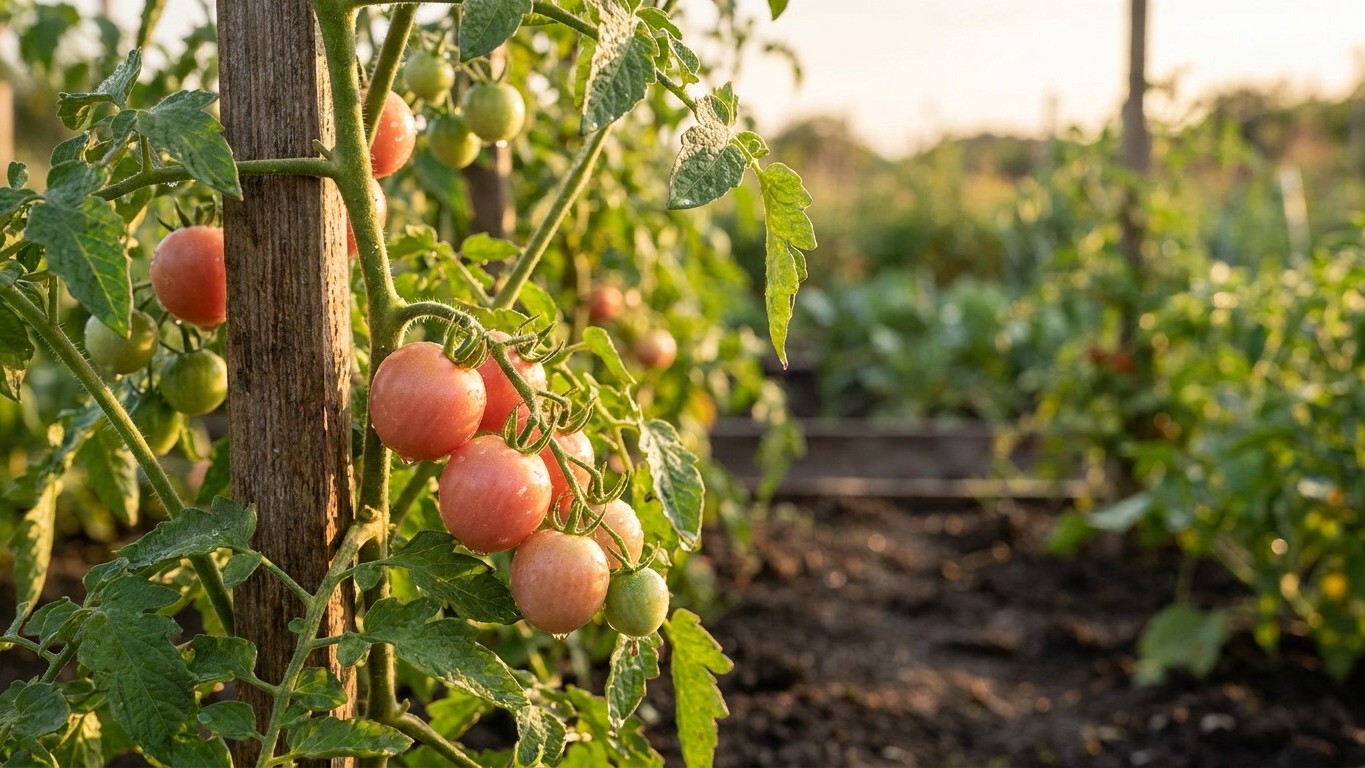

The Sunpeach is a pink-fruited cherry tomato built for salads and snacking, and it reaches harvest in about 60 days counted from transplant. For most of the country that number leaves a comfortable cushion before frost, but the margin shrinks fast in short-season regions and the plant has its own limits that a maturity date won’t show you.
What Brandywine actually is

Start with the numbers that decide whether this plant fits your garden before anything else. Sunpeach is a cherry tomato, pink-skinned, with fruit running 15 to 20 grams, small enough for a single bite and light enough that a full cluster won’t bend a stem to the ground. Days to maturity is listed at 60, and that figure is measured from transplant, not from the day you sowed seed indoors. That distinction matters more than people think: if you start counting from germination you can misjudge your harvest window by three to four weeks, which is exactly the kind of error that turns a comfortable season into a frost race.
The habit is indeterminate, meaning the vine keeps growing and setting fruit until frost cuts it down, rather than stopping after one flush like a determinate plant. That has a direct consequence for the garden: it needs a tall cage or a stake, and it needs one from the start, not added later once the vine has sprawled. Left unsupported, an indeterminate cherry tomato turns into a tangled mat on the ground, and fruit sitting on damp soil is fruit lost to rot and slugs.
In the kitchen the fruit is described as sweet, growing on a plant that’s both productive and crack-resistant, which suits its intended use: salads and snacking, eaten whole rather than sliced or cooked down. That crack resistance is worth noting for anyone who’s grown cherry tomatoes near an irrigation line or through an uneven rain pattern, since splitting after a heavy watering is one of the most common complaints with small-fruited varieties.
Where it ripens in time, and where it is a gamble
A 60-day maturity window is short by tomato standards, and that’s the whole story here: this variety is built to work almost everywhere a tomato can be grown at all, with the tightest margins showing up only in the shortest-season pockets of the country.
The arithmetic a gardener needs is simple, and it’s worth doing by hand rather than trusting a seed packet’s optimism. Take your local frost-free window, the number of days between your last spring frost and your first fall frost. Subtract roughly two weeks at the start, because tomato roots don’t do much work until soil temperature climbs into the 60s Fahrenheit, so setting transplants out the day after the “last frost” date rarely gains you anything real. Subtract the 60 days to maturity from that adjusted start. Whatever is left is your picking window, the stretch of time you actually get to eat fruit rather than just watch it develop.
In a region with a frost-free season stretching close to six months, that arithmetic leaves months of harvest after the first ripe fruit, plenty of room for the vine to keep cropping right up to fall frost, which suits an indeterminate plant that never really stops setting new trusses. In a region where the frost-free window runs closer to three months, the same math gets tight: two weeks lost to soil warm-up, 60 days to first ripe fruit, and what’s left might be four to six weeks of actual picking before the vine runs out of season. That’s still workable, since 60 days is short compared to many beefsteak types that need 80 or 90, but it leaves far less room for a cool, wet spring that delays transplanting or a slow-to-warm early summer.
No specific frost-date station data is cited here, and none should be invented. The honest advice is to pull your own area’s average last-spring-frost and first-fall-frost dates from a source you trust locally, such as your county extension office, and run the subtraction above with your own numbers. A gardener in a northern valley and a gardener forty miles away on a warmer slope can have frost windows that differ by two or three weeks, and that difference decides whether this variety gives you a long, easy season or one where every week of delay costs a chunk of your harvest.
The two ways a season goes wrong
A long frost-free window doesn’t guarantee a good tomato season, and that’s the gap a maturity date can’t fill. Two separate limits sit underneath the calendar, and neither one shows up when you’re just counting days to frost.
The first is accumulated warmth. Some regions have a technically long frost-free season that stays cool through much of it, coastal and high-elevation areas especially, where nights routinely dip below 50°F even in summer. Tomato flowers won’t set fruit reliably below that threshold, no matter how many frost-free days remain on the calendar. A vine can sit and bloom for weeks without producing anything to show for it if nighttime temperatures don’t cooperate.
The second limit runs the opposite direction. Above roughly 86°F, tomato pollen turns sterile, and fruit set stalls out through the hottest stretch of summer. This is why growers in hot climates plan around two shorter seasons, a spring crop that finishes before the worst heat and an autumn crop planted once temperatures ease back down, rather than expecting one continuous harvest from May through October.
For Sunpeach specifically, the short 60-day maturity works in the plant’s favor against both limits. It’s fast enough to squeeze a full harvest into a cool-summer window before nights get too warm to matter, and fast enough to fit a compact spring crop ahead of a hot midsummer lull, with time left for a second planting once temperatures drop back into range in early fall. The variety’s real vulnerability leans toward the cold-night problem in short, cool seasons more than the heat-sterility problem, simply because its quick timing gives it less exposure to a long midsummer heat stretch than a slower-maturing beefsteak would face.
What it resists, and what it does not
Published disease resistances for this variety cover two things, and it’s worth being precise about what each one means. Sunpeach carries high resistance to Tomato Mosaic Virus, and high resistance to Leaf Molds A through E. Both are graded as high, not intermediate, which is a real distinction: intermediate resistance means a plant slows a disease’s progress and often produces a usable crop despite some symptoms, while high resistance means the plant fends off that disease far more effectively under normal pressure. Calling an intermediate rating “resistant” without qualification is the kind of shortcut that costs a gardener a crop they thought was protected.
Just as important is what isn’t on this list. No resistance is published here for early blight, late blight, fusarium wilt, verticillium wilt, or bacterial spot, some of the most common problems that hit home tomato patches across the country. That doesn’t mean the plant is defenseless against them, only that no catalogue-graded resistance protects against them. In practice this means the usual precautions still apply: rotate tomatoes away from last year’s bed, avoid overhead watering that splashes soil-borne spores onto lower leaves, and stake the vine so its foliage isn’t sitting in still, damp air near the ground.
The two resistances it does carry line up well with its cherry-tomato role. Leaf mold thrives in the humid, lower-airflow conditions common in crowded garden beds or high tunnels, exactly where a heavily fruiting, non-stop-growing indeterminate vine tends to end up by midsummer. Mosaic virus resistance matters most for growers who handle plants a lot while pruning and tying, since that’s a common way the virus spreads from plant to plant on hands and tools.
Growing it without the usual mistakes
Because this is an indeterminate plant, the growing plan looks different from a determinate variety that ripens in one flush and finishes. There’s no single harvest window to plan around here; instead, expect a steady trickle of ripe cherries from first fruit until frost takes the vine down, which means ongoing maintenance rather than a one-time push.
Support has to go in early, before the plant needs it, since retrofitting a cage around a sprawling six-foot vine mid-season damages roots and stems. A tall stake or cage set at transplant time, with ties added every foot or so of new growth, keeps the fruit off the ground and the foliage open enough for air to move through, which matters given the leaf mold pressure this variety is bred to withstand.
Feeding should taper off once the plant is fruiting heavily rather than continuing at the seedling-stage rate. Too much nitrogen late in the season pushes leafy growth at the expense of fruit set and can worsen the exact crowding problem that invites leaf mold in the first place. A light, balanced feed through midsummer, tapered further as harvest peaks, tends to work better than steady heavy feeding straight through.
The mistake this variety’s short timing invites is complacency about succession. Because 60 days feels fast, it’s tempting to treat one planting as the whole season’s tomato supply. But an indeterminate plant with a productive, crack-resistant fruit like this one rewards a second wave of picking discipline: harvesting every few days rather than letting cherries accumulate on the vine, since a heavy, unpicked cluster slows new fruit set and, given the plant’s tendency to keep producing until frost, that slowdown compounds over a long season.
Common questions
Is Sunpeach a determinate or indeterminate tomato?
Indeterminate. The vine keeps growing and setting fruit until frost, so it needs a tall cage or stake set up from the start rather than added later.
How many days does Sunpeach take to ripen?
About 60 days, counted from the day you set transplants in the ground, not from when seed was sown indoors.
Does Sunpeach resist tomato diseases?
It carries high resistance to Tomato Mosaic Virus and high resistance to Leaf Molds A through E. No resistance is published for blights or wilts, so normal rotation and airflow precautions still apply.
What does Sunpeach fruit taste like, and how is it best used?
The fruit is described as sweet, growing on a plant that’s productive and crack-resistant, with fruit weighing 15 to 20 grams. It’s suited to salads and snacking rather than cooking down or slicing.