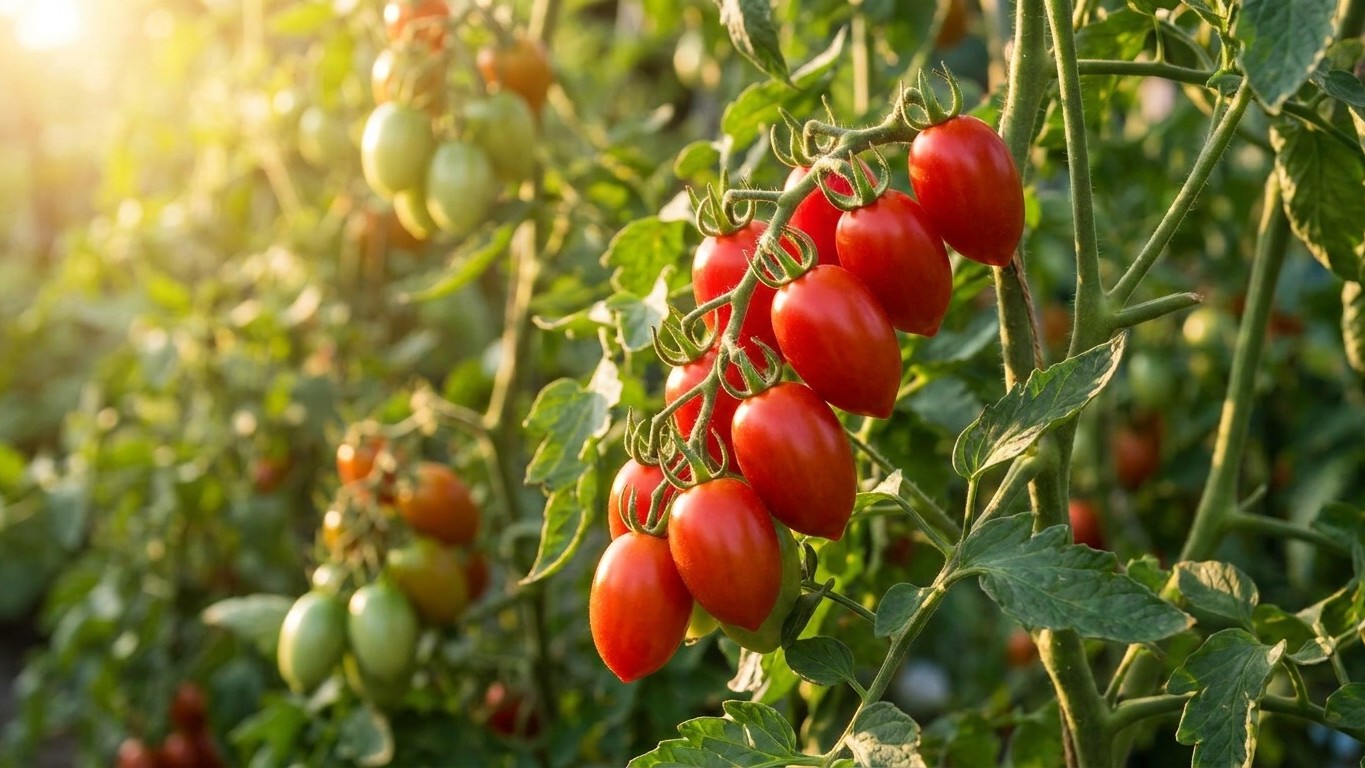

Valentine is a red grape tomato that reaches harvest about 55 days after you set transplants in the ground, on a vine that keeps growing and setting fruit until frost. In most of the country that window is comfortable; in the shortest-season gardens and the hottest mid-summer stretches, the math and the weather each ask something different of the grower.
What Brandywine actually is

Before anything else, know what kind of plant you’re dealing with. This is a grape tomato, red-skinned, bred for salads and snacking rather than slicing or sauce. The habit is indeterminate: the vine does not stop at a set height or ripen one flush and quit. It keeps climbing, branching, and fruiting for as long as the weather allows, which is the single fact that decides how you stake it, how far apart you plant it, and how long you keep feeding it.
The catalogue figure to build a season around is 55 days to maturity, counted from transplant, not from the day you sowed seed indoors. That distinction matters more than it sounds. Seed-to-transplant time for tomatoes typically runs four to seven weeks under lights before the plant ever meets outdoor soil, so the true span from seed to first ripe fruit is considerably longer than the 55-day figure alone suggests. Gardeners who forget this often think a variety is running late when it is actually running exactly on schedule.
On flavor and yield, the catalogue description is blunt: massive early yields, deep red color, and unusually rich flavor for a grape tomato. That combination, fast maturity plus an indeterminate habit, is why this variety tends to produce a steady, heavy stream of small fruit rather than a single dramatic flush.
Where it ripens in time, and where it is a gamble
The 55-day figure only means something once you subtract it from what your own garden actually gives you. Start with your local frost-free window, the stretch between your average last spring frost and your average first fall frost. That number is specific to your county and, ideally, to a weather station near you rather than a state-wide average; two towns forty miles apart can differ by two or three weeks in either direction.
From that window, subtract the time your soil needs to warm before a tomato transplant will actually grow instead of sulking. Cold, wet soil below roughly 60F stalls root development even if the air feels mild, so most gardeners hold off transplanting for one to two weeks after their official last-frost date to let the ground catch up. That subtraction alone removes a meaningful chunk of a short season before the plant has grown a single leaf outdoors.
What’s left after that is the runway you actually have for the plant to reach maturity and then keep producing. Subtract the 55 days, and whatever remains is your harvest window, the stretch during which this indeterminate vine can keep setting and ripening fruit before fall frost shuts it down. In a garden with a long, mild fall, that remaining window might be two or three months of continuous picking. In a garden where the frost-free season itself barely clears 100 days, the math gets tight: 55 days to first fruit can leave only a few weeks of harvest before the season closes, which is a very different outcome from a long-season garden where the same plant might produce for four months straight.
Exact frost dates for a specific city are not published here, and they shouldn’t be guessed at. The only reliable way to run this arithmetic for your own address is to look up your local average frost dates and do the subtraction yourself, county by county if you’re near a climate boundary, rather than trusting a regional rule of thumb. What the 55-day figure tells you is how much runway you need at a minimum; whether your address has that runway is a separate, local question.
Because the maturity window is short by tomato standards, this variety tends to sit on the comfortable side of that arithmetic for the large majority of the country, gardens that manage even a modest three-and-a-half to four month frost-free stretch. It’s the handful of the shortest-season gardens, at higher elevation or in the far north, where the margin narrows and every week of delayed transplanting starts to matter.
The two ways a season goes wrong
A long frost-free window on paper does not guarantee a good tomato season, and a frost table cannot show either of the two problems that actually undo a crop.
The first shows up in cooler regions where the calendar window looks generous but the days themselves never get warm enough. Tomatoes need not just frost-free days but a certain accumulation of real warmth to set fruit, and nights that regularly dip below 50F will cause blossoms to drop or fail to set at all, regardless of how many frost-free days remain on the calendar. A season can be long and still cold in the way that matters to a tomato flower.
The second problem runs the opposite direction. In much of the South, once daytime temperatures climb past roughly 86F, tomato pollen becomes sterile and fruit set stalls out even though the vine keeps growing and flowering. That’s why growers in hot climates typically plan two separate cropping windows, a spring planting that finishes before the worst of summer heat and a second planting in late summer that fruits into a milder fall, rather than expecting one plant to produce straight through July and August.
For a fast, 55-day variety like this one, the cold-accumulation problem matters less than it would for a 90-day beefsteak, because the plant reaches maturity and starts producing before a short cool season has much chance to stall it. The bigger practical risk here is the southern heat gap: since the vine is indeterminate and keeps flowering all summer, a mid-season stretch of 90-plus-degree days will simply pause fruit set on an otherwise healthy, actively growing plant, which is a normal and temporary condition rather than a sign of disease.
What it resists, and what it does not
The published disease resistance for this variety is narrow, and it’s worth being precise about it rather than rounding up. The catalogue rating is Early Blight, Intermediate. That single rating is the entire published resistance profile, and nothing else appears on the list.
Intermediate resistance is not the same thing as high resistance, and it is a long way from immunity. An intermediate rating means the plant can slow the progress of early blight symptoms, buying time and reducing severity, not that the disease won’t appear on the leaves at all. Gardeners who treat “resistant” as a synonym for “won’t get it” tend to skip the basic sanitation, watering, and airflow practices that actually keep early blight in check, and then lose the lower leaves to it anyway by midsummer.
More important than what’s listed is what isn’t. There is no published resistance here to late blight, Fusarium wilt, Verticillium wilt, or Septoria leaf spot, the other diseases that commonly hit tomato plantings in home gardens. In practice, that means this variety carries no catalogue-documented defense against any of those four, and a grower in a region prone to them should plan crop rotation, mulching, and morning watering as if planting a variety with no listed resistance at all, because for those specific diseases, that’s exactly the situation.
Growing it without the usual mistakes
Because the habit is indeterminate, this plant needs support built for a season, not for a single flush. A short tomato cage sized for a determinate bush will be overwhelmed within weeks; a tall stake, at least 6 feet, or a sturdy cage of similar height, set in place at transplanting rather than added later, saves the trouble of tying down a sprawling vine after the fact. Space plants roughly 24 to 36 inches apart to give that continued growth room for airflow, which also helps limit the early blight the variety only partly resists.
The most common mistake with a fast, heavy-yielding indeterminate variety is treating it like a determinate: gardeners see the first big flush of small red fruit around the 55-day mark, assume the show is largely over, and ease off watering and feeding. That’s backwards here. The vine is just getting started, and it will keep flowering and setting fruit until frost as long as it has consistent moisture and nutrients. Keep a steady watering schedule to avoid the cracking that irregular moisture causes in thin-skinned grape tomatoes, and continue a balanced feeding program through midsummer, tapering off only as the plant approaches its final weeks before fall frost, when redirecting energy into ripening existing fruit matters more than pushing new growth.
Because the fruit is small and prolific, plan on picking every two to three days once the plant hits its stride. Letting grape tomatoes sit too long on an indeterminate vine doesn’t just risk splitting; it also slows the plant’s overall output, since a vine loaded with ripe fruit tends to shift energy away from setting new blossoms.
Common questions
Is 55 days to maturity counted from seed or from transplant?
From transplant. Add the weeks the seedling spent growing indoors before it went into the garden to get the true seed-to-harvest timeline.
Does this variety need a cage or a stake?
Either works, but it needs to be tall, at least 6 feet, and set up at planting time, because the indeterminate habit means the vine keeps growing all season rather than stopping at a fixed size.
Will it survive in a short-season northern garden?
The 55-day maturity gives it more margin than most tomato varieties, but the exact answer depends on your local frost-free window. Subtract soil warm-up time and the 55 days from your own frost dates to see how much harvest window remains.
Is intermediate resistance to early blight enough to skip fungicide or rotation?
No. Intermediate resistance slows the disease, it doesn’t prevent it, and the variety has no published resistance to late blight, Fusarium, Verticillium, or Septoria leaf spot, so standard sanitation and rotation practices still matter.