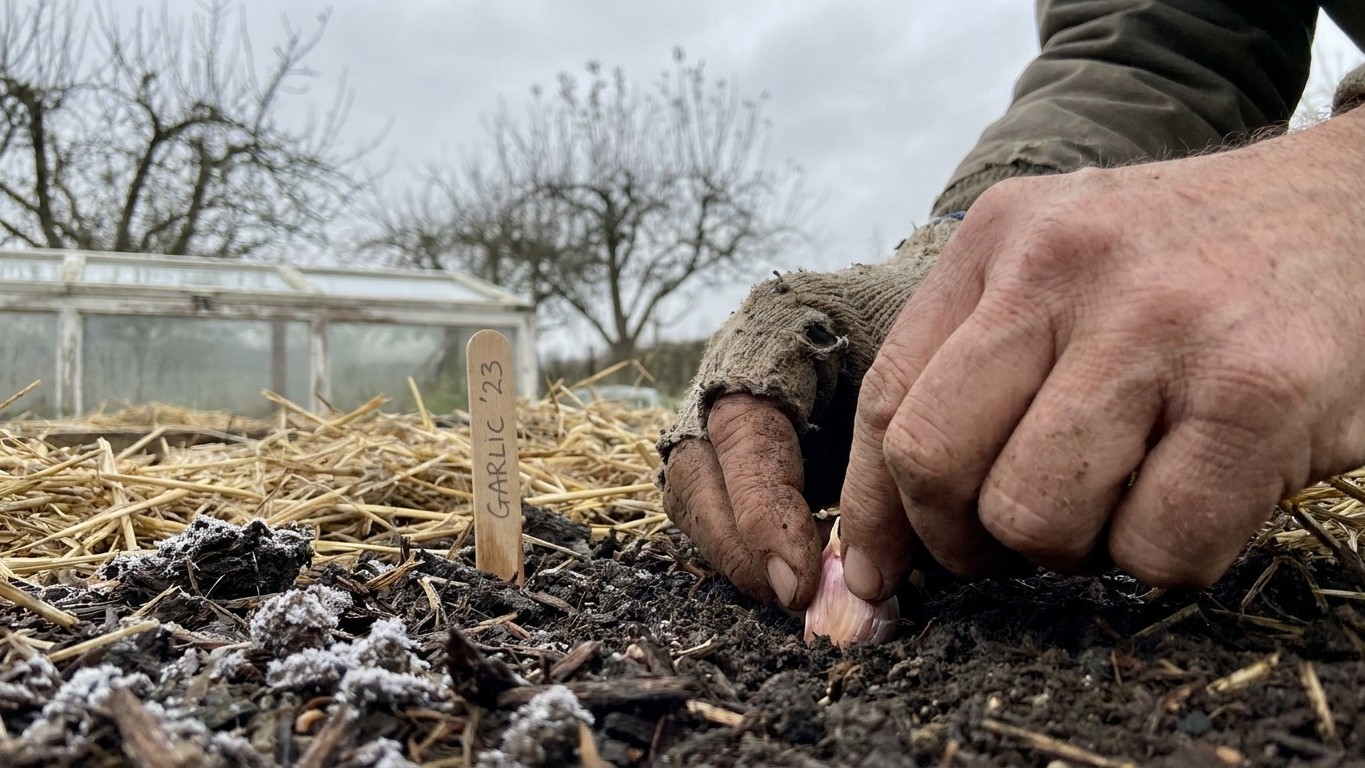

Garlic and shallots still go into workable ground across most of Georgia in December, dormant fruit trees and canes can be planted bare-root, and cold frames keep hardy greens producing. Almost nothing else goes into open soil this month statewide, since the state’s first fall frost has already arrived by the time December opens.
What goes in the ground in December

Soil temperature decides what survives this month, not the date on the wall. By December, Georgia has already crossed its first fall frost window of November 13 to December 1 (NOAA NCEI, 1991-2020 Climate Normals), so the ground has cooled and stayed cool across the state’s 6a-9b hardiness range. That range matters here: a gardener in the north Georgia mountains, closer to 6a, is working with harder, colder ground than someone on the coastal plain near 9b, where soil rarely locks up hard.
Garlic and shallot cloves are the safest bet almost everywhere in the state this month, as long as the bed isn’t waterlogged or frozen solid. Push them in, mulch, and let winter do the vernalizing. In the warmer southern and coastal zones, onion sets and fava beans can still go in for a late-winter harvest, something that would rot in colder, wetter northern soil.
Beyond the alliums, this is a month for structures and dormancy rather than open-ground sowing. Cold frames and low tunnels let a gardener tuck in transplants of spinach, mache, or lettuce that would otherwise stall or die exposed. Bare-root and dormant plantings, fruit trees, blueberry bushes, roses, and cane fruit like blackberries and raspberries, go in now precisely because the plant isn’t pushing new growth that a hard freeze could kill.
One trick worth borrowing from older kitchen gardens: forcing. Dig chicory roots or rhubarb crowns, pot them, and force them in a dark, warmish spot indoors for tender greens or early stalks weeks ahead of anything the garden could produce outside. It isn’t glamorous, but it’s real food from a month that otherwise offers little from open ground.
What to start under cover
Counting backward from the last spring frost, which NOAA NCEI puts at March 11 to March 29 depending on location within the state, tells you more than any calendar date. Most warm-season seedlings like tomatoes and peppers need six to eight weeks indoors before they’re ready to go outside after that frost window closes, which puts their start date in late January or February, not December. Starting them now sets up exactly the failure mode to avoid: leggy, rootbound plants sitting in small pots far too long before the weather cooperates.
December is better suited to slow starters. Onions and leeks grown from seed need ten to twelve weeks before they’re transplant-ready, so a December sowing under lights or in a heated cold frame lines up well with an early spring transplant date, especially in the northern part of the state where that March 11 end of the frost window applies. In the warmer south, where the frost window can run closer to March 29, there’s a little more slack, but not much.
Broccoli and cabbage for an early spring bed fall into the same eight-to-ten-week bracket. Start them too early and they’ll be tired and stunted by transplant time; start them too late and there won’t be enough cool weather left before summer heat arrives, especially in the southern half of the state where spring turns to summer fast. The safest habit is reading the seed packet’s “weeks before transplant” number and counting back from the frost date for your own county, not from December 1.
What is ready to pick
Outdoors, December harvests lean on crops that improve after a freeze rather than crops planted recently. Collards, kale, and turnip greens sweeten once frost breaks down starches into sugars, which is exactly why cooks across the state have always waited for a cold snap before harvesting them. Brussels sprouts firm up and taste better after the same exposure. Leeks, carrots, and beets can often stay in the ground under a thick mulch layer and get pulled as needed, even in the colder northern counties.
Cold frames extend this further, keeping spinach, lettuce, and mache pickable well past what open ground allows. Indoors, sprouts and microgreens fill the gap entirely, ready in one to two weeks from seed on a countertop, no frost tolerance required at all.
Stored crops need regular checking this month, not just at harvest. Winter squash, sweet potatoes, and stored onions should get a hands-on inspection every couple of weeks: press gently for soft spots, look for mold at the stem end, and pull anything starting to sprout or weep before it spreads rot to the rest of the bin. One squash with a soft patch left in a crate of a dozen can take down the whole batch within a week or two.
The jobs that matter this month
Pruning and structure
Dormant pruning is the headline job of December for a reason: cutting a fruit tree, grapevine, or blueberry bush while it’s fully dormant avoids the stress and disease risk that comes with pruning active growth. Apple and pear trees, cane fruit, and grapes are all fair game now. One exception worth flagging: shrubs and trees that bloom on old wood, like azaleas and camellias, already have next season’s flower buds set. Prune those now and the pruning shears take the spring flowers with them.
Soil, planning, and gear
Bare ground makes this the easiest month to pull a representative soil sample and send it to a lab, since there’s no active root mass or recent fertilizer skewing the results. Getting that test back before spring means amendments can be worked in on a real timeline instead of a rushed one. It’s also the month to sketch next season’s bed rotation on paper, order seed for varieties that tend to sell out fast once catalogs go live, turn the compost pile so cold weather doesn’t stall decomposition completely, and run a wire brush and a file over pruners, loppers, and shovel edges before they sit idle and rust.
Fencing and raised bed frames are worth a walk-around too. A loose board or a gap under a deer fence found now gets fixed on a mild afternoon; found in March, it costs a bed of seedlings.
What not to do in December
The most common December mistake in Georgia gardens is trusting the air instead of the soil. A run of 60-degree afternoons doesn’t mean the ground has warmed enough for tomato or pepper seed to germinate or for warm-season transplants to sit outside without stalling. Seeds rot in cold, damp soil long before they sprout, and transplants set out early simply wait, stunted, for a freeze that’s still coming.
A close second is uncovering cold frames or row covers too soon after a mild stretch. Tender new growth that pushed out during a few warm days gets killed outright when the next cold front rolls through, which in Georgia can happen within days of a warm spell, not weeks.
Fertilizing at the wrong moment wastes both money and plant health. Nitrogen applied to dormant lawns, trees, or shrubs pushes soft new growth that has no cold tolerance, and in winter rain that same nitrogen is more likely to leach past the root zone than get used. Hold feeding until growth actually resumes.
Finally, leaving root crops uncovered through a hard freeze without mulch invites splitting and rot rather than the sweetening a light frost provides. A few inches of straw or leaves over a carrot or beet bed makes the difference between a crop that holds and one that turns to mush.
Checking this against your own county
A statewide December guide is a starting point, not a substitute for local conditions. Georgia’s 6a-9b hardiness range and its frost windows shift by weeks between the mountains and the coast, and elevation alone can move a frost date by days within the same county.
| Region | Approx. USDA zone (within the state’s 6a-9b range) | Frost pattern |
|---|---|---|
| North Georgia mountains | Near 6a | Frost arrives earliest in fall, lingers latest in spring |
| Atlanta / Piedmont (NOAA reference station) | Mid-range | First frost Nov 13-Dec 1; last frost Mar 11-29 |
| Coastal Plain / South Georgia | Near 9b | Frost arrives latest in fall, ends earliest in spring |
For a county-specific check, the University of Georgia Extension office is the reliable next stop, along with the state’s own month-by-month Georgia planting calendar.
Common questions
Can I plant garlic in Georgia in December?
Yes, as long as the soil is workable and not waterlogged or frozen. Garlic cloves planted this month have the full winter to vernalize before spring growth.
Is it too late to start seeds for spring in December?
For slow growers like onions and leeks, no, this is close to ideal timing given their ten-to-twelve-week window before transplant. For tomatoes and peppers, yes, starting now leads to leggy, rootbound seedlings long before it’s safe to move them outside.
What vegetables can survive frost in Georgia gardens?
Collards, kale, turnip greens, and Brussels sprouts all tolerate frost well and often taste better after one. Carrots, beets, and leeks can stay in mulched ground and get harvested as needed.
When should I prune fruit trees in Georgia?
While they’re fully dormant, which typically covers December through the depths of winter. Avoid pruning shrubs like azaleas and camellias that bloom on old wood, since their flower buds are already set.