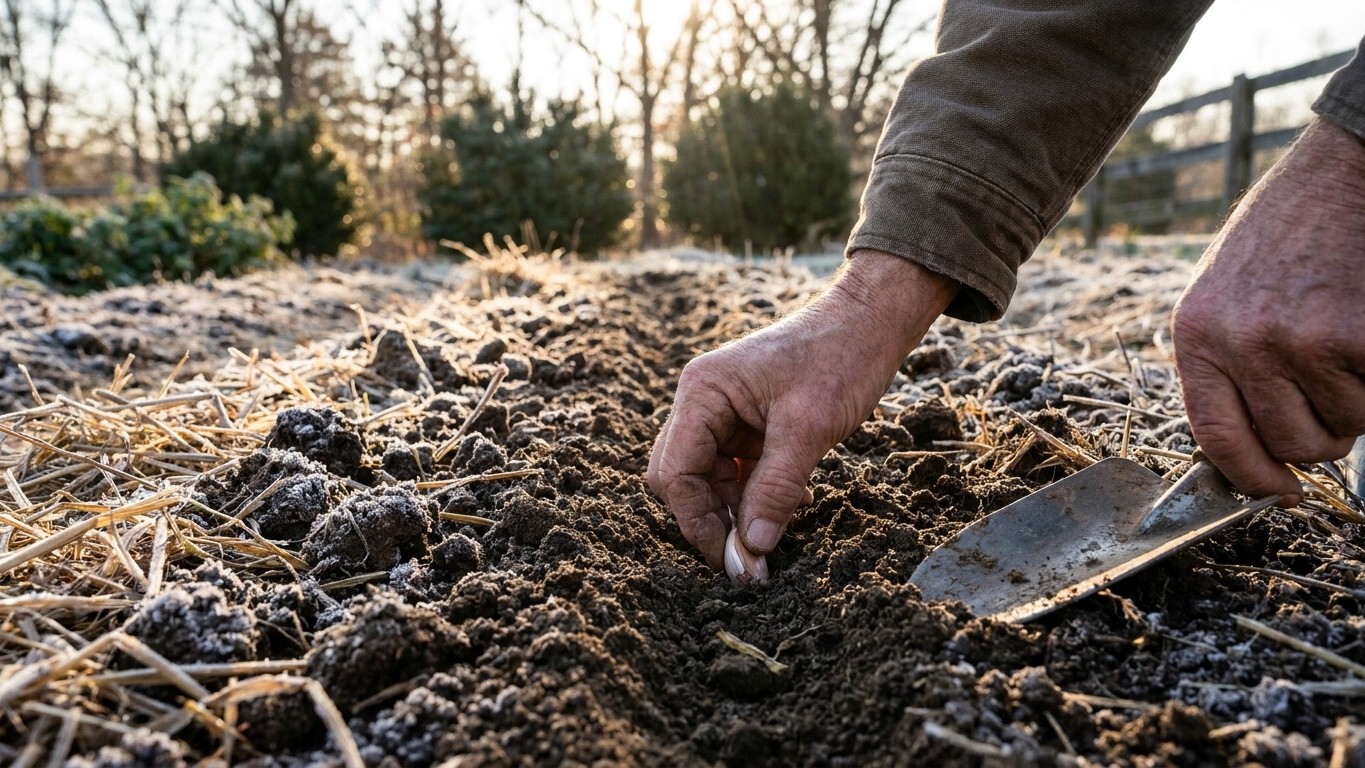

By December, Kentucky’s fall frost window (November 2 to November 12, per NOAA’s 1991-2020 Climate Normals) is weeks behind you, and the ground has already settled into winter dormancy. In that cold, nothing tender survives outdoors. What still makes sense: garlic and shallot cloves pressed into workable soil, cold frames and low tunnels holding hardy greens, and bare-root fruit stock going in while the ground isn’t frozen solid.
What goes in the ground in December

Soil temperature decides what lives here, not the date on the wall calendar. Kentucky sits in USDA hardiness zones 6a to 7a, a classification built on one number: the average coldest temperature a location sees in a typical winter. That’s cold enough to kill unprotected roots and seedlings outright, which is why the fall frost window closing in early-to-mid November already marked the end of open-ground planting for anything but the toughest crops.
Garlic and shallots are the exception, and December still works for them in most years, as long as the ground hasn’t locked up hard. Push cloves 2 inches deep, root end down, and mulch heavily with straw once the soil surface starts to crust. That mulch layer matters more than the exact planting date: it buffers the freeze-thaw cycles that heave cloves out of loose soil.
Bare-root fruit trees, brambles, and dormant perennials can also go in this month if the ground is workable, meaning it crumbles rather than compacts into mud. Cold frames and low tunnels extend the season for spinach, mâche, and claytonia sown earlier, and they’re really the only “planting” happening under glass or plastic right now. Indoors, forcing chicory roots for winter salad greens or forcing rhubarb crowns in a dark, cool basement gives the kitchen something fresh while the garden sleeps.
| Crop or task | Safe in December? | Why |
|---|---|---|
| Garlic, shallots | Yes, if ground is workable | Needs a cold period; roots establish before hard freeze |
| Bare-root trees, canes | Yes | Dormant, no leaf tissue to freeze |
| Cold frame greens (already established) | Yes, continued growth | Protected microclimate holds above lethal cold |
| Tomatoes, peppers, beans | No | Zone 6a-7a lows kill tissue outright |
| Direct-sown lettuce, spinach (new, unprotected) | No | Soil too cold for germination |
What to start under cover
Count backward from the spring frost window rather than forward from today. Kentucky’s last spring frost typically falls between March 24 and April 4. Onions and leeks are the slow growers that reward an early start: they’re often begun 10 to 12 weeks before that transplant-out date, which puts the seed-starting window somewhere between late December and mid-January depending on where in that March 24-April 4 range a given county tends to land.
That arithmetic is worth doing on paper for your own address rather than trusting a generic date. Take the earliest plausible frost-free date for your county, subtract 10 to 12 weeks, and that’s your seed-starting Saturday. Artichokes, which need a cold snap to trigger flowering later, are another slow crop some gardeners start indoors this month under lights.
The two ways this goes wrong are predictable. Start too early and seedlings sit under grow lights for three or four extra weeks, getting leggy and rootbound in cell trays never meant to hold a plant that long. Start too late, especially with onions, and the plants never build enough leaf mass before transplant to size up a decent bulb. Both mistakes trace back to the same root cause: treating the last-frost window as a single fixed date instead of the range it actually is.
What is ready to pick
Almost nothing new is coming out of open garden soil in December, and that’s the honest starting point. What’s still on offer are crops planted months ago and built to hold through cold: kale, collards, and leeks that shrug off hard frosts and often taste sweeter for it, since cold converts stored starches to sugars in those leaves.
Cold frames and low tunnels are doing real work here. Lettuce, spinach, and mâche started in September or October keep producing slowly under cover, and a quick check after a cold snap tells you whether the frame held: leaves that are wilted but spring back within an hour of warming are fine, leaves that stay limp are done.
Indoors, sprouts and microgreens fill the gap. A jar of sprouting seeds on the counter or a tray of pea shoots under a window gives fresh greens in under two weeks, no garden required. This is also the month to walk the root cellar or basement shelf and check stored squash, potatoes, and onions by hand. A squash with a soft spot or a sweet smell should be used immediately, not left to season the whole bin, and any onion pushing a green sprout is telling you it’s done storing and ready to cook.
The jobs that matter this month
Dormant pruning tops the list, and December is squarely inside the window for it. Apple, pear, and stone fruit trees, along with brambles like blackberries and raspberries, are leafless and their branch structure is easy to read. Cutting out crossing limbs, water sprouts, and damaged wood now heals cleaner than pruning during active growth, and it happens before sap starts moving in late winter.
Seed ordering belongs on this month’s list too, and it has a real deadline attached: popular varieties, especially heirloom tomatoes and specific onion types, sell out of seed companies’ stock by late winter. Ordering now means the seed is in hand and ready for that backward-count start date in Section 2, instead of waiting on a backordered packet in February.
Soil testing is cheap insurance done now rather than in spring, when everyone else is also mailing samples in and results back up. A basic test through the local extension office tells you pH and major nutrient levels while there’s time to amend before the next planting season, since lime especially needs months to adjust soil chemistry.
Turn the compost pile if it hasn’t frozen solid, since a slower breakdown all winter still beats no breakdown at all. Clean and sharpen pruners, shovels, and hoes before they sit unused for weeks; rust and dull edges are far easier to fix now than to discover mid-task in spring. Walk fence lines and raised bed frames for winter damage, and fix what’s loose before snow load or ice makes it worse.
What not to do in December
The classic mistake is trusting a warm afternoon over the calendar of freeze probabilities behind it. A 60-degree day in the middle of a Kentucky December doesn’t mean the soil has warmed to match, and any tender transplant set out during that warm spell is gambling against a freeze that’s still statistically likely within days.
Uncovering cold frames and low tunnels too early after a mild stretch is the same mistake in reverse. The protected air inside has adjusted to that warmth, and pulling the cover off exposes acclimated plant tissue to a temperature swing it isn’t ready for when the cold returns, which it will.
Feeding nitrogen this late in the season is another common error, and it works against the plant rather than for it. Dormant trees and perennials aren’t building new growth right now, so nitrogen applied in December either leaches away with winter rain before spring roots can use it, or worse, it pushes a flush of tender new growth right before a hard freeze kills it back. Hold nitrogen until active growth resumes, and spend December’s fertility budget on compost and soil testing instead.
Working soil while it’s wet or partly frozen does lasting damage too. Walking or digging in compacted, saturated ground crushes the pore structure that roots and water need, and that damage can take a full season to repair. If a bed won’t crumble easily in your hand, leave it alone until it dries or thaws.
Checking this against your own county
A single statewide frost window is a starting point, not an instruction for a specific backyard. Elevation shifts, valley cold pockets, and the general difference between Kentucky’s warmer western counties and its higher, colder eastern hills can move real frost dates by two or three weeks in either direction from the statewide range. Urban areas like Louisville also run measurably warmer than the surrounding rural county, which shifts the reference dates further still.
The University of Kentucky Cooperative Extension Service is the right next stop for county-level guidance, including local planting calendars built from data closer to a specific address than any statewide range can offer.
Common questions
Can I still plant garlic in Kentucky in December?
Yes, as long as the soil is workable rather than frozen solid. Plant cloves 2 inches deep and mulch heavily with straw right after planting to buffer freeze-thaw cycles through winter.
What vegetables can survive a Kentucky winter outdoors?
Kale, collards, and leeks planted earlier in the season typically hold through Kentucky’s zone 6a-7a winters, especially with a layer of mulch or a cold frame for added protection.
Is it too late to start seeds indoors in December?
Not for slow growers like onions and leeks. Counting back 10 to 12 weeks from the last spring frost window (March 24 to April 4) puts their ideal indoor start right around late December to mid-January.
Why shouldn’t I fertilize my garden in December?
Dormant plants aren’t using nitrogen for new growth, so fertilizer applied now either leaches away in winter rain or triggers tender new growth that a hard freeze will kill back.