
February in Kentucky sits roughly six to eight weeks before the last frost window, which NOAA records as March 24 to April 4 for the Louisville area. That gap rules out nearly all direct outdoor planting. Garlic and shallots can still go into workable ground, and cold frames stretch the season for hardy greens, but the real action this month happens indoors: seed starting, dormant pruning, soil testing, and the planning that decides how the next few months unfold.
What goes in the ground in February

What decides whether you can plant
The calendar says February, but the ground doesn’t care what the calendar says. What decides whether anything can go into open soil is soil temperature and how far the date sits from the last spring frost window, which NOAA’s 1991-2020 climate normals for the Louisville area place between March 24 and April 4. That’s five to eight weeks out depending on where spring actually lands, and it rules out anything tender. Tomatoes, peppers, beans, squash: none of that touches open ground this month, full stop.
What can go in now
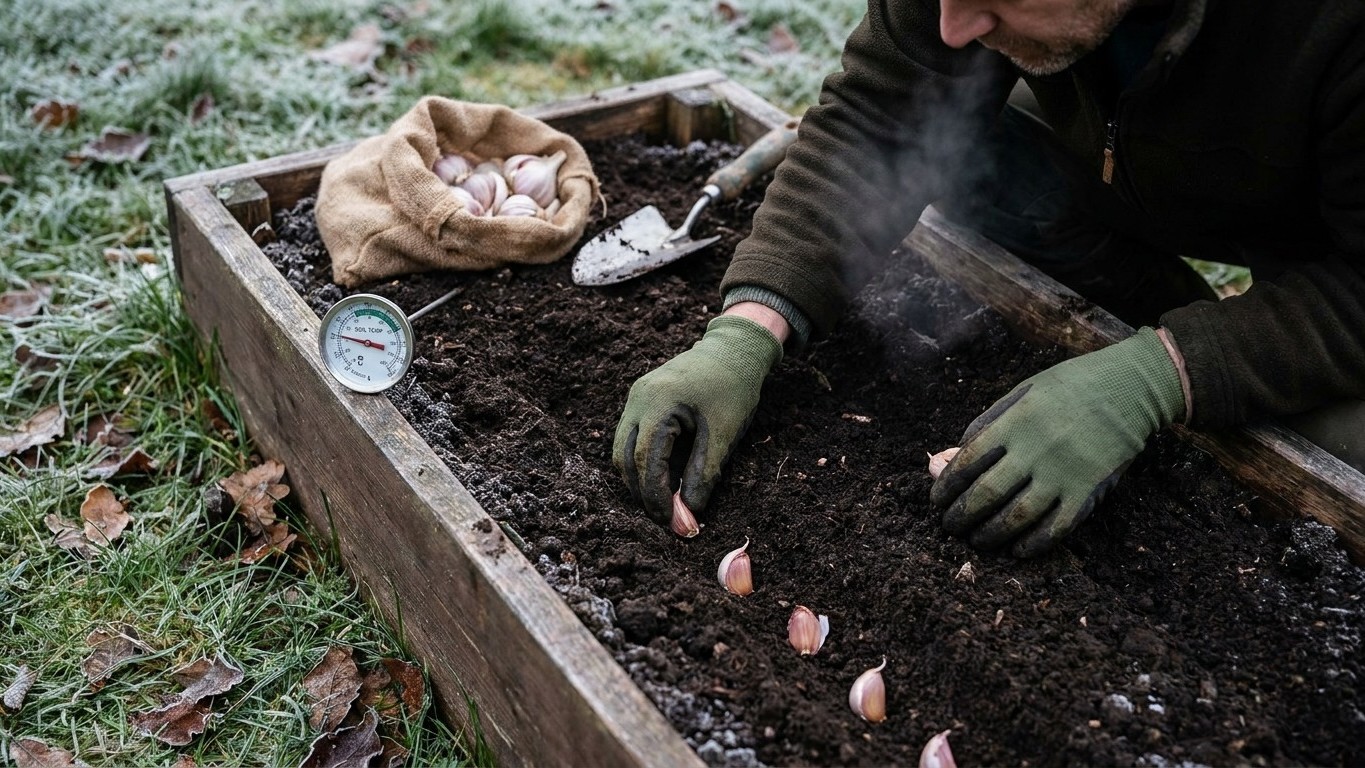
What’s left is the short list of crops built for cold soil. Garlic cloves and shallot bulbs can still be tucked into workable ground early in the month if fall planting didn’t happen, or if a mild spell has thawed the top few inches; both need cold exposure to trigger bulb formation later, so a late start isn’t fatal the way it would be for a summer crop. Bare-root fruit trees, brambles and grapevines can also go in while still dormant, provided the ground isn’t frozen solid or waterlogged from snowmelt.
Cold frames and low tunnels do the heavy lifting for anything green. Spinach, mache (corn salad), and claytonia tolerate the low light and cold nights under a frame far better than they’d survive in the open, and a frame started now often produces a harvest before outdoor beds are workable at all. Kale and collard transplants raised indoors can move into a cold frame toward the end of the month once daytime temperatures under the cover regularly climb above freezing.
Indoors, this is also the month to force rhubarb crowns or chicory roots for an early harvest, a trick that costs almost nothing and produces something to eat while the outdoor garden is still bare. None of this replaces spring planting. It just keeps something alive and growing while the frost window slowly closes the gap.
What to start under cover
Counting backward from frost
Seed starting this month is entirely about counting backward from the frost window, not forward from a fixed date on a seed packet. With the last spring frost falling somewhere between March 24 and April 4 for the Louisville area, a crop that needs ten to twelve weeks indoors before transplant should already be underway in early February. A crop needing six to eight weeks has more room to wait.
| Crop | Weeks needed indoors | Approximate start |
|---|---|---|
| Onions, leeks (from seed) | 10-12 weeks | Early February |
| Peppers | 8-10 weeks | Early to mid-February |
| Early cabbage, broccoli | 6-8 weeks | Mid to late February |
| Lettuce and other greens | 4-6 weeks | Late February |
Two ways to get it wrong
Two mistakes show up every year. The first is starting too early: seedlings that spend extra weeks under indoor lights before the ground is ready end up rootbound, leggy and stressed by the time they’re finally hardened off, and they rarely outperform a later, healthier start. The second is starting too late, particularly with onions and leeks, whose long timeline means a two-week delay can push transplanting past the point where the plants build enough size before summer heat sets in. When the count-back math is close, erring early beats erring late for these long-season crops.
What is ready to pick
What’s still in the garden
Little comes out of a Kentucky garden from open ground this month, and there’s no point pretending otherwise. What’s still there mostly survived rather than grew: kale, collards and leeks left in the ground under mulch or snow cover often taste better after hard cold, since the plant converts starches to sugars as a natural antifreeze. Pushing snow aside to check on them after a storm is worth doing, both to harvest and to make sure the crowns haven’t rotted from sitting in meltwater.
Cold frames change the math. Spinach, mache and other frame-grown greens planted the previous fall can still be cut lightly this month, as long as harvesting stays light enough that each plant keeps leaves to photosynthesize through the remaining cold weeks. Indoors, sprouts and microgreens fill the gap for anyone wanting fresh greens on a shorter timeline: mung beans, alfalfa, or a tray of pea shoots can go from seed to harvest in under two weeks, no outdoor space required.
What’s in storage
The other job this month is checking what’s already in storage. Squash stored over winter should get a hands-on inspection: any soft spots, mold at the stem end, or a sudden smell mean that squash needs to be used or discarded now, before it spreads to the rest of the batch. Potatoes and onions in storage deserve the same check, sorting out anything that’s started to sprout, soften or shrivel so it doesn’t take the healthy ones down with it. A stored crop lost to rot in February is a crop that won’t make it to the next harvest.
The jobs that matter this month
February’s garden work happens mostly with pruners, seed catalogs and a soil test kit rather than a trowel, and skipping it costs real yield later, not just tidiness.
Dormant pruning and stored crops
Apple, pear and stone fruit trees, along with bramble canes like raspberries and blackberries, should get their dormant pruning done this month while the plant’s energy is still in the roots and the branch structure is easy to see without leaves in the way. Cutting now, before buds swell, reduces disease spread and shapes the plant for a stronger fruit set later. The same goes for grapevines, which bleed heavily if pruned too close to bud break. Stored crops need a second pass too: garlic braids, winter squash, and root vegetables in cold storage should be checked again for the soft, sprouting or moldy specimens that build up over winter.
Planning, soil and tools
This is also the last realistic window to order seed before the popular tomato, pepper and heirloom varieties sell out, since many small seed companies stop restocking certain varieties by early spring. A soil test, sent to the county extension office now, comes back in time to guide any lime or amendment application before spring planting starts. Turning an existing compost pile aerates it and speeds decomposition ahead of the season it’s needed most. Cleaning and sharpening pruners, hoes and mower blades takes an afternoon and prevents ragged cuts that invite disease into fruit trees and canes. Raised beds, cold frames and fencing damaged by winter weather are also easier to repair now, before soil work and planting compete for the same hours.
What not to do in February
Trusting warm air over cold soil
The most common mistake this month is trusting the air instead of the ground. A stretch of 60-degree days can feel like spring, but soil several inches down often stays cold for weeks after the air warms, and tender transplants set out on the strength of one warm weekend usually get knocked back hard, or killed outright, when the next cold front arrives. Nothing tender should move outdoors until the calendar is inside the actual frost window, not just close to it.
A related error is uncovering cold frames, mulch or row cover too early after a mild spell. Plants that have adjusted to the protected environment inside a frame are more vulnerable to a sudden cold snap once that cover comes off, and a week of exposure can undo months of protection. Cold frames should be vented on genuinely warm days to prevent overheating, but the cover itself should stay in place until the frost risk has actually passed.
Fertilizing is another spot where timing matters more than the label suggests. Feeding nitrogen to fruit trees, brambles or overwintering crops this early pushes soft new growth right when a hard freeze is still a real possibility, and that tender growth is exactly what winter cold damages first. Nitrogen applications generally wait until growth is already underway and the risk of a damaging freeze has dropped. The same caution applies to pruning cuts made too early on marginally hardy plants; cutting encourages the buds just below the cut to break, and broken buds are far more frost-sensitive than dormant ones.
Checking this against your own county
Everything above is built on a single weather station’s data for the Louisville area, and Kentucky is not one climate. NWS Louisville notes that this station itself tends to warm up later in spring and cool down earlier in fall than the surrounding rural county, so a rural garden nearby should expect a tighter frost-free window than the numbers above suggest. Farther east into the mountains, elevation pushes frost dates later into spring and earlier into fall; farther west and south, the growing season typically opens up sooner. Statewide hardiness zones for Kentucky span 6a to 7a on the USDA map, another sign of how much growing conditions shift from one county to the next. Before committing seed or transplants to the ground, check current conditions and planting guidance through the University of Kentucky’s Cooperative Extension Service, which tailors recommendations down to the county level.
Common questions
Is it too early to start tomato seeds in February?
For most Kentucky gardens, yes. Tomatoes typically need six to eight weeks indoors before transplant, and with the last frost falling between March 24 and April 4 for the Louisville area, starting much before late February risks plants stuck too long under lights, growing leggy and rootbound before it’s safe to move them outside.
Can garlic still be planted in February if fall planting was missed?
Yes, garlic can still go into workable soil in February. Bulbs may end up smaller than fall-planted garlic since the cloves get less cold exposure before spring growth begins, but a February planting still produces a usable harvest.
When is it safe to move seedlings outside in Kentucky?
Not until the local frost window has passed. NOAA’s 1991-2020 climate normals put that window at March 24 to April 4 for the Louisville area, and rural counties nearby, along with higher-elevation and northern parts of the state, often see a tighter, later window than that figure suggests.
Do cold frames really make a difference in February?
They do. A cold frame can keep hardy greens like spinach and mache producing through the coldest weeks and lets some transplants begin hardening off ahead of the last frost. The frame needs venting on any day it heats up inside, since trapped heat can damage plants faster than the cold outside ever would.