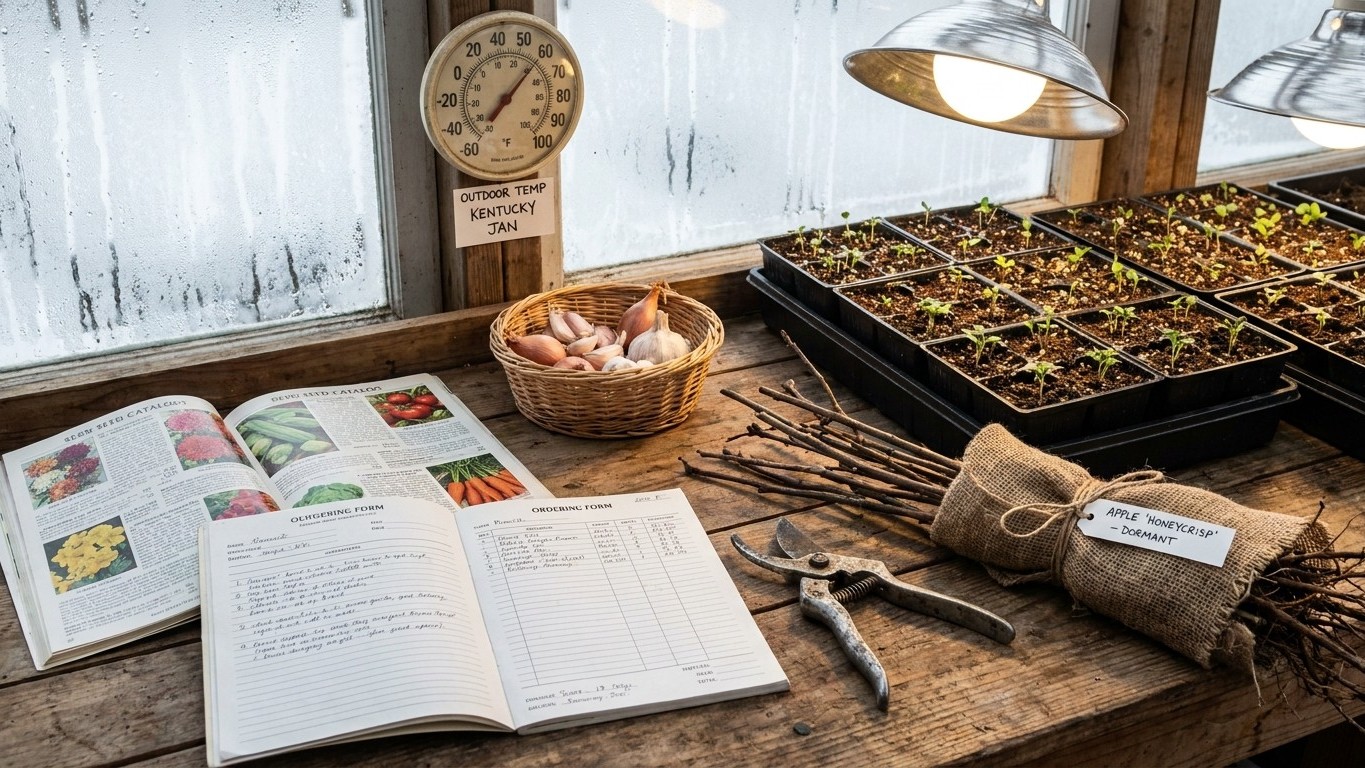

January in Kentucky means almost nothing goes into open ground, and that’s fine. The real work this month is indoors and under cover: starting long-season seedlings on a schedule counted back from the state’s March 24 to April 4 frost window, pruning dormant fruit trees, ordering seed before good varieties sell out, and getting garlic or shallots into workable soil if you haven’t already.
What goes in the ground in January

Soil temperature decides everything here, not the page of a calendar. Across most of Kentucky, ground temperatures in January sit well below the 40-degree threshold that root crops and alliums need just to wake up, and the state’s last spring frost doesn’t clear until March 24 to April 4 in an average year. That’s a two-to-three month gap. Planting into ground this cold isn’t early, it’s a gamble that ends with rotted seed or stalled bulbs.
So the honest answer is that almost nothing new goes into open garden beds this month. What’s still possible is narrow but real. Garlic and shallots can go in if the ground hasn’t frozen solid and you missed the fall window, though germination will lag until soil warms. Bare-root fruit trees, brambles, and dormant perennials can be planted whenever the ground is workable, meaning not frozen and not saturated to mud. Cold frames and low tunnels extend the season for cold-hardy greens like spinach, mache, and claytonia, which can be direct-sown under cover even while the open beds sit idle.
Forcing crops indoors
This is also the month for forcing chicory into pale, tender chicons and pushing rhubarb crowns into early growth in a dark, cool space, both classic cold-season tricks that give you something fresh from the garden while the beds outside are dormant. Neither needs a greenhouse, just a bucket, some soil, and a spot that stays above freezing.
What doesn’t belong on this month’s list: peas, lettuce, brassicas, or anything else direct-sown into open Kentucky soil. Seed catalogs sometimes suggest these can go in “as soon as soil can be worked,” but in January that phrase describes a day that mostly hasn’t arrived yet in this state. Save the direct-sowing instinct for late winter, when soil temperature and the frost calendar actually start moving in your favor.
What to start under cover
Seed starting in January works backward, not forward. Take the last-frost window of March 24 to April 4, and count back the number of weeks a crop needs before it’s ready to transplant. Onions and leeks want the longest head start, often eight to ten weeks under lights, which puts their start date squarely in January for many Kentucky gardeners. Peppers, needing roughly eight weeks, and early brassicas like cabbage and broccoli, needing six to eight, also fit this month’s window if you’re aiming for an early-spring transplant.
Tomatoes are the crop most gardeners rush. Started too early, in January instead of closer to the frost window, they turn into leggy, rootbound plants sitting in pots for weeks longer than they should, stressed before they ever touch soil. That’s one of the two failure modes worth naming directly: starting too early wastes the plant’s best growth on a windowsill instead of a garden bed. The other failure mode is starting too late, particularly for onions and leeks, and ending up with transplants too small to size up properly before summer heat arrives.
A heat mat helps for peppers and eggplant, which germinate slowly in a cool house. A simple shop-light setup, kept just inches above the seedlings and raised as they grow, prevents the stretching that ruins transplants started under a sunny window alone. None of this requires expensive equipment, just consistent light and a little arithmetic redone against your own county’s frost dates rather than a generic seed-packet date.
What is ready to pick
Little to nothing comes out of open Kentucky garden beds in January, and there’s no point pretending otherwise. But a household growing food this month isn’t necessarily eating only from the pantry. Kale, collards, and leeks left in the ground under a blanket of mulch or snow often survive and even sweeten after hard frost, and can be harvested as needed if the ground around them isn’t frozen solid.
Cold frames and low tunnels planted in fall keep producing spinach, mache, arugula, and other hardy greens through the month, usually in smaller, slower-growing leaves than fall’s flush but still worth harvesting. Indoors, sprouts and microgreens fill the gap fastest, ready in one to two weeks from seed on a countertop tray, no soil or sunlight requirements beyond a windowsill.
This is also the month to walk the root cellar or pantry shelf and check stored crops before small problems spread. Squash with a soft spot near the stem, potatoes gone green or sprouting, onions with a papery neck gone soft, all of these should be pulled and used immediately rather than left next to sound produce. One rotting squash in a bin can take down its neighbors within a week if it’s not caught early. A five-minute check now saves a much bigger loss later in the storage season.
The jobs that matter this month
Dormant pruning is January’s biggest task, and the timing matters more than it seems. Apple, pear, and stone fruit trees, along with brambles like raspberries and blackberries, are pruned while fully dormant and before buds swell, which for most of Kentucky means this month through February. Cut too late, once sap is rising, and the tree wastes energy on wounds instead of new growth; cut now, and the plant heals cleanly before spring pushes it into leaf.
Seed ordering belongs on this month’s list too, and not as an afterthought. Popular varieties, particularly disease-resistant tomatoes and certain heirloom beans, sell out from seed companies well before planting season, so ordering in January instead of March means actually getting the variety you planned for rather than a substitute.
Soil testing is worth doing now while beds are empty and there’s time to act on the results. A test sent to a lab in January comes back with weeks to spare before amendments need to be worked in, unlike a test run in April that arrives too late to change anything before planting.
Beyond that, this month covers the unglamorous maintenance that keeps the rest of the season running: turning compost piles so they don’t go anaerobic over winter, cleaning and sharpening pruners and hoes before the rush of spring work dulls them further, repairing raised bed frames or fencing damaged by winter weather, and mapping out next season’s crop rotation on paper while there’s no pressure to have shovels in the ground yet.
What not to do in January
The most common mistake this month is reading a warm afternoon as a planting signal. A 55-degree day in January doesn’t mean soil temperature has caught up, and warm-season seed or transplants put into ground that’s still cold below the surface will simply sit and rot rather than germinate. Air temperature and soil temperature are different measurements, and only one of them matters for planting decisions.
A related error is uncovering cold frames, row covers, or mulched beds too early after a mild stretch. Kentucky’s frost window doesn’t close until March 24 to April 4 at the earliest, and a week of mild weather in January is not a preview of spring, it’s a pause inside winter. Plants exposed too soon lose the protection they need for the freeze that almost always follows.
Nitrogen fertilizer is the third trap. Feeding dormant trees, shrubs, or garlic beds with nitrogen in January can push a flush of tender new growth right before a hard freeze arrives, and that new growth is exactly what gets killed back, wasting the plant’s stored energy. Save nitrogen applications for active growth periods later in the season, and stick to phosphorus and potassium amendments, or nothing at all, while everything is still dormant.
Checking this against your own county
A state-wide month is a starting point, not an instruction. Kentucky spans USDA hardiness zones 6a to 7a, and elevation, valley cold pockets, and the distance between the state’s northern and southern counties can shift real planting windows by two or three weeks in either direction. A garden in the hills differs from one in a river bottom even a few miles away.
For a planting calendar built around your specific county, the University of Kentucky’s Cooperative Extension Service is the reference worth checking. Local extension agents also track soil temperature reports that no state-wide guide can replace.
Common questions
Can I plant garlic in January in Kentucky?
Yes, if the ground isn’t frozen solid, though fall planting gives better results. Late-planted garlic in January often produces smaller bulbs than cloves set in October or November, since it misses part of the root-establishment period before cold sets in.
Is it too late to start seeds indoors in January?
No, for many crops it’s exactly on time. Onions, leeks, and early brassicas need six to ten weeks indoors before Kentucky’s last-frost window of March 24 to April 4, which places their start date in January for most of the state.
Why shouldn’t I fertilize dormant plants in January?
Nitrogen encourages new growth, and new growth in the middle of winter has no protection against a hard freeze. That tender growth dies back, wasting energy the plant needs to save for spring.
What’s the single most useful task in a Kentucky garden this month?
Dormant pruning of fruit trees and brambles. It has a firm deadline, before buds swell, and skipping it costs an entire season’s fruit shape and health rather than just a delayed task.