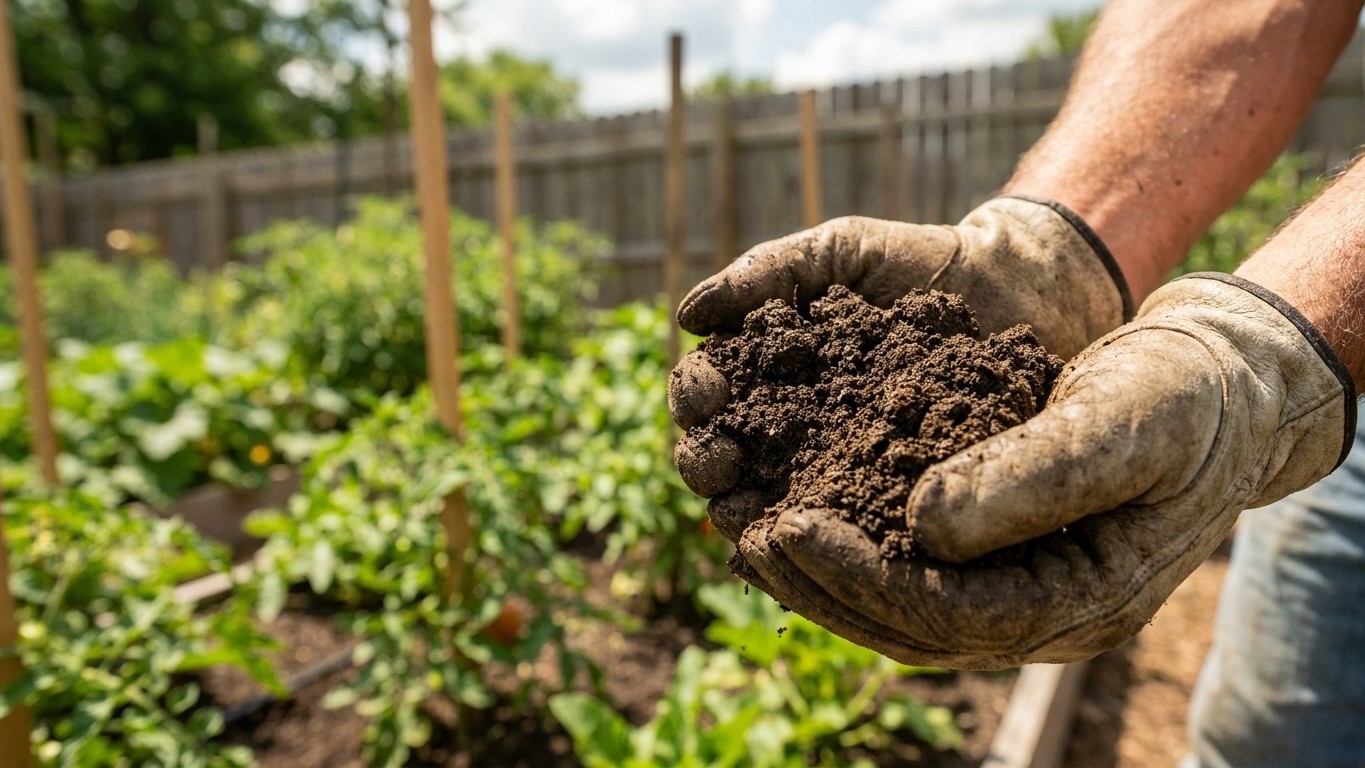

Kentucky’s official state soil is the Crider series, a silt-heavy, moderately fertile ground that drains well and leans slightly acid. Knowing that name is a starting point, not a diagnosis of your own backyard, but it tells you what the region tends to do underfoot and what to check for yourself.
What is under your garden

The Crider series became Kentucky’s legal state soil in 1990, under the USDA NRCS State Soils program, and it’s a fitting pick. Crider is an Alfisol, a forest-derived soil type that formed under hardwood cover and tends to hold onto nutrients better than soils that formed under other conditions. It’s what soil scientists call a loam to silt soil, and the numbers back that up plainly.
| Reading | Value |
|---|---|
| Surface pH | about 6.2 (slightly acid) |
| Sand | 5 percent |
| Clay | 19 percent |
| Silt | 76 percent |
| Organic matter | about 3.0 percent |
| Drainage class | well drained |
Those figures come from USDA NRCS Soil Data Access, averaged across 255 mapped components of the Crider series. That’s a real, measured baseline, not a guess. But it’s a representative picture of the state, stitched together from soil surveys across the landscape, not a measurement of the dirt under your tomato bed. A garden a few miles away, sitting on river bottom ground or on a lot a builder scraped and filled with subsoil, can behave nothing like this. Crider tells you what the region’s native ground tends toward. Your own soil still needs its own look.
Reading your own dirt in five minutes
Grab a handful of moist soil and try the ribbon test. Squeeze it between your thumb and forefinger and push it upward, forming a ribbon. Soil that barely holds together before breaking, an inch or less, is sandy. A ribbon that stretches two inches or more before snapping is heavy in clay. Something in between, with a silky, slightly slick feel, is telling you silt is doing the work, which lines up with what Crider’s numbers suggest for the region.
The jar test takes longer but confirms it. Fill a clear jar about a third with soil, top it with water, shake hard, and let it sit overnight. Sand drops first and settles at the bottom within a minute or two. Silt follows over the next few hours. Clay stays suspended longest and forms the topmost layer once it finally settles. Measure the bands the next morning and you’ve got a rough percentage breakdown of your actual garden, no lab required.
Testing before you amend
A bag of lime or a jug of sulfur is cheap. Buying the wrong one because you guessed at your soil’s pH is not. Amendments react to specific numbers, and pouring one on blind faith can push a garden further from healthy rather than closer. The regional baseline lets you expect a pH somewhere near 6.2 and a texture leaning silty. Expecting is not the same as knowing, and county soils have variables the survey map can’t capture: the fill dirt from a driveway project, decades of wood ash from a burn pile, a low spot where clay has washed in from a slope above.
A proper soil test through your local extension office answers what your eyes can’t. It reports actual pH, phosphorus, potassium, and often organic matter and micronutrients, all specific to your patch of ground. The lab fee is usually modest, and the results come back with amendment recommendations tailored to what you’re growing.
- Choose a day when the soil is moist but not soaked, and avoid sampling right after fertilizing.
- Pull 8 to 10 small cores from around the garden bed, each about 6 to 8 inches deep, since that’s where most root activity happens.
- Mix the cores together in a clean bucket, breaking up clumps and removing rocks, roots, and mulch.
- Spread the mixed soil out to air dry for a few hours if it’s noticeably wet.
- Bag roughly a pint of the mixed sample and label it with the bed location and what you plan to grow there.
- Drop it off or mail it to your county extension office along with the testing form.
Repeat this every two to three years, or any time a bed starts underperforming for no obvious reason.
Amending it
Kentucky’s representative pH of about 6.2 sits on the acid side of neutral, which is common for soils that formed under forest cover and heavy rainfall. That number points toward a specific, manageable correction rather than a guessing game.
Liming acid ground
If your test comes back below 5.5, lime is the tool, not sulfur. Acid soil below that threshold locks up phosphorus, making it unavailable to roots even when it’s present in the ground, and it stresses brassicas like broccoli and cabbage, which prefer a more neutral range. Ground limestone raises pH slowly, over one to two growing seasons, not weeks. Work it into the top 6 inches in fall so it has winter moisture to react with, and retest before adding more the following year. Sulfur has no business here; it would push already-acid ground in the wrong direction entirely.
Correcting alkaline ground
If a test instead comes back above roughly 7.3, the fix flips completely. Lime must never touch that ground. Elemental sulfur, applied gradually and worked into the soil, along with regular additions of compost and other organic matter, is the slow, honest route down. High pH locks iron out of reach for plant roots, and that’s exactly what yellow leaves with green veins, a condition called iron chlorosis, are telling you. Expect this correction to take two to three seasons, not one.
Working with heavy clay
Crider’s clay content sits around 19 percent, moderate rather than heavy, but plenty of Kentucky gardens sit on denser clay pockets. The fix is organic matter, worked in every season, never sand. Mixing sand into clay is a classic mistake that can create a texture closer to concrete than soil. Never work clay ground while it’s wet; compacted clumps formed that way can last for years.
Working with sandy ground
Sandy soil, less common where Crider dominates but present in river-adjacent spots, needs organic matter too, plus a shift in watering habits: shorter, more frequent sessions since nothing stays put in loose sand. Clay corrections take patience measured in seasons. Sand corrections show results faster, often within one growing year, because organic matter improves water and nutrient holding almost immediately.
Drainage and compaction
Crider carries a well-drained classification, meaning water moves through it at a workable pace rather than pooling or vanishing instantly. In a garden built on ground like this, a hard rain shouldn’t leave standing puddles more than a few hours. But drainage varies bed to bed, and a simple test tells you what’s actually happening under your own boots.
Dig a hole about a foot deep and roughly the same across. Fill it with water and let it drain completely once, just to saturate the surrounding soil. Then fill it again and time how long it takes to drop, measuring in inches per hour. A rate of 1 to 3 inches per hour is typical of well-drained ground and comfortable for most vegetables and ornamentals. Anything under half an inch an hour signals a drainage problem, often compaction or a clay layer trapping water below the surface.
Foot traffic and heavy equipment compact soil by squeezing air pockets out of it, and repeated compaction over years can undo good drainage even on naturally well-drained ground like Crider. Double digging, once a standard fix, has fallen out of favor because it disturbs soil structure and biology more than it helps, and the benefit rarely outlasts a season. On ground that drains poorly no matter what you try, a raised bed is often the more honest answer than three more years of amendment and hope.
- Fast-draining, well-aerated beds: expect success with root vegetables, tomatoes, and most perennials without extra intervention.
- Beds testing under half an inch per hour: avoid deep-rooted crops there and consider raised construction instead.
- High-traffic paths near beds: lay mulch or stepping stones rather than walking directly on planting soil.
Local help
The Kentucky Cooperative Extension Service runs soil testing through county offices statewide, and staff there read your results with you rather than mailing back a number and leaving you guessing. Reach the program through the University of Kentucky Cooperative Extension Service, find your county office, and ask about current sample submission steps and testing fees.
Common questions
Is all Kentucky soil like the Crider series?
No. Crider represents a widespread and agriculturally significant series, but the state includes river bottomland, hill country, and disturbed urban lots that can differ completely in texture, pH, and drainage.
How often should I retest my garden soil?
Every two to three years under normal conditions, or sooner if plants show unexplained yellowing, stunted growth, or poor yields despite regular care.
Can I fix soil pH with kitchen ingredients like coffee grounds or eggshells?
These have minor, slow effects at best and won’t substitute for lime or sulfur applied based on an actual test result. Treat them as a compost addition, not a pH correction tool.
Why does my soil seem different from my neighbor’s a block away?
Soil varies over surprisingly short distances due to old grading, fill dirt, drainage patterns, and even past land use like a filled-in pond or a removed driveway. Local variation is normal and part of why individual testing matters more than regional averages.