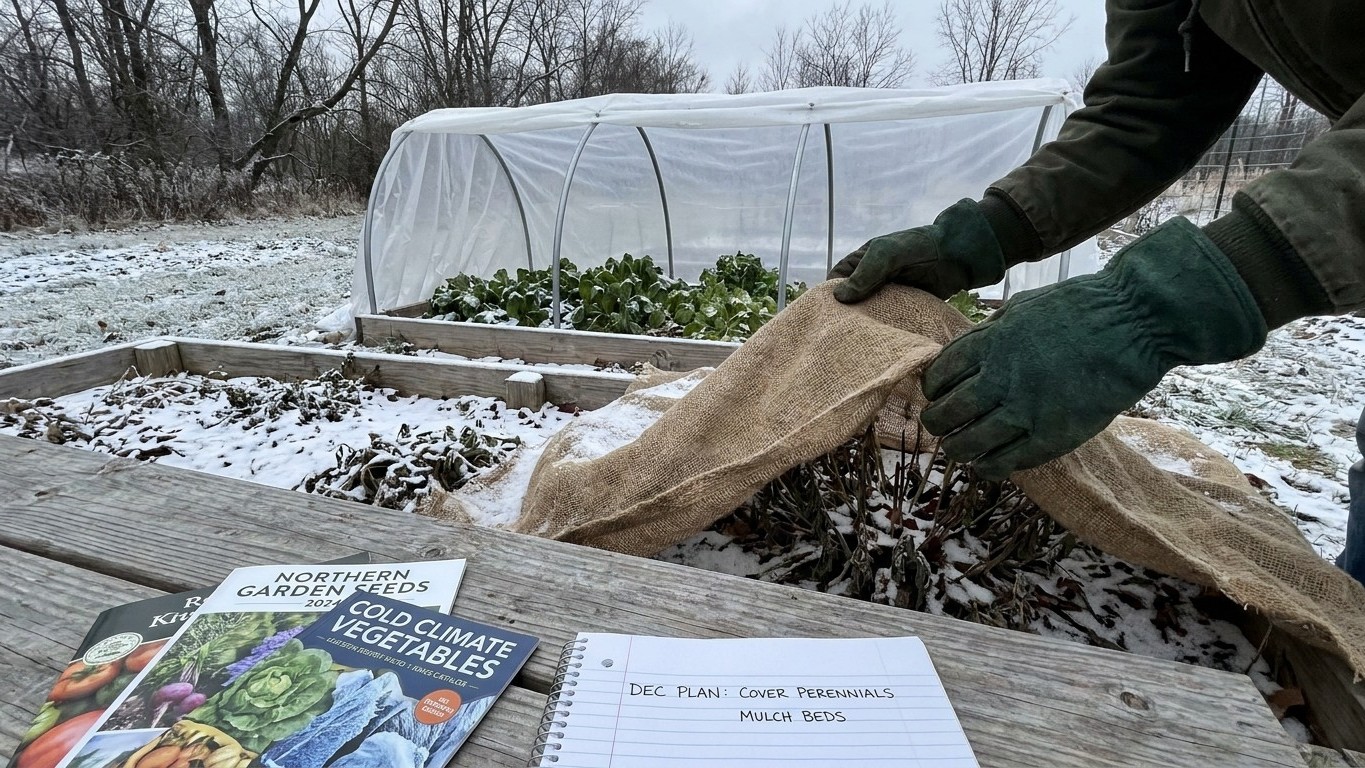

December offers almost nothing to plant directly outdoors across Michigan. With ground frozen or freezing through most of the state, the real answer this month is dormant work: pruning, seed ordering, soil planning, and protecting what’s already stored. A handful of cold-hardy options exist under cover, but open-ground planting mostly waits until spring.
What goes in the ground in December

The decision here isn’t the calendar, it’s soil temperature and whether the ground is workable at all. Michigan sits in USDA hardiness zones 4a to 6b, a range built entirely around the average annual extreme minimum temperature, and by December most of that range is dealing with frozen or partially frozen soil. In the far southern counties near Detroit, where the growing season stretches longest, there can occasionally be a narrow window early in the month when the top few inches of soil remain workable after a mild stretch. That window is not reliable, and it closes fast once a hard freeze sets in.
If garlic or shallots didn’t go in during fall, a workable-soil window in the far south is the last realistic chance, and even then it’s a gamble against the next freeze. For most of the state, the honest answer is that nothing new goes into open ground this month.
That doesn’t mean the garden goes untouched. Cold frames and low tunnels can still shelter cold-hardy greens like spinach, mache, and claytonia that were established earlier, letting them limp through the coldest stretch under an extra layer of insulation. Bare-root fruit trees, canes, and shrubs that arrive from mail-order nurseries this time of year shouldn’t go straight into frozen ground; instead, heel them into a trench of loose soil or moist sawdust in an unheated garage or shed until spring planting is possible. Forcing crops indoors is the other real option: potted rhubarb crowns or chicory roots brought into a dark, cool space will push tender growth for the table within weeks, a genuine harvest from a garden that otherwise looks finished.
Where the state’s frost windows differ
| Region | Last spring frost | First fall frost |
|---|---|---|
| Detroit area | around April 30 | not published here |
| Most of the Lower Peninsula | early to mid May | October 6 to October 21 (zone 6a) |
Both figures come from MSU Extension’s frost-date and garden calendar data, and they show why a “December in Michigan” answer has to be treated as a starting point rather than a single instruction for every county.
What to start under cover
Counting backward from those frost windows is the right way to plan seed starting, and for December the arithmetic actually argues against starting most transplants yet. Even the slowest growers, onions and leeks, generally need 10 to 12 weeks indoors before they go out, which lands their start date in late winter, not December, whether the local last frost falls around April 30 near Detroit or a week or two later further north. Start them now and they’ll be leggy, rootbound, and stressed long before the ground is ready to take them.
What does make sense under cover this month isn’t tied to the frost date at all. Microgreens and sprouts run their whole cycle in one to three weeks under a grow light or on a sunny sill, so they can be sown on repeat all winter without any backward math. Perennial and native seed that requires cold stratification, things like milkweed, coneflower, or many fruit tree rootstocks, can be sealed in damp sand or vermiculite and set in a refrigerator or unheated space now, so the chilling period finishes on schedule and the seed is ready to sow once the soil actually warms.
The two failure modes to watch for are opposite ends of the same mistake: starting too early leaves plants stretched and weak by the time they can go outside, while starting too late means running out of season before fruit or roots can mature. December sits closer to the first problem for nearly everything except the cold-treatment seed and the quick indoor crops.
What is ready to pick
Outdoors, there’s little to nothing left to harvest across most of Michigan by this point. Kale and leeks that were left in the ground under a thick blanket of mulch or snow can sometimes still be dug or cut on a mild day, since both crops tolerate hard freezes and often taste sweeter after cold exposure. A cold frame with spinach, mache, or arugula planted earlier in fall can keep producing small pickings through the month, especially on the sunnier side of a south-facing wall.
Indoors is where most of the household’s fresh food is coming from now. Microgreens and bean or pea sprouts started on a kitchen counter deliver a harvest in days rather than months, and they don’t care what the thermometer outside is doing.
The other job this month is checking what’s already in storage. Winter squash should be firm with no soft spots or mold at the stem; any that feel the least bit spongy need to be used immediately rather than left to spread rot to the rest of the batch. Potatoes and onions stored in a cool, dark spot should be checked by hand every few weeks, pulling out anything that’s sprouting, shriveling, or going soft, since one bad onion in a mesh bag can take down its neighbors fast.
The jobs that matter this month
December carries plenty of real deadlines even without open-ground planting, and skipping them costs the next season, not this one. Dormant pruning of fruit trees, brambles, and grapevines is one of the best uses of a cold afternoon: with leaves gone, the branch structure is easy to read, and cuts made while the plant is fully dormant heal cleanly without the sap loss or disease risk that comes with pruning in active growth. Apple and pear trees, raspberry canes, and grapevines all benefit from thinning out crossing or damaged wood now.
Seed ordering belongs on this month’s list too. Popular varieties, especially the shorter-season types bred for northern Michigan’s tighter windows, sell out well before spring planting, and ordering early means having options rather than settling for whatever’s left. While planning seed orders, it’s worth sketching next season’s crop rotation on paper, so beds that grew heavy feeders don’t repeat the same crop family back to back.
Soil work pays off now as well. A soil test taken while beds are idle gives time to source and apply lime, sulfur, or organic matter before spring, rather than scrambling once planting starts. Compost piles built up over fall should get a turn to keep them breaking down instead of freezing solid in a stalled state. Tools deserve attention too: cleaning soil off blades, oiling wood handles, and sharpening pruners and hoes now means everything is ready to grab the first workable day in spring instead of losing that day to maintenance. Raised beds, fencing, and trellis hardware that took a beating over the growing season are easiest to repair while nothing is planted and the ground isn’t yet frozen solid everywhere.
What not to do in December
The most common misstep is trusting a warm afternoon over the soil itself. A stretch of 50-degree air doesn’t mean the ground underneath has thawed, and anything transplanted or direct-sown into soil that’s still cold and wet a few inches down will sit and rot rather than grow. The fix is simple: check the soil with a hand, not the forecast, before doing anything to it.
A related mistake is pulling mulch or row covers off too soon after a mild spell, exposing crowns and roots right before the next cold snap moves back in. Winter mulch is there to buffer temperature swings, not just to block a single cold night, and it should stay in place until growth actually resumes in spring, not whenever the weather feels temporarily friendly.
Fertilizing dormant plants is another wasted, sometimes harmful, effort. Nitrogen applied to a tree or shrub that isn’t actively growing doesn’t get used; it can leach away with winter precipitation or, worse, push a flush of tender new growth right before a hard freeze damages it. Feeding waits until growth restarts.
Finally, walking on frozen or saturated garden beds and lawns compacts the soil structure in a way that’s hard to reverse, squeezing out the air pockets roots need come spring. Laying a board down to distribute weight, or simply staying off beds until they’re dry and workable, avoids undoing a season’s worth of soil-building work.
Checking this against your own county
A state-wide answer for December is a starting point, not a set of instructions for every yard. Michigan’s hardiness zones span from 4a to 6b, and elevation, lake effect, and simple north-south distance move frost windows by weeks in either direction. A coastal county downwind of Lake Michigan can see a very different snow load and thaw pattern than an inland spot just fifty miles away. For a local read, MSU Extension’s frost-free date data and garden calendar are the reference point worth checking against whatever’s happening in a specific backyard.
Common questions
Can garlic still be planted in December in Michigan?
Only if the ground remains workable, which is rare outside the far southern counties early in the month. Once the soil freezes, garlic cloves sit exposed to rot rather than rooting in before winter, so a fall planting window is far more reliable.
What vegetables can survive a Michigan winter outdoors?
Kale and leeks are among the toughest, often surviving under mulch or snow cover and remaining harvestable on milder days. Spinach, mache, and other cold-hardy greens can also persist under a cold frame or low tunnel.
Is it too late to start seeds indoors in December?
For most transplants meant to go outside after the last frost, yes, since even the slowest growers only need 10 to 12 weeks and would end up leggy well before spring. Microgreens, sprouts, and cold-stratifying perennial seed are the exceptions that make sense to start now.
Why does my garden’s frost date differ from the state average?
Lake effect, elevation, and regional position all shift frost timing, sometimes by weeks. MSU Extension’s county-level data and the Michigan Garden Calendar offer a closer estimate than any statewide figure can.