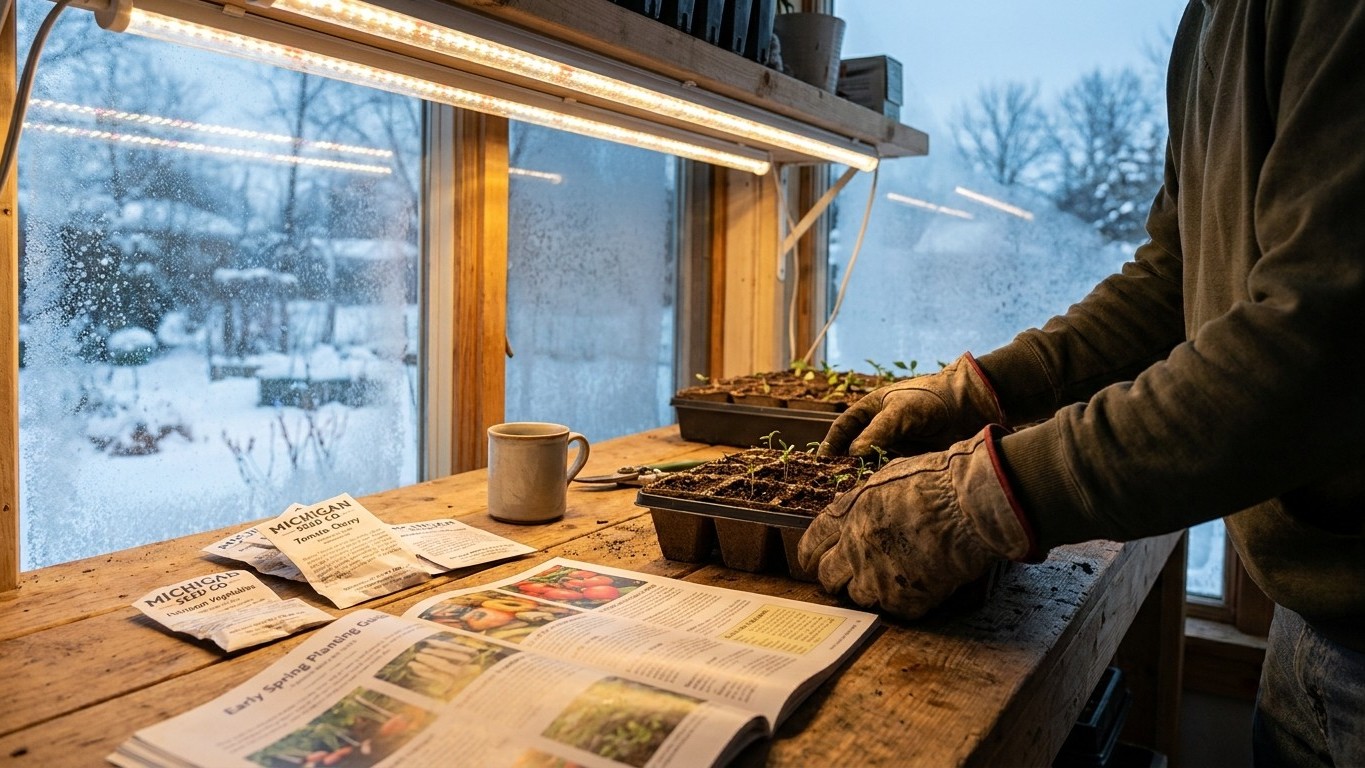

Across Michigan, January means frozen or waterlogged ground almost everywhere, so nothing goes into open soil this month. The real work is indoors and under cover: starting slow-growing onions and leeks from seed, forcing rhubarb or chicory in a dark corner, ordering seed catalogs before the popular varieties sell out, and pruning dormant fruit trees while they’re still asleep.
What goes in the ground in January

Soil temperature decides what can go into the ground, not the date on a calendar. MSU Extension puts the last spring frost around April 30 in the Detroit area, with early to mid May the more typical window across most of the Lower Peninsula. January sits three to four months ahead of that mark statewide, which means the honest answer for outdoor planting this month is: nothing goes into open ground in Michigan right now, regardless of what county you’re in.
That’s not the whole story, though. If garlic and shallots were tucked into a bed back in fall, they’re already doing their quiet underground work through the freeze, and there’s nothing to plant now to catch up if that window was missed. What January does allow is management of what’s already growing or dormant. A cold frame or low tunnel over a bed of hardy greens (spinach, mache, claytonia) can keep them alive and even slowly growing on sunny days, especially in the southern tier of the state where USDA Plant Hardiness Zone Map data (2023) puts winter lows in the 6a to 6b range, milder than the 4a zones found in the far north and the Upper Peninsula.
January is also the month for forcing. Digging a rhubarb crown or a few chicory (Belgian endive) roots and bringing them into a dark, cool space indoors produces tender stalks or chicons in a matter of weeks, with none of the frost risk of anything outdoors. Bare-root fruit trees and berry canes can sometimes arrive from mail-order nurseries this early, but they go into pots or a holding trench indoors or in an unheated garage, not into frozen garden soil.
The mistake to avoid: reading a seed packet’s zone map and assuming Michigan’s 4a-6b range means something can go outside because “it’s a cold-hardy zone.” Hardiness zones describe the average extreme minimum winter temperature a perennial plant can survive while dormant. They say nothing about whether garden soil is workable in January, and in most of the state, it simply isn’t.
What to start under cover
The arithmetic here works backward from the frost window, not forward from January 1. Onions and leeks are the classic January starts because they’re slow: they need roughly 10 to 12 weeks of growth indoors before they’re ready to go outside as transplants. Counting back from a last-frost target of late April to mid May, that lands seed-starting for onions and leeks squarely in January, especially in the Detroit area and points south where the frost window opens earliest.
Celery and celeriac follow the same logic. Both are slow, fussy germinators that benefit from the extra weeks a January start provides, and both sulk badly if rushed. Artichokes, if a gardener is chasing them as an annual crop in Michigan’s climate, also need this much lead time to produce before fall frost arrives, which MSU Extension’s Michigan Garden Calendar places between October 6 and October 21 in zone 6a.
What doesn’t belong on a January seed-starting tray: tomatoes, peppers, and other tender crops with an 8-week head start. Started this early, they’ll be leggy and rootbound long before the ground is warm enough to take them, sitting on a windowsill outgrowing pot after pot. That’s the first failure mode, starting too early and ending up with sad, stretched seedlings that never fully recover once transplanted.
The second failure mode runs the other direction: waiting too long on the genuinely slow crops (onions, leeks, celeriac) and running out of growing season before the first fall frost closes things down. January is the sweet spot for those specific crops precisely because the math works out only once, not twice, in a typical Michigan season.
What is ready to pick
Outdoors, the honest answer is close to nothing. Almost anything left in an unprotected garden bed by January has already been taken by frost, and what’s left standing is either buried in snow or frozen solid. That doesn’t mean the pantry and the cold frame are empty, though.
Kale and leeks mulched heavily before the ground froze can often still be dug out from under snow cover, especially in the milder 6a and 6b pockets of the southern Lower Peninsula. The flavor actually improves after hard frost, as the plant converts starches to sugars in self-defense. A cold frame with spinach, mache, or arugula planted the previous fall can keep producing small pickings through winter on clear days, even under a foot of snow outside its glass or plastic cover.
Indoors, sprouts and microgreens fill the gap nicely: mung beans, alfalfa, broccoli sprouts, and trays of pea or sunflower microgreens are ready in a week to ten days from a jar or a shallow tray on a windowsill, no garden required.
January is also the month to walk the root cellar or basement shelves and check stored squash, potatoes, and onions. Squash with a soft spot near the stem, potatoes that have gone green or started sprouting eyes, and onions that feel soft when squeezed should get pulled and used first, before they take neighboring produce down with them. A single rotting onion in a mesh bag can spread mold to everything touching it within days.
The jobs that matter this month
Dormant pruning tops the list, and January is one of the better windows for it. Apple, pear, and other fruit trees, along with raspberry and blackberry canes, can be pruned while fully dormant and while it’s easy to see branch structure without leaves in the way. Cutting now, before sap starts moving in late winter, reduces stress on the tree and lowers the risk of disease entering fresh wounds. Skip this window and pruning gets riskier the closer the tree gets to bud break.
Seed ordering deserves its own line item. Popular varieties, especially anything featured in a seed company’s catalog cover or newsletter, sell out weeks before planting season actually arrives. Ordering in January means first pick rather than leftover picks in March.
Soil testing is easy to put off and easy to do now, while there’s no planting pressure competing for attention. A basic test through a county extension office or a home kit shows pH and major nutrient levels in time to amend before spring, since lime especially needs months to change soil pH, not weeks.
Compost piles don’t stop needing attention just because it’s cold. Turning a pile even once this month keeps decomposition moving and prevents the whole heap from freezing into a solid, inactive brick until April.
Rounding out the list: cleaning and sharpening pruners, shovels, and hoes before they sit rusting in a shed for another two months; repairing raised bed frames, trellises, and fencing while there’s no crop in the way; and rereading the previous season’s notes to plan crop rotation, since moving nightshades and brassicas to new ground each cycle cuts down on soil-borne disease pressure.
What not to do in January
The most common mistake is starting tender, warm-season seeds (tomatoes, peppers, basil) far too early because a seed catalog arrived and the itch to plant something took over. Started in January for a last frost that doesn’t arrive until late April or May, these seedlings turn leggy and rootbound weeks before it’s safe to move them outside. The fix is simple: count back 6 to 8 weeks from the actual local frost window, not from the day the seed packets showed up.
A second mistake follows a warm spell. A few days in the 40s can fool a gardener into pulling covers off a cold frame or removing mulch from garlic beds, only for a hard freeze days later to hit exposed plants with no protection. Covers and mulch stay on until the thaw is clearly sustained, not just a brief break in the pattern.
Fertilizing dormant plants is a third trap. Nitrogen applied to a dormant fruit tree or overwintering perennial does nothing for a plant that isn’t actively growing, and can even push tender new growth right before a hard freeze damages it. Feeding waits until active spring growth resumes.
Working garden beds while they’re frozen or saturated causes lasting soil compaction that takes a full season to undo. If a boot sinks or the soil feels like cold pudding, that’s the signal to stay off the bed entirely and find another task on the list above instead.
Checking this against your own county
A statewide month is a starting point, not an instruction. Elevation in the northern Lower Peninsula, lake effect snow and moderated temperatures near Lake Michigan and Lake Superior, and the plain distance between Michigan’s southern border and its Upper Peninsula tip can shift these windows by weeks in either direction. A garden near Lake Michigan’s shoreline often sees a milder, later-arriving winter than one at the same latitude fifty miles inland.
For a local frost-date lookup and a county-specific planting calendar, MSU Extension’s outreach directory connects to county offices that track these differences directly.
Common questions
Can anything be planted outdoors in Michigan in January?
No, not into open garden soil. The ground is frozen or too wet to work across nearly the entire state. Garlic and shallots planted the previous fall continue developing underground, but nothing new goes in now.
What vegetables should be started indoors in January in Michigan?
Onions, leeks, celery, and celeriac are the best January starts because they need 10 to 12 weeks of indoor growth before transplanting. Tomatoes and peppers should wait until later, since starting them now leads to leggy, rootbound seedlings.
Is there anything to harvest in a Michigan garden in January?
Very little outdoors. Overwintered kale and leeks under heavy mulch or snow can sometimes still be dug, and a cold frame with fall-planted greens may still produce light pickings. Indoors, sprouts and microgreens are ready within a week to ten days.
What is the biggest gardening mistake to avoid in a Michigan January?
Starting warm-season seedlings too early. Tomatoes and peppers started in January will be stretched and rootbound long before Michigan’s last-frost window, which runs from around April 30 in the Detroit area to early or mid May across most of the Lower Peninsula, according to MSU Extension.