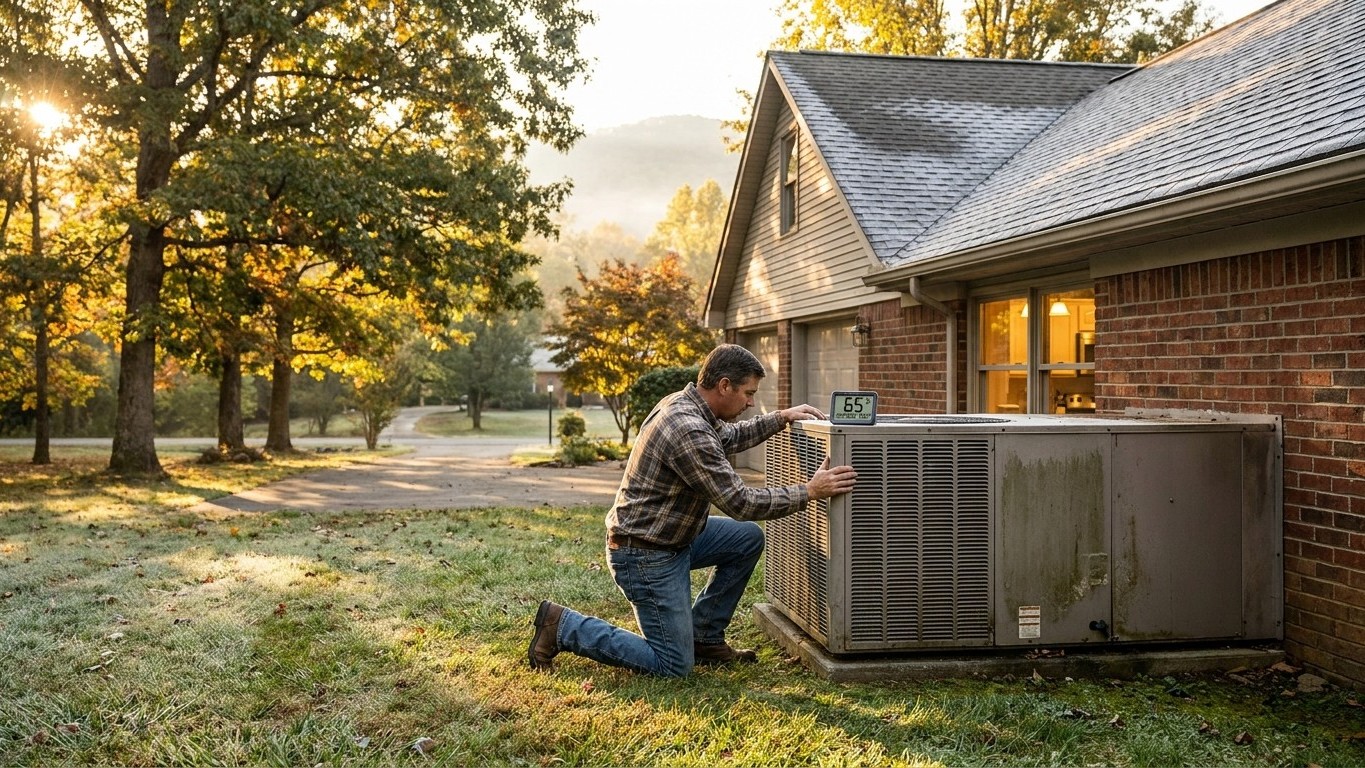

Heating season in Kentucky opens in October, when the average temperature first drops below the 65°F mark used to calculate heating demand. It peaks in January and runs roughly seven months, easing off by May. But that’s the statewide average, mountain counties in the east often need heat weeks earlier than the Bluegrass region does.
When the heating season starts in Kentucky

The number that actually answers this question comes from Louisville International Airport, the National Weather Service reference station for the state. October is the first month where the 30-year average temperature (60.3°F) slips under the 65°F threshold that meteorologists use to count heating degree days. That’s not a guess or a rule of thumb, it’s the same base the National Oceanic and Atmospheric Administration uses nationwide to track when buildings start needing supplemental heat.
January carries the heaviest load, with 908 heating degree days recorded in the 1991-2020 normals. The season runs about seven months total, with the average climbing back above 65°F by May. Keep in mind this is a 30-year average, not a forecast, the first real cold snap of any given year almost always shows up before the calendar says it should. A homeowner in Owensboro or Bowling Green might already be running the furnace on a chilly September night, long before the monthly numbers say the season has technically arrived.
Here’s the month-by-month breakdown, straight from the NOAA Climate Normals dataset:
| Month | Heating Degree Days |
|---|---|
| January | 908 |
| February | 715 |
| March | 524 |
| April | 222 |
| May | 59 |
| June | 3 |
| September | 22 |
| October | 198 |
| November | 499 |
| December | 786 |
The table skips July and August entirely, those two months carry no measurable heating degree days at this station, meaning furnaces have essentially nothing to do during that stretch.
How hard the winter works here
Add up every month in that table and Louisville lands around 3,936 heating degree days a year. That figure matters more than any single cold snap, because heating degree days are essentially a proxy for fuel use. A house that needs 3,936 heating degree days worth of warmth burns roughly twice the fuel of an identical house sitting somewhere with 2,000 degree days, all else being equal.
What the annual number can’t tell you is the shape of the season, and that’s where the monthly table earns its keep. Two places can post the same yearly total in very different ways: one might have a long, mild stretch of chilly-but-manageable months, while another crams the same total into a short, brutal window. Kentucky’s pattern, based on the numbers above, leans toward the former, demand builds gradually from October, peaks hard in January, and tapers off through spring rather than spiking and vanishing.
That gradual curve has practical implications. A furnace here isn’t asked to survive a few weeks of extreme output and then sit idle for ten months. It’s working, at some level, for the better part of two-thirds of the year. That’s a different kind of wear than a system in a place with a short, violent winter and a long shoulder season, it argues for steady maintenance rather than a single frantic pre-winter check.
What most homes in Kentucky actually heat with
According to the U.S. Energy Information Administration’s Residential Energy Consumption Survey, the furnace is the dominant piece of equipment in Kentucky homes by a wide margin, and electricity edges out natural gas as the more common fuel source overall.
| System or Fuel | Share of Kentucky Homes |
|---|---|
| Furnace | 66% |
| Central heat pump | 22% |
| Steam or hot-water boiler | not published (estimate suppressed) |
| Electricity as heating fuel | 49% |
| Natural gas as heating fuel | 43% |
| Propane | 4% |
| Fuel oil or kerosene | not published (estimate suppressed) |
Two figures listed as “not published” aren’t zero, the survey either found too few respondents to report a reliable number or suppressed the estimate for accuracy reasons. It’s not evidence that nobody in Kentucky uses a boiler or fuel oil, just that the sample size wasn’t there.
The furnace’s dominance here isn’t a recommendation, it’s a snapshot of what was cheap and available when Kentucky’s housing stock went up. That share reflects decades of building decisions, not a verdict on what works best in any single house today. What it does mean, practically, is that most readers of this page are dealing with forced-air ductwork rather than radiators or baseboard units. Furnaces heat a house fast and recover quickly after a door’s been left open, but they depend entirely on the duct system to actually deliver that heat, and that’s where a lot of the waste in a typical setup happens. The one maintenance item furnace owners skip most often, and pay for later, is the air filter. A clogged filter forces the blower motor to work harder, chokes airflow to distant rooms, and in bad cases can cause the system to overheat and shut itself down mid-winter.
Run it once before you need it
The worst time to discover a heating system won’t start is the first genuinely cold night of the year, right when every HVAC technician in the region is already booked solid. The smart move is testing everything in October, before the real demand hits. Here’s the order that matters, cheapest and fastest steps first:
- Turn the thermostat down, then back up to a few degrees above room temperature, and listen for the system to kick on within a minute or two.
- Let it run a full cycle. A burnt-dust smell in the first few minutes is normal, it’s just dust burning off elements or a heat exchanger that’s been dormant since spring — but it should fade quickly. If it lingers or turns acrid, shut it down.
- Check the air filter and replace it if it’s visibly gray or clogged. This is the single cheapest thing that affects both airflow and efficiency.
- Walk the house and clear anything blocking vents, radiators, or the outdoor unit of a heat pump, furniture, curtains, boxes, leaves, or debris all restrict airflow.
- Test every carbon monoxide alarm in the house. Combustion appliances that haven’t run in months are exactly the systems worth checking before you rely on them daily; a working alarm is the backstop if something’s off with venting or a cracked heat exchanger.
- If the system won’t start, cycles on and off rapidly, or throws an error code on a smart thermostat, stop and call a technician rather than troubleshooting further yourself.
Even a furnace that passes every one of these checks isn’t necessarily delivering all its heat where it’s supposed to. The U.S. Department of Energy notes that “in a typical house, about 20%-30% of the air that moves through the duct system is lost due to leaks, holes, and poorly connected ducts.” That’s air paid for and heated, then lost in the attic or crawlspace before it ever reaches a register. It’s worth having ductwork inspected if certain rooms never seem to warm up no matter how long the system runs.
What turning it down is actually worth
The Department of Energy puts a specific number on thermostat setbacks: “You can save as much as 10% a year on heating and cooling by simply turning your thermostat back 7-10 F for 8 hours a day from its normal setting.” That’s a yearly figure covering both heating and cooling combined, not a per-degree formula and not a winter-only number.
In a state where heating demand stretches across seven months, from October through April, that 8-hour setback has a long window to work in. A programmable or smart thermostat set back overnight or during work hours has months of cold weather to apply that saving against, rather than the few scattered weeks a milder climate might offer. The setback doesn’t need to be dramatic or constant to matter, consistency across the season is what makes the number add up.