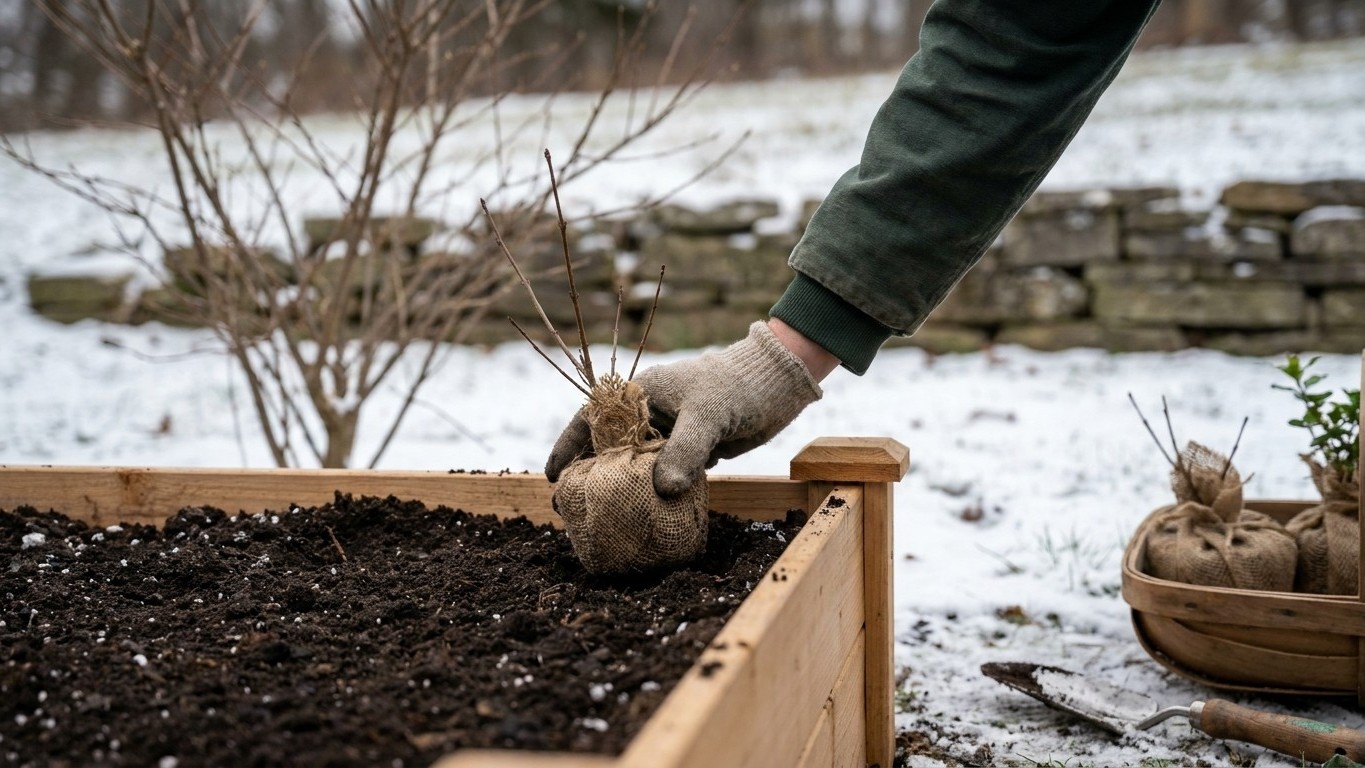

In New Brunswick, December means frozen ground and snow cover across most of the province, so nothing goes into open soil this month. What still moves the garden forward: mulch checks on fall-planted garlic, cold-frame maintenance, indoor forcing of rhubarb and chicory, and the planning work that decides how spring turns out.
What goes in the ground in December

New Brunswick sits in Canadian hardiness zone 5a, based on the reference station used for this page, and the numbers explain why December closes the door on planting. The average first fall frost lands around October 2, and the average last spring frost doesn’t arrive until May 23. That means the province is roughly two months past its fall frost and still five months from spring safety. Soil at this point is frozen solid in most districts, often under a snowpack that won’t budge until March or April.
So the honest answer is that nothing new goes into open ground this month. No direct sowing, no transplanting, no bare-root planting into bed soil that’s frozen to a foot or more down. Trying to work frozen or waterlogged clay does more harm than good, compacting structure that takes a full season to recover.
What’s still legitimate: garlic and shallots planted back in October are already dormant underground, and if a hard freeze arrived before the mulch went down, this is the month to fix that with four to six inches of straw or shredded leaves over the row. Cold frames and low tunnels holding hardy greens sown earlier keep producing through insulated cover, though that’s maintenance, not new planting. Forcing rhubarb crowns or chicory (Belgian endive) roots in a dark, cool spot indoors gives a genuine harvest from stock already in hand. Bare-root fruit trees and shrubs wait for either late fall before the ground locked up, or the spring thaw. Attempting it now against frozen soil just kills the roots.
What to start under cover
Counting backward from the average last spring frost of May 23 is the only way to time indoor sowing correctly, and December is too early for almost everything on a standard seed-starting schedule. Onions, started indoors 10 to 12 weeks ahead of transplanting, would go under lights in early to mid March. Peppers and tomatoes, needing 6 to 8 weeks, start even later. Sow those categories now and by May they’re rootbound, leggy, and stressed before they ever touch garden soil, the first of the two classic failure modes.
The second failure mode runs the other way: gardeners who wait too long on slow growers like celery, leeks, or onions from seed end up transplanting undersized starts that never catch up before the short northern growing season runs out. December sits outside both windows for most vegetables, which is exactly why it’s a good month for the things that don’t follow the frost calendar at all.
Perennial flower seeds that need cold stratification, things like echinacea or milkweed, can go into damp sand or a moist paper towel in the refrigerator now, giving them the four to eight weeks of chilling they need before a spring sowing. Microgreens and sprouts (radish, pea shoots, sunflower) are on their own clock entirely and can be started indoors under grow lights on a rolling basis all winter, giving fresh greens with no frost math involved.
What is ready to pick
Outdoors, the honest answer is close to nothing this month. Anything left unharvested in the open ground is either frozen solid or buried under snow, and digging through frozen soil for root crops risks damaging roots and tools alike.
What still feeds the table: kale and leeks left in the ground under a heavy mulch or snow layer often survive and actually sweeten with cold exposure, but they need to be dug before a deep freeze locks the soil hard enough to make harvest impossible. Cold-frame crops, spinach, mâche, claytonia, keep cropping slowly as long as the frame stays clear of heavy snow load and gets occasional daytime venting on sunny days. Indoors, sprouts and microgreens are ready in as little as a week from sowing and are the most reliable fresh green available this month.
Stored crops deserve a walk-through now rather than later. Squash should feel firm with no soft spots near the stem end, a common early sign of rot. Potatoes that have started sprouting or gone green need pulling from the batch before they spread moisture and mold to neighbors. Onions with soft necks or a sour smell won’t improve, and pulling them early salvages the rest of the bin.
The jobs that matter this month
December carries plenty of real deadlines even with nothing going into the ground, and skipping them costs real ground come spring.
Pruning, ordering, and planning
Dormant pruning of apple and pear trees can begin once the trees are fully leafless and past the coldest snaps of early winter, since cutting into wood during an extreme cold event increases dieback risk at the cut. Cane fruit like raspberries benefits from removing spent floricanes now, before new growth complicates the job in spring. Seed catalogs move fast, and ordering now, rather than in February, is the difference between getting the variety wanted and settling for whatever’s left. This is also the natural month to sketch next season’s crop rotation on paper, moving nightshades and brassicas to beds they haven’t occupied in the last two or three years to keep soil-borne pests and diseases from building up.
Soil, tools, and storage
Soil testing doesn’t need warm weather. Samples can go to a lab now, giving results back in time to plan amendments before spring planting rather than scrambling in April. Compost piles keep working through winter if insulated with a layer of straw or leaves around the bin, and turning them on a mild day speeds the process along. Tools cleaned of dirt and sharpened now are ready to go the first workable day of spring instead of sitting rusted in a shed. Raised bed frames and fencing damaged by fall storms are easiest to repair with the garden empty and no plants in the way. Stored crops, as covered above, need a periodic check through the whole winter, not just once.
What not to do in December
A run of unusually mild days is the most common trap this month. A 50-degree afternoon doesn’t mean the soil underneath has thawed, and treating it as workable ground compacts wet, half-frozen clay into a hard mass that takes a full season to loosen again. The same mild spell tempts gardeners to pull mulch off garlic beds to “let them breathe,” but exposing the crowns right before the next freeze snaps back does more damage than leaving the mulch alone all winter.
Starting warm-season seeds indoors out of impatience is another classic misstep. Given the May 23 average last frost, anything sown for tomatoes, peppers, or squash in December sits under lights for four or five months, well past the point where the plant benefits, and ends up rootbound and stressed by transplant time.
Feeding nitrogen at this point in the season is also a mistake, whether to overwintered garlic or to fall-planted perennials. Nitrogen pushes soft new growth precisely when the plant needs to stay dormant and cold-hardened, and that tender growth is what gets killed outright by the next real freeze. If a boost is needed, it belongs in spring once active growth resumes, not now. Overwatering potted perennials stored in an unheated garage or porch causes root rot faster than any cold snap, since dormant roots need only enough moisture to keep from fully drying out.
Checking this against your own county
A province-wide December calendar is a starting point, not a fixed instruction. New Brunswick’s geography moves these windows by weeks on its own: the Fundy coast runs milder and later into frost thanks to ocean moderation, while inland and northern counties like Restigouche or Madawaska see harder, earlier freezes and deeper snowpack. Elevation shifts things further, with higher ground holding frost long after nearby valleys have cleared.
For a reading tied to a specific address, the Natural Resources Canada hardiness zone lookup gives a local figure rather than the province-wide 5a used here. For seasonal guidance and crop-specific advice, Agriculture and Agri-Food Canada is the reliable federal resource to check against local extension recommendations.
Common questions
Can garlic still go in the ground in December in New Brunswick?
Not as a new planting. Garlic needs to go into unfrozen soil, typically in October, to root before winter. By December the ground is usually frozen, so the only task left is checking and reinforcing mulch on rows already planted.
What hardiness zone is New Brunswick in?
The reference city used for this page sits in Canadian zone 5a, based on Natural Resources Canada’s 1991-2020 normals. This is the Canadian system, built on seven climate variables, and it does not convert directly to a USDA zone.
Is there anything to harvest in a New Brunswick garden in December?
Very little outdoors. Kale and leeks left under heavy mulch or snow can sometimes still be dug, and cold frames may still yield hardy greens like spinach or mâche. Indoors, sprouts and microgreens are the most dependable fresh crop this month.
When should seed starting begin for a New Brunswick garden?
It depends on the crop, counted backward from the average last spring frost of May 23. Onions typically start 10 to 12 weeks ahead, peppers and tomatoes 6 to 8 weeks ahead, which puts most seed starting in late winter or early spring, not December.