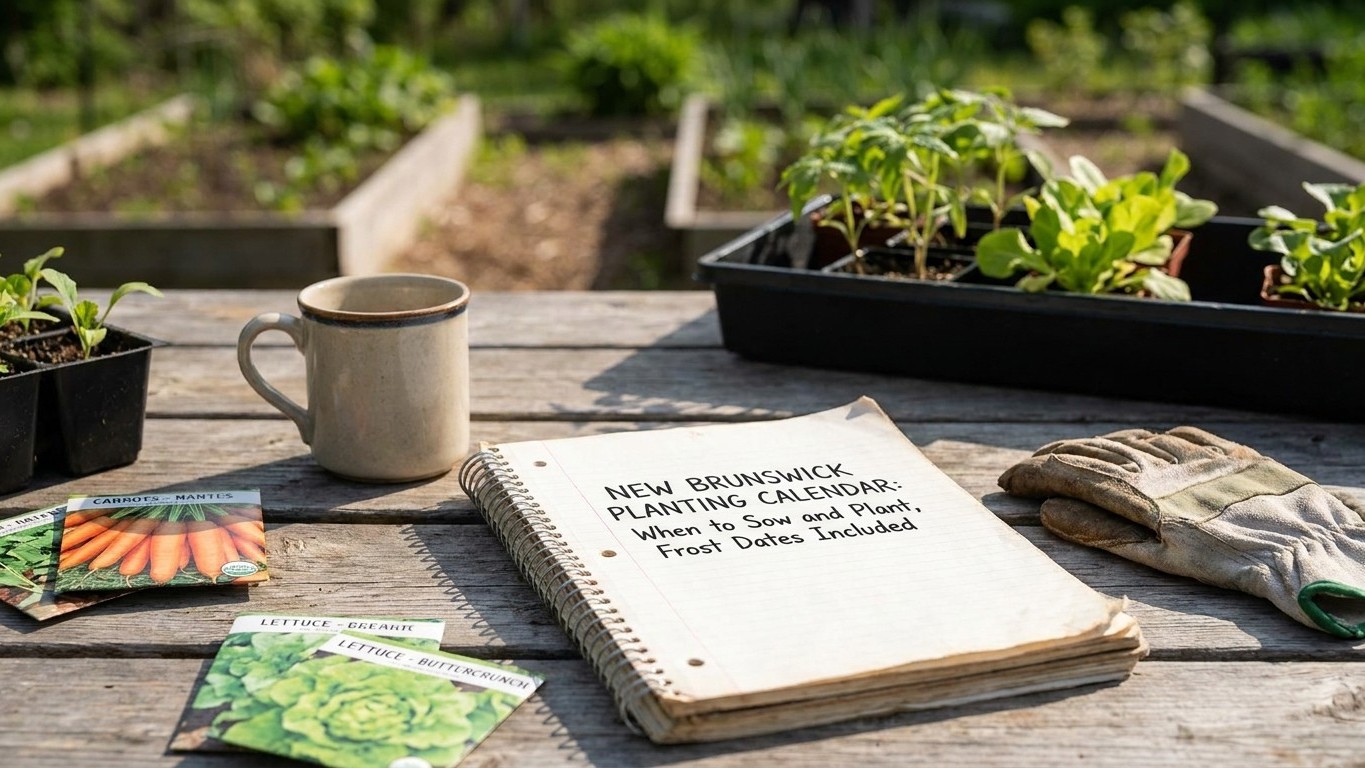

New Brunswick’s growing season runs from an average last spring frost of May 23 to an average first fall frost of October 2, both figures from Environment and Climate Change Canada’s 1981-2010 Climate Normals for the Moncton station. That leaves a frost-free window of roughly 130 days in a typical year, though “average” cuts both ways: frost lands later than May 23 in half of the years on record. Watch your own soil and sky before trusting the calendar, and keep frost cloth ready for the weeks on either side of that date.
The frost window in New Brunswick

Two dates set the boundaries of the New Brunswick garden year. Environment and Climate Change Canada’s 1981-2010 Climate Normals, recorded at the Moncton station, put the average last spring frost at May 23 and the average first fall frost at October 2. Count the days between them and you get a frost-free season of roughly 130 days, call it four and a half months, in an average year.
That word “average” deserves attention before you plant anything. A mean date is the midpoint of a spread, not a guarantee: it fell later than May 23 in half the years Environment and Climate Change Canada measured, and earlier in the other half. Treat May 23 as the center of a window that runs a couple of weeks either side, not as the day frost switches off. Growers across the Gulf work with a still later frost-free window, a difference worth seeing laid out in our Newfoundland and Labrador planting calendar.
Moncton sits in a moderated part of the province, close to the Northumberland Strait. Gardens inland, at higher elevation, or tucked into cold-air pockets typically see frost linger later into spring and arrive earlier in fall than the Moncton normals suggest. If you garden north of the Miramichi or well inland, plan for a growing season measurably shorter than Moncton’s, and lean on your own frost log rather than a single provincial number. Early in the year, What to Plant in New Brunswick in March can help you get seed starting and cold-hardy crops off to a good start, once the frost risk truly clears, What to Plant in New Brunswick in June can guide the shift to warm-season crops, mid-season, What to Plant in New Brunswick in August can help you keep succession plantings and harvests on track, and once frost closes in, What to Plant in New Brunswick in November can help you wrap up the season and plan aheadk, and as the season winds down, What to Plant in New Brunswick in October can help you plan the final weeks before that first fall frost arrives.
What a 130-day season means for crop choice
A season of this length rules out very little if you choose varieties deliberately. It does mean that anything with a long days-to-maturity figure, counted from either seed or transplant, needs a head start indoors, and it means gardeners further from Moncton should read every days-to-maturity figure with a week or two of caution built in. If you want to get a jump on the season with early indoor sowing and cold-hardy planning, see What to Plant in New Brunswick in February. As frost risk eases, What to Plant in New Brunswick in May covers the main transplanting push. Once the season is in full swing, What to Plant in New Brunswick in July covers the crops best suited to peak summer conditions. For a month-by-month breakdown of what to start now, see What to Plant in New Brunswick in April, for guidance heading into fall harvest season, see What to Plant in New Brunswick in September, and for guidance on closing out the season, check What to Plant in New Brunswick in Decembe, or start planning ahead with What to Plant in New Brunswick in Januaryr.
Cool-season crops
Peas, spinach, lettuce, and the brassica family tolerate a light frost because their growing points sit low, close to soil warmth, or because their tissue handles a freeze-thaw cycle without collapsing. These crops go in the ground while May still carries frost risk, not after it.
- Peas and spinach: direct-sow as soon as soil can be worked, well before the last frost.
- Lettuce: transplant or direct-sow while some frost risk remains.
- Brassicas (kale, cabbage, broccoli, Brussels sprouts, cauliflower): start indoors, set out young transplants ahead of last frost.
- Carrots, beets, radishes, turnips: direct-sow only, since transplanting disturbs the taproot.
Direct-sow versus transplant
Sow peas and spinach directly into the soil as soon as it can be worked in spring, well ahead of the May 23 average last frost. Both germinate in cold soil and shrug off a freeze once they’re up, though a hard late frost can still nip young pea shoots back to the ground; they usually recover and resprout from the base.
Lettuce and the brassicas split into two paths. Start them indoors under lights several weeks before the frost date and set out young transplants while there is still real frost risk, since transplants handle a light freeze better than direct-sown seedlings handle cold soil. Or direct-sow the quicker lettuce types once the soil has warmed slightly, accepting a later harvest in exchange for skipping the indoor step.
Root crops go directly into the ground rather than being transplanted, since disturbing the taproot at transplant time stunts or forks the root. Radishes are fast enough to sow in succession every couple of weeks from the earliest workable soil through early summer. Carrots and beets take longer and reward an early start, since a longer stretch in cool soil before summer heat tends to produce sweeter roots.
The common thread across all of these crops is that none of them wait for the last frost date. They go in based on soil condition and workability, and the frost date matters mainly as a marker of how much cool-season growing time remains before warm-season crops need the same space.
Warm-season crops

Tomatoes, peppers, squash, beans and corn all die at first contact with frost, so the frost date works differently for them: it’s the line you plant behind, with a buffer, rather than a target to sow ahead of. Soil temperature limits these crops as much as air frost does. Warm-season seed rots in cold, wet soil before it germinates, and transplants set into cold soil simply sit and sulk instead of growing.
Wait until the soil has warmed and settled past the frost date before setting out tomatoes, peppers, squash, and beans, and before direct-sowing corn and beans outdoors. Every cultivar named below assumes a set-out date of early June, several days after Moncton’s average May 23 last frost, to give the soil time to catch up. Gardeners north or inland of Moncton, where frost risk runs later, should push that transplant date later still rather than holding to a fixed calendar day.
Counting back from transplant to seed-starting date
Indoor seed-starting dates are counted backward from the transplant date, not from the last frost date directly. A tomato started from seed typically needs several weeks of indoor growth before it’s a sturdy transplant, so if your target set-out window is early June, back up from there when you fill trays, adjusting for the bench space and light you can give the seedlings.
The days-to-maturity figure on a seed packet is counted from the transplant date for tomatoes and peppers, and catalogue figures can run a week or two off in either direction depending on the season’s heat. The table below applies that arithmetic to New Brunswick’s frost window: transplant date in early June, days-to-maturity from the catalogue, and the margin of time left before Moncton’s average October 2 first fall frost.
| Variety | Days to maturity | Type | First ripe | Margin before frost |
|---|---|---|---|---|
| Sakura | 55 | Indeterminate | Late July | 63 days |
| Edox | 55 | Indeterminate | Late July | 63 days |
| Valentine | 55 | Indeterminate | Late July | 63 days |
| Glacier | 55 | Determinate | Late July | 63 days |
| Sun Gold | 57 | Indeterminate | Early August | 61 days |
| Supersweet 100 | 60 | Indeterminate | Early August | 58 days |
| Juliet | 60 | Indeterminate | Early August | 58 days |
| Amalfi | 68 | Determinate | Mid August | 50 days |
| Cherokee Purple | 72 | Indeterminate | Mid August | 46 days |
| Big Beef Plus | 72 | Indeterminate | Mid August | 46 days |
| Tiren | 75 | Indeterminate | Mid August | 43 days |
| Granadero | 75 | Indeterminate | Mid August | 43 days |
| San Marzano II | 78 | Indeterminate | Late August | 40 days |
| Celebrity Plus | 78 | Determinate | Late August | 40 days |
All fourteen cultivars carry at least 40 days of margin before Moncton’s average first fall frost, which gives late-season tomatoes room for a slow finish even in a cooler year, but that margin shrinks fast for gardeners north of Moncton where frost risk arrives sooner. If you garden in a shorter-season pocket of the province, favor the 55- to 60-day varieties like Sakura, Sun Gold, or Juliet over the 75-plus day types like Tiren or San Marzano II.
Peppers follow the same logic as tomatoes: warm soil, a post-frost transplant date, and a long run to maturity that rewards starting seed indoors early. Squash, beans, and corn are usually direct-sown, but only once the soil has genuinely warmed, since squash and bean seed rot readily in cold, damp ground even after air frost risk has passed.
The fall planting window
Working backward from Moncton’s average first fall frost of October 2 tells you the last safe sowing date for a fall crop. Take the days-to-maturity printed on the seed packet, add roughly two weeks of margin because growth slows as daylight shortens through September, and count back from October 2 to find your sowing window. A crop with a 60-day maturity figure needs roughly 74 days of runway, which lands the sowing date in mid to late summer for an October 2 harvest target.
Quick crops fit comfortably into this window. A second planting of radishes, lettuce, spinach, and quick Asian greens sown in mid to late summer often matures well before the average frost date, and these same crops tolerate a light frost once they’re growing, so a slightly late-maturing fall planting isn’t necessarily wasted.
Crops that improve after a light frost
Some crops are better for a touch of cold rather than despite it. Kale, Brussels sprouts, parsnips, and carrots left in the ground through a light frost or two convert stored starches to sugars as a cold-tolerance response, which is why a fall-harvested carrot or a frost-touched kale leaf often tastes sweeter than the same crop pulled in August heat. This is a reason to delay harvest of these crops past the first light frost rather than rushing to clear the bed before October 2.
A first fall frost is rarely a hard freeze that ends the season outright. Cool-season crops with some frost tolerance keep growing slowly for weeks past the average date, especially under a floating row cover, which buys real harvest time beyond what the bare frost date implies. Because the October 2 figure comes from the Moncton station, gardeners in cooler parts of the province should shift their fall sowing dates earlier rather than later, since a garden that sees frost two or three weeks ahead of Moncton needs its fall crops sown that much sooner to reach the same size before the cold arrives.
Garlic runs opposite to this whole calendar. It goes into the ground in fall, after the harvest season winds down, and overwinters in the soil to sprout the following spring, so its planting date is set by the ground freezing up rather than by the first fall frost itself.
Reading a planting calendar properly
A province-wide planting calendar built from one weather station is a starting point, not an instruction sheet for your particular yard. New Brunswick’s terrain varies enough, coastal versus inland, low valley versus exposed ridge, that two gardens forty minutes apart can differ by a real stretch of growing season. A planting calendar built for a climate with no meaningful frost risk at all, like the one in our Hawaii planting calendar, looks nothing like this one, since the entire frost-date framework simply doesn’t apply there.
What actually varies from your neighbor’s yard
Elevation cools things down measurably as you go up, and a garden on a hilltop or in the highlands runs behind a comparable garden at sea level. Low-lying spots collect cold air on clear, still nights the way water collects in a basin, so a garden at the bottom of a slope can see frost when a garden partway up the same slope stays clear, a pattern sometimes called a frost pocket. Coastal proximity works the other way, moderating both the spring warm-up and the fall cooldown thanks to the thermal mass of the water, part of why the Moncton station itself tends to run milder than inland stations at a similar latitude. Urban areas add a further wrinkle: pavement and buildings hold heat, so a downtown garden or one against a south-facing wall can run measurably warmer than an open rural field nearby.
None of these effects show up in a single provincial frost date. What a calendar can’t replace is your own observation: keep a simple log of the date of your last spring frost and first fall frost for a few years running, noted right in your garden, and you’ll have a more useful number than any provincial normal by the third year.
A late cold snap after what looked like a settled warm spell is the single most common way gardeners lose a whole tray of transplants. Average dates smooth this risk out of view. Keep frost cloth, an old sheet, or an overturned bucket on hand through the first couple of weeks after your planting date, since a night or two of protection is far cheaper than replacing a bed of warm-season seedlings.
Local help
For frost dates, soil testing, and planting guidance specific to your county rather than to the Moncton station alone, contact Canada’s federal agriculture department at agriculture.canada.ca, which can point you toward New Brunswick’s own agricultural resources. A local soil test is worth doing before you commit a season’s budget to seed and starts, since soil temperature and drainage vary as much within a county as frost dates do across the province.
Our New Brunswick guides cover more of the province’s growing conditions in detail, useful reading alongside whatever county-level data your local office provides.
Common questions
Is May 23 safe to plant tomatoes outside in New Brunswick?
Not on its own. May 23 is Environment and Climate Change Canada’s average last frost date for the Moncton station, which means frost arrives later than that in half of all years. Wait for soil to warm and settle past that date, and keep a few more days of buffer if your garden sits inland, at elevation, or in a known frost pocket.
How do I find the frost dates for my specific county?
Start with Canada’s federal agriculture department, which can direct you to New Brunswick’s provincial resources for county-level normals, and cross-check against your own garden log if you’ve kept one for a few seasons. The Moncton figures used on this page are a provincial reference point, not a substitute for a station near you.
Can I start seeds outdoors instead of buying transplants?
For cool-season crops like peas, spinach, and root vegetables, yes, direct-sowing is the normal method and transplanting often does more harm than good since it disturbs the root. For warm-season crops like tomatoes and peppers, New Brunswick’s frost-free season is short enough that starting from transplants is what gets you a real harvest before the fall frost catches up with a long-maturing variety.
What happens if frost hits my tomato plants early?
A light frost damages foliage but a hard freeze kills the plant outright, so the outcome depends on how cold it actually gets on the night in question rather than on the calendar date alone. Covering plants overnight when a cold night is forecast, even outside the calendar’s frost window, is the cheapest insurance against losing a planting to an early snap.
Do I need to worry about the first fall frost if I’m only growing lettuce and kale?
Less than you would for tomatoes, since both crops tolerate a light frost well and kale in particular improves in flavor afterward. A hard, prolonged freeze will still end the season for both, so the October 2 average is still worth watching as the point when you should start covering plants overnight or planning your last harvest.
Related guides
- Quebec Planting Calendar: When to Sow and Plant, Frost Dates Included
- Nova Scotia Planting Calendar: When to Sow and Plant, Frost Dates Included
- Newfoundland and Labrador Planting Calendar: When to Sow and Plant, Frost Dates Included