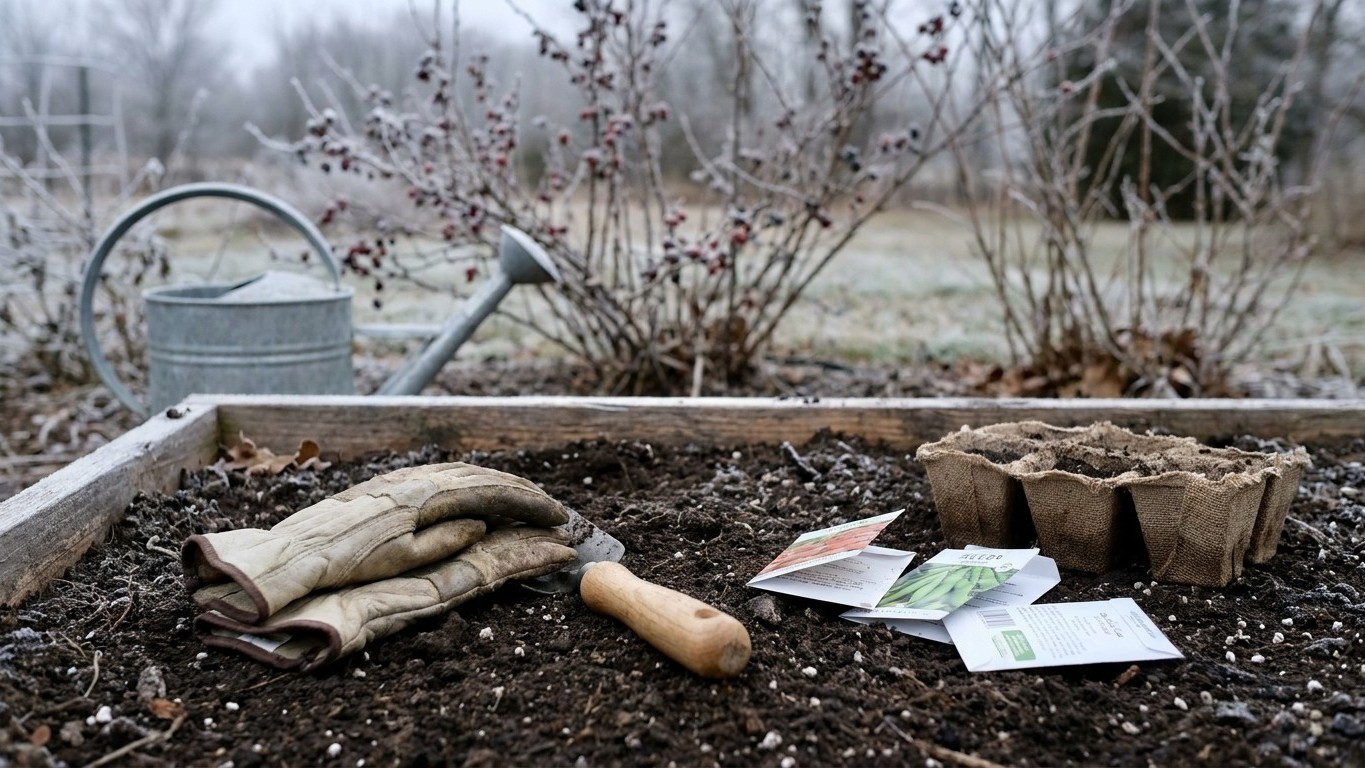

February in New Brunswick sits in the coldest stretch of the year, so nothing goes into open ground outdoors. With a Canadian hardiness zone of 5a at the Moncton reference station and a last spring frost that averages May 23, the soil is frozen or snow-covered across most of the province. The month belongs to cold frames, dormant plantings, seed starting under lights, and the pruning and planning work that makes spring possible.
What goes in the ground in February

The decision here never comes down to a date on the wall. It comes down to soil temperature and how far the ground sits from the last frost window, which in New Brunswick averages May 23 at the Moncton station. That figure is a mean, not a guarantee: in one year out of two, frost arrives later than that. In February, the ground itself makes the call for you. Ask a shovel to break topsoil almost anywhere in the province this month and it will not move.
So the honest answer is that nothing gets direct-sown or transplanted into open, unprotected garden beds this month. That is not a gap in the calendar, it is just where the season is. What still fits inside that reality is narrower but real: garlic and shallots that were meant to go in the previous fall but got missed can sometimes still be tucked into a bed that has thawed enough to work, though this is a gamble that depends entirely on local conditions and should not be counted on.
Cold frames and low tunnels are the actual workhorses of this month. A cold frame set up in the fall can hold hardy greens like spinach, mache, and claytonia through a New Brunswick winter, and February is when a gardener checks that snow load hasn’t crushed the frame and that ventilation is clear on any day the sun gets strong enough to build heat inside. Bare-root fruit trees, canes, and roses can be planted the moment the ground is workable, but in most of the province that window opens later than February, so this month is for having the stock ordered and ready, not in the soil yet. Forcing rhubarb crowns or Belgian endive (chicory) roots indoors in a dark, cool spot is one of the few true harvests this month allows, and it rewards very little effort for a genuinely fresh vegetable in the dead of winter.
What to start under cover
Seed starting indoors runs on its own math, counted backward from the frost window rather than forward from any fixed date. Take the mean last frost of May 23, remember it is a midpoint and not a safe line, then work back by the number of weeks a given crop needs before it can go outside. Onions and leeks are slow from seed and are usually started ten to twelve weeks before transplanting, which lands the sowing date in February for most New Brunswick gardeners. Peppers, another slow grower, typically want eight to ten weeks under lights before they move outdoors, so late February is often the point to start them, always with the understanding that the actual planting-out date may slide later if spring runs cold.
The two ways this goes wrong are mirror images of each other. Start too early, working off a fixed date instead of the frost window, and the seedlings outgrow their pots weeks before it’s safe to move them outside, turning leggy and rootbound on a windowsill or under lights that can’t fully replace the sun. Start too late, and there isn’t enough season left to bring a slow crop to a useful size before the first fall frost, which averages October 2 at the Moncton station, again a mean date rather than a hard stop. New Brunswick’s growing season between those two mean dates runs a little over four months, which is tight enough that a few lost weeks at the start genuinely matter by harvest.
Fast growers like lettuce, brassicas for transplanting, and early herbs can wait until closer to the frost window and still catch up, so there is no need to crowd trays with everything on the same February day.
What is ready to pick
Outdoors, in an open bed, there is little to nothing coming out of a New Brunswick garden in February. That’s simply the season. What keeps a household eating from the garden this month lives under cover or in storage. Kale and some leek varieties, if mulched heavily or buried under consistent snow before the hardest cold set in, can still be dug or cut on a mild day, since snow itself acts as insulation over the crop rather than a threat to it. A cold frame that held on through winter may still be giving up small pickings of spinach or mache, slower now than in fall but usable.
Indoors, sprouts and microgreens are the most reliable fresh green this month, ready in as little as a week from seed on a countertop with no soil at all. Rhubarb forced from a dormant crown in a dark basement or root cellar can be ready to cut within a few weeks of starting the process.
Storage crops need attention now more than at any other point in winter. Squash, potatoes, and onions put up in fall are past the midpoint of their storage life, and this is the month soft spots, sprouting eyes, and mold show up in earnest. Going through the bins by hand, pulling anything that has started to turn before it spreads to its neighbors, keeps the rest of the stash usable for weeks longer.
The jobs that matter this month
Pruning and ordering
Dormant pruning of apple and pear trees, and of raspberry and other cane fruit, is best done in late winter while the plant is fully asleep and the branch structure is easy to see without leaves in the way. Cuts made now heal cleanly before spring growth starts, and pruning too late, once sap is rising, stresses the tree more and invites disease into fresh wounds. Seed ordering also belongs firmly in this window. Popular varieties, particularly of tomatoes, peppers, and any seed sold in limited runs, sell out well before spring, and a gardener who orders in February gets first pick instead of whatever is left on the rack.
Soil, tools, and storage
Soil testing can happen now even where the ground is frozen, since a sample taken in fall or a soil report from a previous season can still guide amendment decisions made on paper this month, ready to apply the moment the ground opens. Compost piles built before winter benefit from an occasional turn on a mild day, mostly to check moisture rather than to drive fast decomposition, which slows to a crawl in the cold anyway. Cleaning and sharpening tools, an easy job to put off, pays for itself the first time a clean, sharp hoe or pruner goes to work in spring instead of a rusted one. Fencing, raised bed frames, and cold frame hardware are all easier to repair now, standing in a quiet garden, than later when planting is competing for the same hours. And stored crops, as noted above, need a regular check this month, not a one-time look back in fall.
What not to do in February
The most common mistake this month is starting warm-season crops indoors far too early because a seed catalog or a stretch of sun through the window creates a false sense of urgency. Tomatoes and peppers started in early February, well ahead of the ten-to-twelve-week window before the May 23 mean last frost, end up leggy, rootbound, and stressed long before it is safe to plant them out. The fix is simple: count backward from the frost window for each crop rather than starting everything on the same day.
A second trap is uncovering mulch, cold frames, or protected beds too early after a mild spell. A few warm days in February do not mean the frost risk has passed. The mean last frost sits nearly three months away, and in half of all years frost arrives even later than that mean date. Pulling back protective mulch now exposes roots and crowns to the next hard freeze, which can undo a full winter of insulation in one cold night.
Pruning spring-flowering shrubs this month is another misstep, since many of them set their flower buds the previous summer, and a February cut removes the very growth that would have bloomed. Save that pruning for right after flowering instead. Feeding nitrogen to dormant lawns, trees, or shrubs is the last of the classic errors: roots aren’t actively growing yet, the nitrogen either leaches away or, worse, pushes a flush of tender growth that a late freeze then kills outright.
Checking this against your own county
Every figure above comes from a single reference station in Moncton, and New Brunswick is not one climate. Elevation in the interior, the moderating effect of the Bay of Fundy along the south coast, and the sharper cold of the north around Restigouche can shift a frost window by weeks in either direction from what’s given here. A gardener in a low-lying frost pocket or at higher elevation should treat these dates as a starting point, not an instruction, and adjust based on what actually happens on their own ground year to year. For guidance tuned closer to home, Agriculture and Agri-Food Canada is a reasonable place to start.
Common questions
Can garlic still be planted in February in New Brunswick?
Only if the ground has thawed enough to work, which is uncommon this month across most of the province. Garlic is normally planted in fall for a reason: it needs a cold period in the ground before spring growth, and a February planting is a gamble rather than a reliable plan.
Is it too early to start tomato seeds indoors in February?
For most of New Brunswick, yes, if done in early February. Tomatoes typically want six to eight weeks indoors before the mean last frost of May 23, which points to a start in mid-to-late spring’s countback, not the dead of winter. Starting too early just produces leggy plants that struggle after transplant.
What can I actually harvest from my garden in February?
Outdoors, expect very little: perhaps kale or leeks that were heavily mulched or buried under consistent snow cover. Indoors, sprouts, microgreens, and forced rhubarb from dormant crowns are the most realistic fresh food this month.
Does the Canadian hardiness zone for New Brunswick match a USDA zone?
No. The Moncton reference station sits in Canadian zone 5a, a system built on seven climate variables rather than the single minimum-temperature measure the USDA system uses. The two scales don’t convert directly, and a single Canadian zone can span several different USDA zones, so this number should never be read as a USDA equivalent.