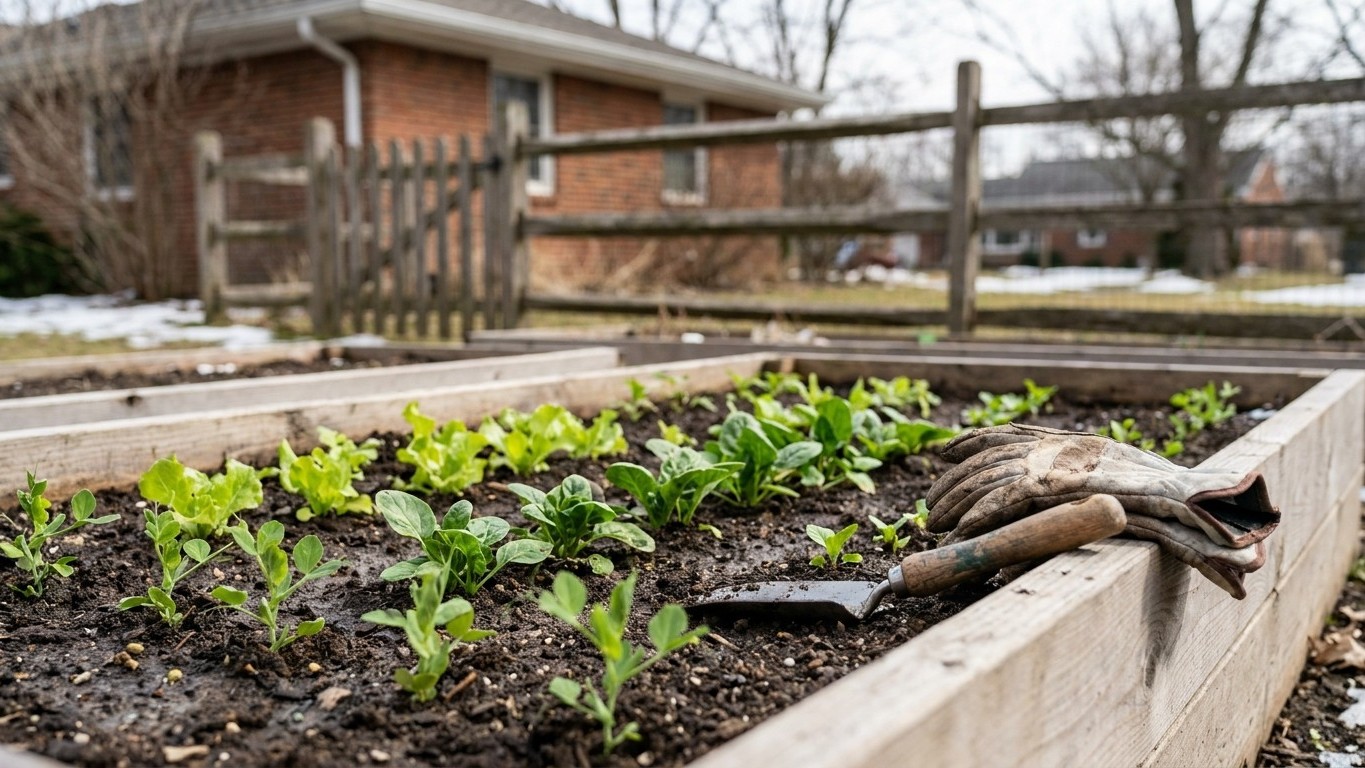

In New Brunswick, March answers to the ground, not the calendar. With the province’s mean last spring frost falling around May 23, most open soil is still cold, often still frozen in low spots, and unsafe for anything but the hardiest crops or protected sowing. What changes the picture from year to year, and county to county, is exactly what this page walks through next.
What goes in the ground in March

For most of New Brunswick, the honest answer is that very little goes into open, unprotected soil this month. The province sits in Canadian hardiness zone 5a at the reference station used for these normals, and the mean last spring frost lands around May 23, a date that Environment and Climate Change Canada’s own normals treat as a midpoint, not a guarantee. In one year out of two, frost arrives later than that. March soil, especially anywhere near the Saint John River valley or inland, is frequently still frozen at depth or turned to cold mud on the surface, neither of which supports root growth or seed germination.
That said, a few tasks belong in the ground this month if conditions cooperate. Garlic and shallots missed in the fall window can sometimes still go in during a thaw, provided the bed is workable and not waterlogged, though fall planting remains the stronger bet for bulb size. Bare-root fruit trees, canes, and dormant perennials can be planted the moment the ground thaws enough to dig a proper hole, but in a zone 5a climate that window often doesn’t open until later in spring, so treat March plantings of this kind as opportunistic rather than routine.
Where protection makes the difference
Cold frames and low tunnels are the real tool this month. Hardy greens like spinach, arugula, and mache can be direct-sown under a cold frame once the soil inside has thawed and drained, since the cover buys several weeks over open ground. Forcing rhubarb or chicory indoors, using roots lifted the previous fall, gives a fresh harvest while the outdoor beds are still off-limits. None of this replaces open-ground planting. It fills the gap until the soil, not the thermometer on a mild afternoon, says the season has actually turned.
What to start under cover
Seed starting indoors runs backward from the frost window, not forward from a date on a packet. With the mean last frost around May 23, a gardener counts back the number of weeks a given crop needs before it’s ready to go outside, then lands on a sowing week. Onions and leeks, which grow slowly and tolerate a longer stint indoors without much harm, are typically among the earliest starts, and March sowing lines up well with a late-May transplant date. Peppers, also slow to germinate and slow to size up, often go in around the same stretch. Tomatoes usually wait a few weeks longer, since they grow fast indoors and can outrun their pots if started too soon.
| Crop group | Typical start timing relative to last frost | Where to start |
|---|---|---|
| Onions, leeks | Early, longest lead time | Trays or cell packs indoors |
| Peppers | Early to mid, slow germinators | Heat mat indoors |
| Tomatoes | Later, fast growers | Indoors, cooler light once up |
| Hardy brassicas (cabbage, broccoli) | Mid, moderate lead time | Cold frame or bright indoor spot |
The two ways this goes wrong are opposite failures. Start too early, without enough light or room to pot up, and the seedlings turn leggy and rootbound weeks before the soil is ready for them, a setback that shows up as stunted plants all summer. Start too late, and with a growing season bounded by a mean frost-free window that closes again around October 2 in the fall, there isn’t enough time left for slow crops to mature before cold weather returns. Counting backward from the frost date, rather than sowing on a fixed date every year, is the only way to hit that window reliably.
What is ready to pick
Outdoors, March offers almost nothing fresh in most of New Brunswick, and it’s worth saying plainly rather than padding the list. Snow cover may still sit over garden beds in the north and interior, and where it has retreated, the ground beneath is typically too cold for active growth. What does still feed a household this month comes from what was put by earlier or tucked under cover.
Overwintered kale and leeks, planted the previous season and left in place under mulch or snow, can often be dug or cut as soon as the ground softens enough to get a fork into it, and their flavor tends to sweeten after hard cold. Cold-frame greens sown in late winter, spinach and mache especially, start growing again as daylight lengthens and can be cut a leaf at a time. Indoors, sprouts and microgreens fill the gap entirely on their own schedule, ready within a week or two of sowing regardless of what the weather is doing outside.
This is also the month to go through the root cellar or pantry shelves with a critical eye. Stored squash should feel firm and heavy for its size; any softening at the stem end or a sweet, fermenting smell means it’s on its way out and should be used first. Potatoes that have started sprouting eyes are still edible once the sprouts are removed, but any green tinge on the skin should be cut away generously. Onions that have gone soft at the neck or started growing a green shoot are best used immediately rather than left to spoil the rest of the bin. New Brunswick’s maple producers are also tapping trees this month, a reminder that the garden isn’t the only thing waking up under the snow.
The jobs that matter this month
March carries real deadlines even though little is growing outdoors, and skipping them costs the season later rather than costing nothing at all.
Pruning and dormant work
Dormant pruning of apple and pear trees, and of raspberry and currant canes, should happen before buds swell and sap starts moving. Prune too late, once growth has begun, and the plant wastes energy healing cuts instead of pushing new wood, and the wounds heal more slowly. Choose a dry day above freezing for the work, since cutting into frozen wood can shatter branches rather than cleaving them cleanly.
Ordering, planning, and prepping
Seed catalogs sell through their most popular varieties early, so ordering now, rather than waiting for a warm afternoon to inspire a trip to the garden center, is the difference between getting the variety planned for and settling for whatever’s left. This is also the natural month to sketch next season’s rotation on paper, moving nightshades and brassicas to beds they haven’t occupied in the past couple of years to keep soil-borne pests and diseases from building up.
- Test soil pH and nutrient levels as soon as beds are workable enough to pull a sample
- Turn the compost pile to speed decomposition before spring demand for finished compost arrives
- Clean and sharpen pruners, loppers, and shovels while there’s time to do it properly
- Repair raised bed frames and fencing that frost heave or winter wind have loosened
- Check stored crops weekly for the ones about to turn, rather than waiting for a smell to announce it
What not to do in March
The most common mistake is trusting the air rather than the soil. A string of mild, sunny days can push the thermometer well above freezing while the ground six inches down is still solid or barely thawed, and warm-season seeds or transplants set into that cold soil simply sit and rot rather than germinate. Wait for the soil itself to warm and drain, not for a comfortable afternoon in a coat.
A related error is uncovering cold frames, pulling back mulch, or hardening off tender seedlings too early after a mild spell. With the mean last frost sitting around May 23, and frost arriving later than that mean in half of all years, an early warm stretch in March is not evidence the cold is finished. Plants exposed too soon can be knocked back hard, or killed outright, by the next cold snap.
Feeding nitrogen at the wrong point is a third trap. Applying a high-nitrogen fertilizer to dormant beds or newly emerging perennials pushes soft, leafy growth before the plant has real root development to support it, and that soft growth is exactly what a late frost damages worst. Hold nitrogen applications until plants are in active growth, and lean on compost or a balanced amendment for anything applied this early instead.
Checking this against your own county
A province-wide frost window is a starting point, not an instruction for a specific backyard. Elevation, distance from the Bay of Fundy, and the difference between the warmer south and the colder, higher interior and north can shift these dates by weeks in either direction. A garden in a low frost pocket may see cold linger well past the provincial mean, while a sheltered coastal spot can run ahead of it.
For a planting calendar built around the specific conditions of a given county, and for soil testing and extension guidance, New Brunswick gardeners can start with the federal Agriculture and Agri-Food Canada site.
Common questions
Can I plant vegetable seeds outdoors in New Brunswick in March?
Direct-sowing into open, uncovered ground is rarely a good bet this month across most of the province, since soil is often still frozen or waterlogged. Hardy greens under a cold frame or low tunnel are the exception, once the soil beneath the cover has actually thawed.
When should I start onions and peppers indoors for a New Brunswick garden?
Both are slow to size up, so an early start indoors, counted back from a late-May transplant target tied to the mean last frost around May 23, generally lands sowing in March. Adjust earlier or later based on how sheltered or exposed the specific garden site is.
Is it too early to prune fruit trees in March?
It’s usually the right window, provided the wood isn’t frozen solid and the day is dry. Pruning before buds swell avoids wasting the tree’s energy and keeps cuts cleaner than pruning after growth has started.
What hardiness zone is New Brunswick, and does it match US zone charts?
The reference city used for these figures sits in Canadian zone 5a, a rating built from seven climate variables rather than the single winter-minimum-temperature measure the USDA system uses. The two scales don’t convert directly, so a Canadian zone number should never be read as if it were a USDA zone.