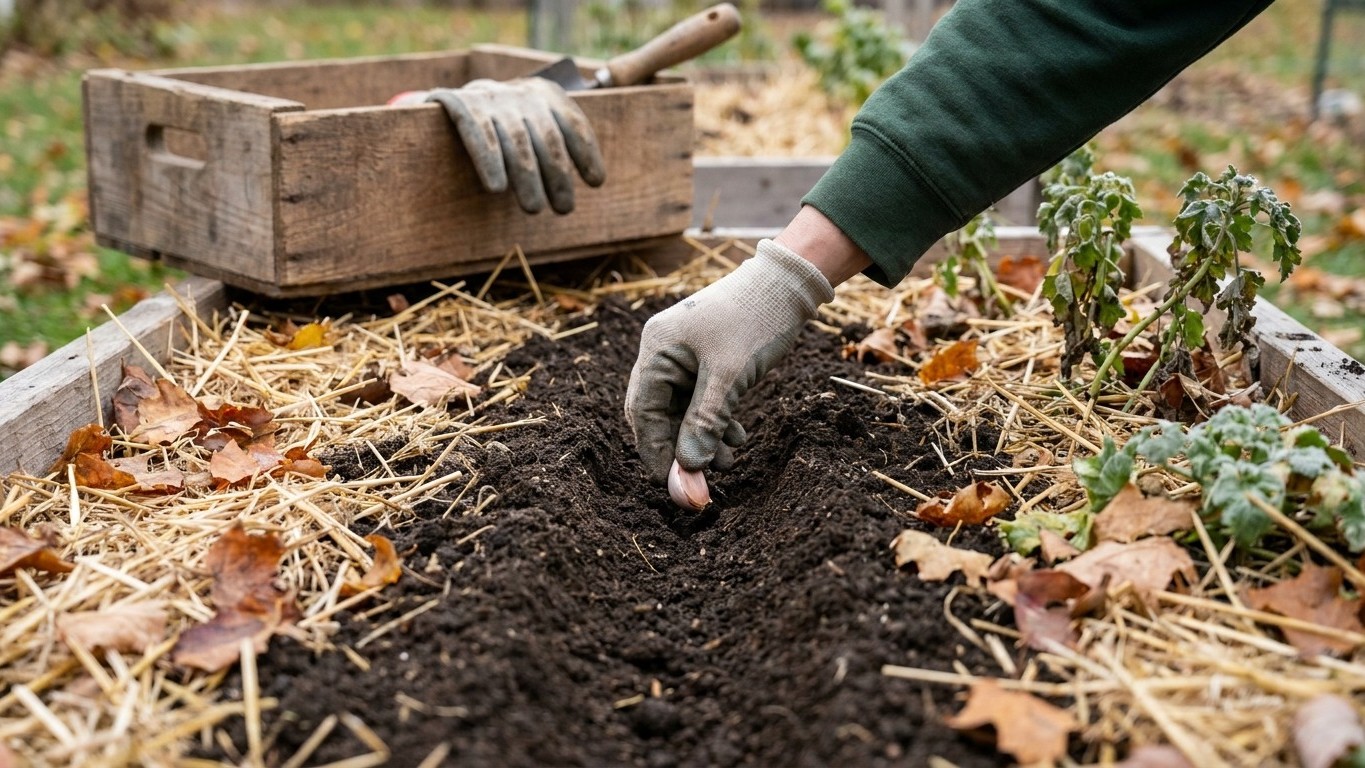

By November, the Piedmont has already crossed into frost territory or is about to. Garlic and shallots still go in the ground, hardy greens survive under cover, and the real work shifts from planting to protecting what’s already growing and prepping the soil for spring. Zone 8a Coastal Plain gardens have more room to maneuver than Zone 6b mountain gardens do.
What goes in the ground in November

The calendar says November, but the soil doesn’t read calendars. What decides whether something survives outdoors this month is soil temperature and where the local first freeze falls relative to today’s date, not the number on the wall. Around Charlotte, that first fall freeze arrives somewhere between October 30 and November 8. That means by the time this page is being read in most years, the Piedmont has already had its first hard frost, or is standing right at the edge of it.
That single fact rules out anything tender. Tomatoes, peppers, beans, squash: none of that belongs in open ground now, no matter how mild a particular week feels. What does still go in is garlic and shallots, planted as cloves or sets while the soil remains workable and before it locks up hard. Both need the cold months to size up bulbs for a summer harvest, so a late-November planting still counts as on time in most of the state.
Cover crops belong in this window too. Cereal rye, crimson clover and winter wheat, broadcast over cleared beds, hold soil through winter rain and add organic matter back in spring. Cold frames and low tunnels extend the list further: spinach, mâche, and mustard greens sown under a layer of plastic or row cover will germinate even after the open garden has stalled out. Bare-root fruit trees and dormant perennials, when nurseries carry them, also go into the ground now while roots are inactive and transplant shock is minimal.
How the state splits by region
| Region | General pattern | What that means for November |
|---|---|---|
| Blue Ridge Mountains | Shorter season, earlier fall freeze | Ground likely already frozen at the surface; focus on cold frames only |
| Piedmont (Charlotte reference) | First freeze October 30 to November 8 | Garlic and cover crops still workable early in the month |
| Coastal Plain | Milder, longer growing window | More outdoor greens still viable under row cover |
The USDA Plant Hardiness Zone Map places North Carolina anywhere from 5b in the highest mountain pockets to 8b along the coast, with Charlotte itself sitting solidly in the milder middle. That range is why a blanket statewide instruction never fits every backyard.
What to start under cover
Working backward from the last spring frost, which lands between March 23 and April 5 around Charlotte, gives a cleaner answer than working forward from today. Long-season transplants like onions typically need 10 to 12 weeks indoors before they go out, which puts their ideal start in late December or January, not November. Starting them now risks the classic failure mode: rootbound, leggy seedlings sitting on a windowsill for two extra months before the ground is ready for them.
What does make sense to start under cover in November is anything meant to be harvested through winter rather than transplanted in spring. Lettuce, spinach, mustard, and Asian greens sown directly into a cold frame or unheated hoop house will germinate slowly in cooling soil and keep producing leaves through much of the winter, especially in Piedmont and Coastal Plain gardens where hard freezes are intermittent rather than constant. Microgreens and sprouts, grown entirely indoors under a grow light or a bright window, sidestep the frost question altogether and deliver a harvest in seven to fourteen days regardless of what’s happening outside.
The other failure mode worth naming is starting too late. Gardeners who wait until deep winter to think about spring onions or early brassicas often find themselves sowing indoors in February for a March transplant window that’s already closing. Counting backward from the frost date, not from habit, is what keeps the timing honest in either direction.
What is ready to pick
Persimmons and pecans are two of the more distinctive November harvests in North Carolina, both ripening after the first cool nights soften or crack their coverings. Fall-planted brassicas, kale, collards and turnip greens in particular, actually improve after a light frost, which converts starches to sugars and takes the bitter edge off the leaf. That’s not folklore; it’s the same cold-hardening response that lets these crops sit in the garden long after tomatoes have turned to mush.
Winter squash and sweet potatoes, if not already pulled and cured, need to come in now if they haven’t already; both rot quickly once soil temperatures drop and moisture lingers. Anything still in storage from earlier harvests, squash, onions, potatoes, deserves a hands-on check this month. Soft spots, a sweet fermenting smell, or sprouting eyes on potatoes all mean that item needs to be used or composted before it takes neighbors down with it.
Cold frame greens sown in September or October should be reaching harvest size by now, and a light thinning of overcrowded rows doubles as the first cut of the season. For households wanting fresh greens without stepping outside at all, a jar of sprouting mung beans or a tray of microgreens on the counter fills that gap in under two weeks.
The jobs that matter this month
Leaves fall in volume across most of the state in November, and that’s less a cleanup chore than a resource. Shredded leaves make free mulch and free compost carbon, and piling them two to three inches deep over garlic beds, strawberry crowns, and perennial roots insulates against the freeze-thaw cycles that heave plants out of loose soil. Skipping this step is one of the more common ways gardeners lose overwintering crops that would otherwise have survived just fine.
Seed ordering belongs on this month’s list too, even though it feels premature. Popular varieties, particular tomato lines, specific pepper cultivars, sell out by midwinter, and catalogs that look fully stocked in November are often picked over by February. Ordering now, while selection is wide, costs nothing but a little planning.
Soil testing is another job with a real deadline behind it. North Carolina State University’s Cooperative Extension processes soil samples, and results that come back showing a lime or nutrient deficiency need weeks to take effect once amendments go down, meaning a test submitted now still has time to correct pH before spring planting rather than after it. Turning compost piles one more time before the coldest weather locks them up keeps the decomposition process from stalling completely over winter.
Tool maintenance, cleaning soil off blades, sharpening pruners, oiling moving parts, takes an afternoon and prevents rust damage that otherwise shows up as a spring surprise. Fencing and raised bed frames that took a beating over the growing season are easier to repair now, with the bed empty, than in spring when there’s a seedling in the way of every repair.
What not to do in November
A stretch of 65-degree afternoons in early November convinces some gardeners the frost warning was overcautious, and that’s the mistake that costs the most. Air temperature and soil temperature move at different speeds; a warm afternoon doesn’t undo a freeze that already hit the ground overnight. Planting anything warm-season into that soil, on the strength of a mild week, wastes both the seed and the effort.
Uncovering cold frames or row-covered beds too eagerly after a warm spell is the same mistake in reverse. Greens that have hardened off under cover can suffer real damage if exposed to a sudden overnight drop after a few days of unprotected mild weather softened their tolerance. The cover stays on through the cold snaps, not just during them.
Nitrogen fertilizer is the other classic misstep. Feeding nitrogen to perennials, fruit trees, or lawns this late pushes soft new growth right before a freeze, and that new growth is exactly what winter damage targets first. Anything getting fed now should get phosphorus and potassium instead, or nothing at all, with nitrogen held back until active spring growth resumes. Pruning fruit trees and cane berries also waits; cutting now, while the plant is only partly dormant, opens wounds that don’t heal as cleanly as they would in the deeper dormancy of midwinter, and it can invite disease into fresh cuts before the tree has fully shut down for the season.
Checking this against your own county
A statewide answer is a starting point, not an instruction for a specific backyard. Elevation alone can shift a frost date by two or three weeks between a mountain hollow and a Piedmont valley a hundred miles away, and the Coastal Plain runs on its own milder schedule entirely. The Charlotte-based frost windows cited here describe the Piedmont; a garden in Asheville or in Wilmington is working from a different calendar even in the same month.
North Carolina State University’s Cooperative Extension, at ces.ncsu.edu, publishes county-level guidance and staffs local offices that know the specific microclimate of a given county far better than any statewide page can.
Common questions
Can I still plant garlic in late November in North Carolina?
Yes, in most of the Piedmont and Coastal Plain, as long as the soil is still workable and hasn’t frozen solid. Garlic tolerates late planting better than most crops because it needs the cold period regardless of exact timing.
Will a light frost kill my kale and collards?
No. Both crops tolerate frost well and typically taste better afterward, as the cold converts stored starches into sugars. Hard freezes below the mid-20s can eventually damage exposed leaves, but a first frost is not a threat to established plants.
Is it too late to start a fall vegetable garden in November?
For most open-ground crops, yes, given how close the first freeze falls to this window in the Piedmont. Cold frames and low tunnels still allow fast-growing greens to be sown successfully.
Should I fertilize my lawn or garden beds in November?
Hold off on nitrogen, which encourages tender new growth right before freezing weather. Phosphorus and potassium, or a soil test-guided amendment, are safer choices for this time of year.