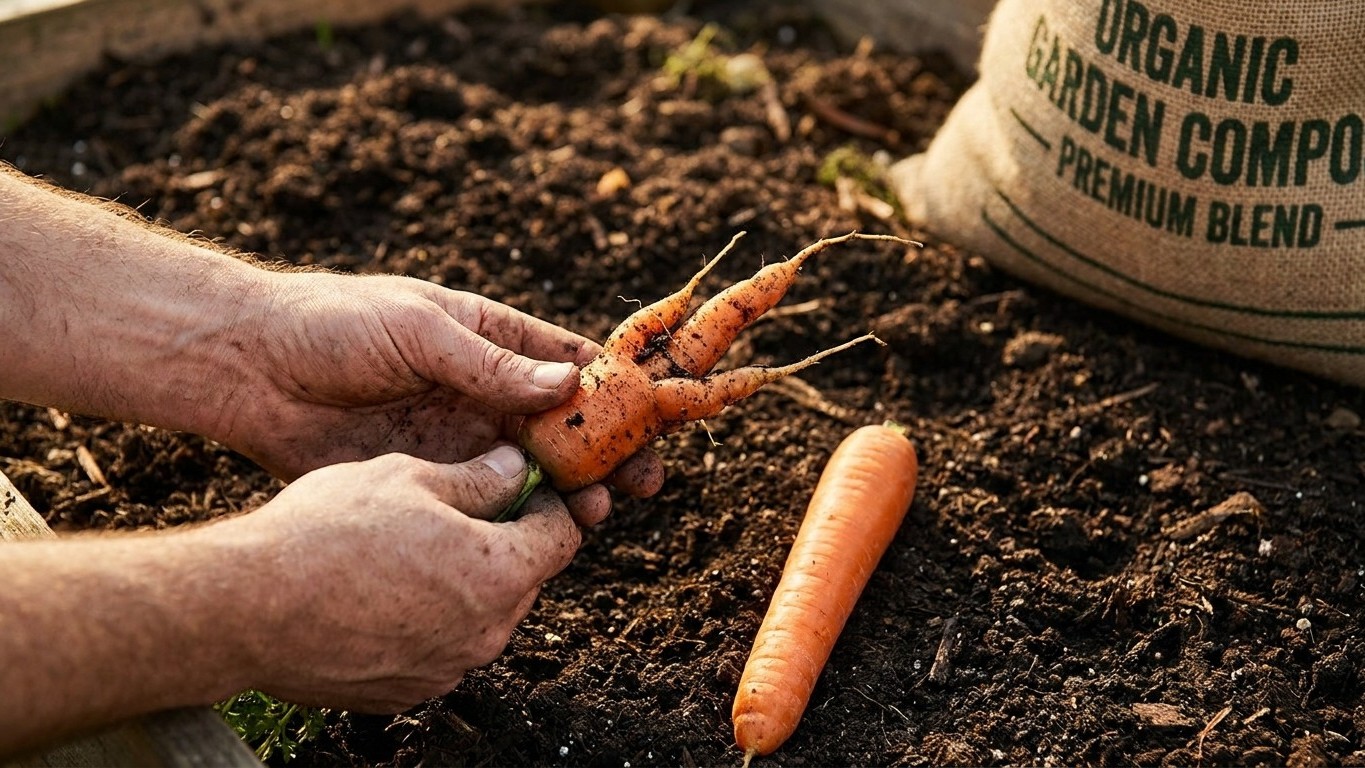

Carrots fork when the taproot hits heavy or rocky soil and splits into several roots instead of growing straight down. The fix isn’t a different seed packet, it’s the dirt itself. Work compost into the bed and loosen it well below where the root will travel, and a single carrot gets the room it needs to grow long and straight. That answer holds whether the garden sits on heavy clay or sandy loam, though how much digging a bed actually needs depends on what’s under your feet.
The short answer
What the extension actually says
According to Utah State University Extension’s publication Carrots in the Garden, the crop wants “fertile, well-drained, deep, sandy soils rich in organic matter.” That single sentence explains why some carrots come out of the ground looking like a hand instead of a finger. When a bed doesn’t match that description, when it’s heavy, compacted, or full of rock, the result is the root forking, producing several roots where there should be one.
The published fix is just as direct. Heavy soil, the extension notes, needs “to be amended with plenty of compost and should be double dug to allow good root development.” There’s no mention of switching seed packets, no raised-bed requirement, no pH target, no variety recommendation. The remedy is the ground itself: add organic matter, then break up the soil to a depth well past where the taproot will travel.
That’s worth sitting with, because it’s tempting to treat forking as a genetics problem and shop for a solution. It isn’t. A carrot forks because its root tip meets something it can’t push through, a rock, a clay clod, a compacted layer, and grows around it or splits trying. Compost and deep digging solve that mechanically. They don’t change the carrot; they change what the carrot has to grow through.
Why a state description isn’t a diagnosis
One caution belongs here. Utah State University Extension is describing Utah conditions in general terms, and Utah alone spans an enormous range of soil, from sandy valley bottoms to heavy clay benches. A state, any state, covers hundreds of distinct soil series, and a description written for one region tells a gardener almost nothing certain about the dirt in a specific backyard.
The test that actually settles the question costs nothing. Dig a shovelful from where the carrots will grow, squeeze a handful when it’s moist, and watch what happens. Soil that holds a ribbon shape and feels slick between the fingers is heavy with clay. Soil that falls apart the moment the hand opens is sandy and probably closer to what the crop wants already. Everything in between calls for judgment, not a chart, and for the same remedy Utah State University Extension already gave: compost, and enough digging to loosen the ground where it counts.
What actually decides it
Texture, compaction, and obstruction
A carrot root doesn’t grow the way a nail gets driven into wood, moving in a straight line by force. It grows the way roots always grow: the tip is soft, and it follows the path of least resistance through the soil around it. In loose, deep, sandy ground, that path is mostly straight down, because nothing deflects it. In heavy or rocky ground, the path bends. And when the growing tip meets something it genuinely can’t push aside, a stone, a dense clay lens, a compacted layer left behind by a tiller blade, it doesn’t just stop. It often splits, sending out two or more growing points where there was one. That’s the fork.
Three things decide whether that happens, and they’re related but not identical. Texture is the ratio of sand, silt, and clay particles, and it’s mostly fixed for a given plot; no amount of digging turns clay into sand. Compaction is different: it’s how tightly those particles are packed together, and it changes with tillage, foot traffic, and organic matter content. Obstruction is the simplest of the three, literal rocks and debris sitting directly in the root’s path.
Why depth matters as much as looseness
Organic matter, compost in practice, works on compaction more than on texture. It doesn’t remove clay particles, but it gets between them, holding open small pockets of air and water that keep the soil easier for a root tip to part. That’s the entire logic behind the double-dig recommendation: digging loosens the soil mechanically, and compost keeps it loose instead of resettling into a dense mass after the first hard rain.
Depth matters as much as looseness. A bed can be beautifully loose in the top few inches and turn to brick just below, and a carrot doesn’t care how nice the surface layer feels if the tip hits a hardpan a few inches down. That’s why the recommendation is to double dig, working the soil in two layers rather than one, so the loosened zone actually reaches as deep as the root intends to grow. None of this requires knowing a soil’s official name. If a spot resists a shovel, holds water after rain, or shows visible stones in the top layer, a root growing through it faces the same three problems: something to deflect it, something to compact around it, and not enough loose depth before it hits either one.
How to do it
The order matters here, because each step depends on the one before it.
- Check the texture first. Take a handful of moist soil from the bed and squeeze it. If it holds a slick ribbon shape, treat the bed as heavy. If it crumbles apart, it’s closer to what the crop already wants.
- Clear rocks and debris from the surface layer. Anything a root tip could physically meet on the way down needs to come out before digging starts.
- Spread compost generously over the bed. This is the organic matter the amendment calls for, and it goes on before the digging, not after.
- Double dig the bed. Work the compost into the top layer, then loosen the layer beneath it as well, so the loosened zone runs deeper than a single spade’s depth.
- Rake the surface smooth and pull out any clods or stones that surfaced during digging.
- Sow carrot seed directly in place. Carrots don’t transplant well, so there’s no seedling stage to move; the seed goes straight into the bed you’ve just prepared.
- Thin the seedlings once they emerge so each root has open soil around it rather than competing with its neighbors for the same loosened ground.
What goes wrong
Soil prep mistakes
- Digging only the top layer. A shallow dig leaves a hard layer just below the surface, and the root forks the moment it reaches it. The remedy is finishing the second pass of the double dig, not stopping after the first.
- Tilling instead of amending. A tiller can loosen the surface without adding anything to keep it loose, and the ground compacts right back after rain. Compost has to go in, not just be stirred through once.
- Leaving rocks in the profile. A bed can look fine on top and still hide stones a few inches down. Sifting the soil, or at least hand-checking it as the digging goes, catches what a quick rake misses.
Cultivar mismatch
Sometimes the soil genuinely can’t be fixed in the time available, a raised bed isn’t an option, or the ground is shallow over rock. In that case, the workaround isn’t more digging, it’s picking a carrot that never has to travel far. According to NC State Extension, cultivars differ enough in root shape that the choice itself changes what the soil needs to provide.
| Type | Root description | Best fit |
|---|---|---|
| Atlas | Small spherical roots 1-2 in long | Shallow soil and containers |
| Nantes group | 6-7 in long cylindrical roots, tender and sweet | Grows well in heavy soils |
| Little Finger | Nantes type with 4 in long roots, small and sweet | Shorter root, less depth needed |
This isn’t a fix for the soil itself. The root still meets the same clay or rock a longer carrot would; it simply doesn’t have to grow through as much of it to reach full size. Pairing a round or short cultivar with unimproved ground avoids forking by shortening the trip, while amending the soil, per Utah State University Extension’s guidance, is what lets a longer type like the Nantes group grow straight in the same bed over time.
Common questions
What causes carrots to fork?
The root tip meets something it can’t push through, a rock, a compacted layer, or dense clay, and splits into more than one growing point instead of continuing straight down.
Can amending the soil fix forked carrots for good?
Utah State University Extension’s remedy, compost plus double digging, addresses the mechanical cause directly, but it has to be repeated as needed since soil resettles over time, especially without regular organic matter added back in.
Do all carrot varieties need deep soil?
No. According to NC State Extension, round types like Atlas and short types like Little Finger need far less depth than long cylindrical types such as the Nantes group, which is why cultivar choice can substitute for soil work in shallow ground.
What’s the fastest way to check if my soil is too heavy?
Squeeze a handful of moist soil from the bed. If it holds a slick ribbon shape, treat it as heavy and follow the compost-and-double-dig approach before sowing.