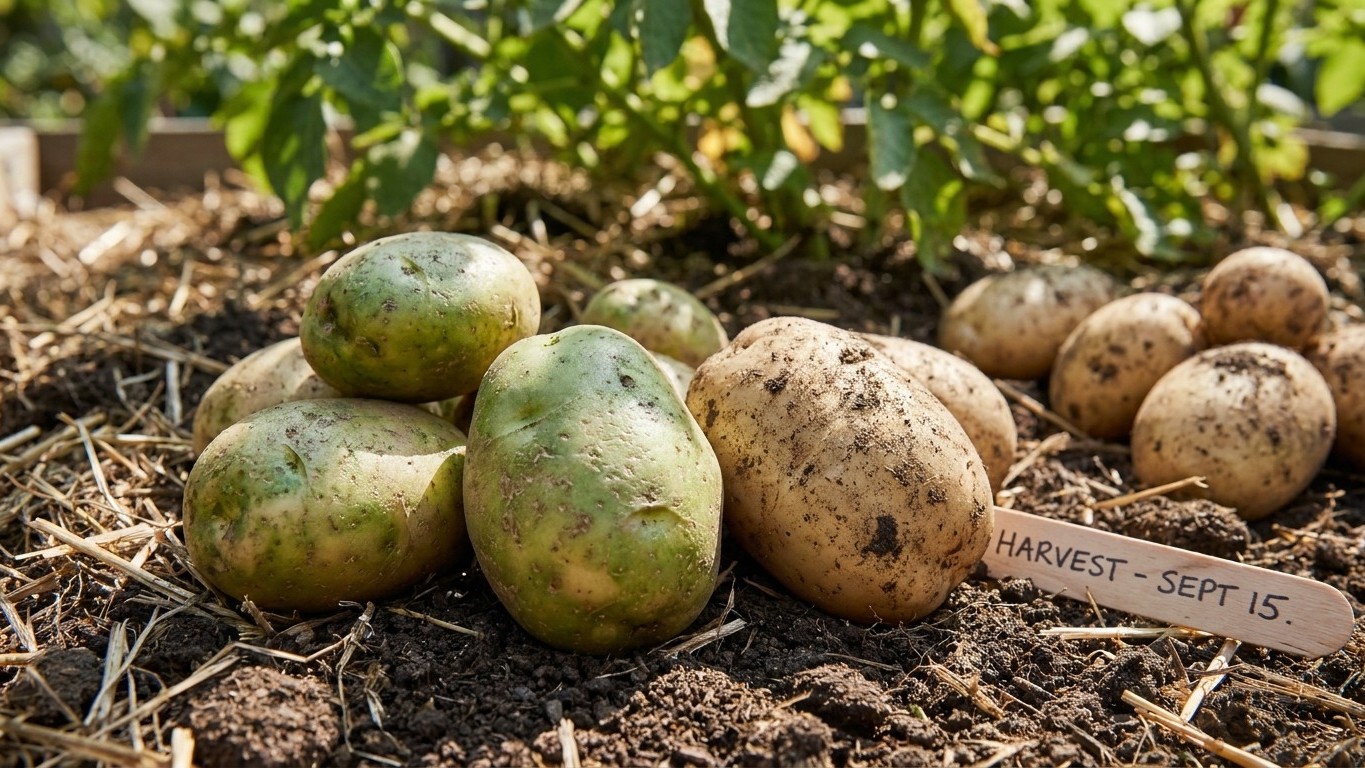

Light does it. Whether it’s sunlight falling on a tuber poking through loose soil, a kitchen counter near a window, or the fluorescent glare of a grocery store display, any exposure that reaches the skin of a potato triggers chlorophyll production, the same green pigment found in leaves. Alongside that green comes solanine, a bitter compound that both Utah State University Extension and the University of Maine Cooperative Extension flag as the real concern, not the color itself.
The short answer
The green skin is chlorophyll, and it shows up because the tuber has been exposed to light, either while it was still growing or after it left the ground. The University of Maine Cooperative Extension, in Bulletin #2077, ties this directly to a garden practice called hilling: gardeners are told to mound soil around the base of the plants once they reach about 6 inches tall, and to repeat that mounding up to three times over the course of the season. Utah State University Extension adds a timing detail from the other end of the calendar, recommending that the first hilling happen within four weeks of planting. Those two pieces of guidance aren’t contradictory, they’re describing the same job from two angles: cover the tubers before they have a chance to catch light, and keep covering them as the plant grows and the soil settles or washes away.
The reason this matters goes beyond appearance. Utah State University Extension states plainly that hilling isn’t cosmetic, the tubers left exposed to light turn green and produce solanine, and solanine tastes bitter. That’s the actual stake here: a green potato isn’t just visually off, it’s carrying a compound the plant makes as a defense response, and it doesn’t cook away.
Same mechanism, after harvest
The greening doesn’t stop once the potatoes are dug up. Utah State University Extension notes that light in storage produces the identical result as light in the garden: green skin, solanine, bitterness. That’s why both extensions push storage conditions that keep tubers in the dark. The University of Maine Cooperative Extension recommends storing potatoes at 38 F with 95 percent humidity. Utah State University Extension gives a slightly different range, 40 to 45 F. The two numbers aren’t in conflict so much as reflecting different emphases, one extension prioritizing a tighter cold target, the other a workable range for a home root cellar or basement. What both agree on, and what actually decides whether your stored potatoes stay clean, is that the space has to be cool, moist, and dark. Skip the dark part and the Temperature number stops mattering.
What actually decides it
Two separate processes are at work, one in the ground and one in storage, and understanding both means you can size up a situation the guidance above never directly addresses.
In the garden: soil coverage versus tuber growth
A potato plant sets its tubers close to the surface, and as those tubers swell, they push upward. Loose or eroded soil, heavy rain that washes a hill flat, or simply not mounding enough soil to begin with, all create the same opening: a tuber breaks the surface and picks up light. This is why the University of Maine Cooperative Extension calls for repeated hilling, up to three times, rather than a single pass. It’s not that the first hilling failed, it’s that growth and weather keep undoing the coverage. A gardener facing a case this page doesn’t specifically cover, say, a raised bed with sandy soil that drains and shifts fast, should reason from that same principle: whatever situation keeps soil loosely piled and tubers shallow is a situation that needs more frequent hilling, not less.
In storage: darkness as the ongoing requirement
Once potatoes are out of the ground, the light exposure risk doesn’t end, it just changes shape. A tuber sitting in a paper bag on an open shelf, near a window, or under a bright bulb is undergoing the same chlorophyll and solanine reaction as one left uncovered in the field. Utah State University Extension’s point that storage light produces the same effect as garden light is the key piece of reasoning here: the fix isn’t unique to gardening. Any container or room that blocks light, regardless of whether it hits the temperature numbers exactly, is working. Get the darkness right and the temperature range becomes the fine-tuning, not the deciding factor.
How to do it
- Plant potatoes and let the plants establish, watching for the point where they reach roughly 6 inches tall.
- Perform the first hilling, mounding soil up around the base of the plants; Utah State University Extension notes this should happen within four weeks of planting.
- Continue monitoring the hills as the plants grow, watching for soil that has washed down, settled, or been disturbed by rain or weeding.
- Re-hill as needed, repeating the process up to three times over the season, per the University of Maine Cooperative Extension’s guidance.
- Harvest the tubers once the growing season has run its course for that variety’s season class, whether early, mid-season, or late.
- Move harvested potatoes promptly into a storage space that can be kept dark.
- Set that storage space to a cool, moist environment, either around 38 F at 95 percent humidity (University of Maine Cooperative Extension) or in the 40 to 45 F range (Utah State University Extension).
- Check stored potatoes periodically for any green tinge, which signals that light is reaching them despite the covering or container.
What goes wrong
- Hilling starts too late. If soil isn’t mounded until the plants are well past 6 inches, tubers may have already begun forming near the surface. Utah State University Extension’s four-week benchmark is a useful check: if a month has passed since planting and no hilling has happened, catch up immediately rather than waiting for a taller plant.
- Hilling happens only once. A single mounding early in the season looks complete at the time but rarely stays that way. Rain, irrigation, and the tubers’ own growth erode or lift the soil. The University of Maine Cooperative Extension’s recommendation of up to three hillings exists precisely because one pass isn’t durable.
- Harvested potatoes sit in a lit space, even briefly. A countertop, a sunny mudroom, or an open porch all count as light exposure. Utah State University Extension is direct that storage light causes the same greening as garden light, so a few days on a windowsill can undo careful garden hilling.
- Storage temperature drifts warm. A garage or pantry that swings above the ranges both extensions describe (38 F at 95 percent humidity per the University of Maine Cooperative Extension, or 40 to 45 F per Utah State University Extension) won’t cause greening by itself, but it does undercut the storage quality these guidelines are built around. Darkness is the non-negotiable piece; temperature is the part worth tightening once darkness is handled.
- A green potato gets eaten anyway. Since solanine is the actual issue, not just appearance, a tuber that has turned green in the garden or in storage should be treated as a quality problem rather than a cosmetic one, per Utah State University Extension’s description of the bitterness it produces.
Common questions
Does washing or peeling a green potato remove the solanine?
Neither extension source used here publishes guidance on removing solanine through washing or peeling, so that specific claim isn’t answered by this page.
How often should I check the hills during the season?
Neither source gives a specific checking interval. What’s published is the action itself: the University of Maine Cooperative Extension calls for hilling up to three times over the season, which implies checking often enough to catch soil that has washed away or settled.
Is 38 F or the 40 to 45 F range the correct storage temperature?
Both are published, from different sources: 38 F at 95 percent humidity comes from the University of Maine Cooperative Extension’s Bulletin #2077, while 40 to 45 F comes from Utah State University Extension. Neither source here states that the other’s number is incorrect; both fall under the same broader instruction to store potatoes cool, moist, and dark.
Can I tell how long a potato has been exposed to light just by how green it looks?
That isn’t addressed in the sources used for this page. What is established is that any light exposure, whether in the garden or in storage, produces the same green, solanine-linked result, per Utah State University Extension.