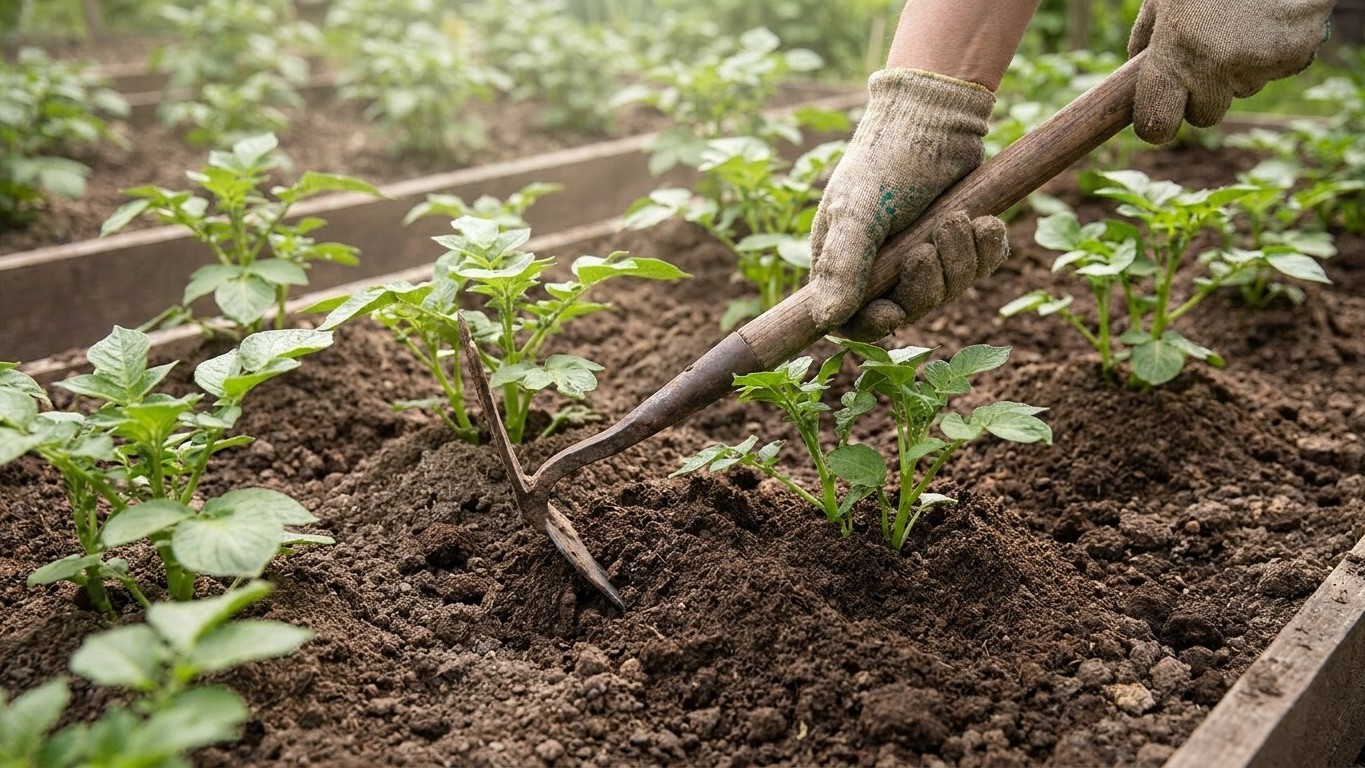

Hill potatoes once the plants reach about 6 inches tall, and plan on doing it up to three times over the growing season, according to the University of Maine Cooperative Extension (Bulletin #2077). Utah State University Extension adds a second marker: get that first hilling done within four weeks of planting. Skipping the job isn’t a cosmetic shortcut. Tubers that see daylight turn green and develop solanine, a compound that makes them taste bitter, per Utah State University Extension’s guide to potatoes in the garden.
The short answer
Two land-grant extension programs give the timing for this job, and they agree more than they disagree. The University of Maine Cooperative Extension, in Bulletin #2077, ties the first hilling to plant size rather than the calendar: once potato plants stand roughly 6 inches tall, it’s time to mound soil around the stems. Maine’s guidance also sets an upper limit on frequency, up to three times per season, which tells you hilling isn’t a one-and-done task but a repeated one as the plant keeps growing.
Utah State University Extension frames the same job from a different angle, one built around planting date instead of plant height. Their recommendation is to complete the first hilling within four weeks of planting. Both numbers point at roughly the same stage of growth, since a potato plant that’s been in the ground about a month is usually somewhere near that 6-inch mark anyway, depending on soil Temperature and variety.
Why two extensions, one job
Neither source contradicts the other. Maine’s bulletin is written for gardeners tracking what the plant is doing above ground. Utah State’s guidance is written for gardeners tracking what’s on the calendar since planting. If your plants are growing fast, plant height will hit that 6-inch threshold before the four-week mark. If they’re growing slow, in cool soil or a short-season location, the four-week rule catches you first. Using both markers together is more reliable than leaning on just one, because a stalled or slow-emerging crop can throw the calendar off in ways that a quick look at the plant won’t.
What neither extension publishes is a days-to-maturity number for when hilling should stop altogether. That’s a separate question tied to variety and season class, not to the hilling schedule itself. What both do agree on is that hilling isn’t a single event. Maine’s “up to three times” framing matters because a potato plant keeps pushing new growth and new tubers set closer to the surface as the season goes on, which means the job has to be repeated, not checked off once and forgotten.
What actually decides it
Hilling isn’t about tidiness. It solves a specific physical problem that potato plants create for themselves as they grow, and understanding that problem is what lets you adjust the schedule for a plant, a container, or a raised bed the sources above never mention.
Why light triggers solanine
Potato tubers form near the soil surface, often within an inch or two of it, and any tuber that pokes through into direct light responds by producing chlorophyll, the same pigment that turns the tuber’s skin green. Utah State University Extension’s guidance on potatoes in the garden identifies that green coloring as a marker for solanine, a compound that makes the tuber bitter. This is the mechanism that makes hilling non-optional rather than aesthetic. A gardener could, in theory, skip hilling and still get a potato plant that flowers, sets fruit, and yields a harvest. What they’d also get is a percentage of that harvest with green, bitter skin sitting exposed at the surface, regardless of variety, regardless of whether the potato is one grown for baking or one grown for boiling.
Why tubers form above the seed piece
New tubers develop on stolons, underground stems that branch off the main stalk above where the original seed potato was planted, not below it. That’s the reason hilling works at all: mounding soil up around the base of the plant gives those stolons more dark, loose material to extend into, which means more room for tubers to form without breaking the surface. A plant left flat, with soil only at its original planting depth, runs out of covered space for tubers sooner, forcing more of them toward daylight.
Why timing follows plant height, not the calendar alone
Plant height is a proxy for how much stem is available to bury. A stem buried too early, before it has grown enough to hill without smothering the entire plant, does the crop no favors. A stem hilled too late has already let tubers start forming closer to the surface, some of which may already be catching light. That’s the logic behind Maine’s 6-inch marker and Utah State’s four-week window: both are trying to catch the plant at the point where there’s enough stem to work with, but before tubers already forming are exposed.
How to do it
- Watch the plants after emergence and check their height regularly rather than relying on a fixed date, since growth rate depends on soil temperature and variety.
- Begin the first hilling once plants reach about 6 inches tall, per the University of Maine Cooperative Extension, and no later than four weeks after planting, per Utah State University Extension, whichever marker arrives first.
- Pull loose soil from between the rows or from the sides of the bed up around the base of each stem, building a mound that covers the lower portion of the plant while leaving the top growth and leaves exposed to light.
- Firm the mound gently so it doesn’t wash away with the next watering or rain, without compacting it so hard that new stolons can’t push through.
- Continue hilling as the plant grows taller, repeating the process up to three times over the season according to Maine’s Bulletin #2077, each time adding more soil to keep pace with new stem growth and newly forming tubers.
- Check exposed soil around the base of the plants periodically between hillings, and add a thin cover of soil over any tuber that becomes visible before the next scheduled hilling.
What goes wrong
- Hilling too early. Mounding soil around plants that haven’t reached the 6-inch mark buries too much of the plant’s limited leaf area, slowing the photosynthesis it needs to keep growing. Wait until the plant has enough height, per Maine’s Bulletin #2077, before building the first mound.
- Hilling too late. Waiting past the four-week window that Utah State University Extension recommends risks leaving tubers already formed near the surface exposed. Once you notice plants well past that stage without a first hilling done, catch up immediately rather than waiting for the “ideal” moment that has already passed.
- Skipping repeat hillings. Treating the job as a single event ignores Maine’s guidance that up to three hillings may be needed over a season. Plants that keep growing keep setting new tubers closer to the surface, so one mound early in the season won’t protect a harvest that develops over months.
- Letting mounds erode. Loose, unfirmed soil washes down after heavy watering or rain, re-exposing the base of the stem and any tubers just beneath it. Check mounds after storms and top them off rather than assuming one hilling holds all season.
- Ignoring green tubers once they appear. A tuber that has already turned green has already developed solanine, according to Utah State University Extension, and covering it with soil afterward doesn’t reverse that. The remedy is prevention through timely hilling, not correction after the fact; a green tuber found at harvest should be set aside rather than eaten.
Common questions
Does hilling frequency change for potatoes grown in containers or grow bags?
That specific comparison isn’t published in the sources used here. The underlying mechanism, tubers forming near the surface and needing cover from light, applies regardless of the growing structure, so the same height-based and time-based markers from Maine and Utah State are a reasonable starting point until a container-specific figure is available.
Can I hill potatoes with mulch instead of soil?
Neither the University of Maine Cooperative Extension bulletin nor Utah State University Extension’s guidance used here specifies mulch as an alternative material for hilling. What both sources establish is the goal, covering developing tubers to keep them out of direct light, so any material that reliably blocks light while staying in place around the stem is working toward that same purpose.
What happens if I only hill once instead of three times?
The University of Maine Cooperative Extension frames three hillings as the upper end of what a season may require, not a fixed requirement for every planting. A single hilling may be enough for a shorter-season crop or a plant that stops adding height early. The risk of hilling only once is that later tuber formation, closer to the surface as the plant matures, goes uncovered.
Is a green potato safe once I cut away the green part?
That specific food-safety threshold, how much of a green potato can be trimmed away safely, isn’t addressed in the sources used for this page. What Utah State University Extension does establish is that greening signals solanine and a bitter taste, which is the reason hilling matters in the first place rather than a fix to apply after harvest.