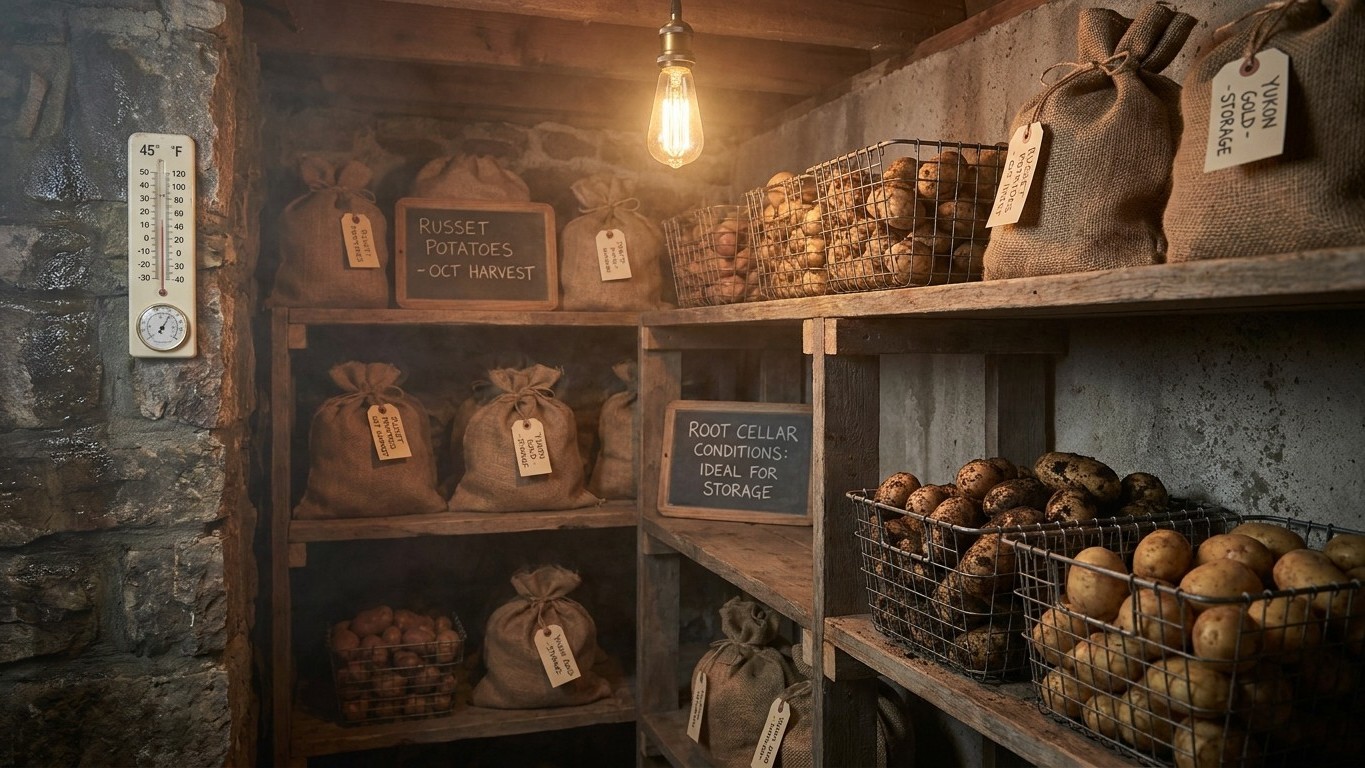

Two extension services, two numbers. The University of Maine Cooperative Extension puts ideal storage at 38 F with 95 percent humidity. Utah State University Extension gives a range of 40 to 45 F. Neither is wrong, they’re describing slightly different goals, and the gap between them is the whole story of why your potatoes go soft, sprout, or turn green in the pantry.
The short answer
Store potatoes cool, moist, and dark. That’s the shared principle behind both published figures, even though the numbers themselves don’t match exactly. The University of Maine Cooperative Extension (Bulletin #2077) recommends 38 F at 95 percent humidity as the target for long-term storage. Utah State University Extension, in its guide Potatoes in the Garden, gives a slightly warmer window of 40 to 45 F.
Why the difference matters less than it looks: both numbers sit well below room temperature, and both call for high moisture in the air around the tubers, not a dry basement shelf. A potato sitting at 70 F on a kitchen counter is losing quality daily. One sitting at 38 F, wrapped in humid dark air, can hold for months. The 7-degree spread between the two extension recommendations is a matter of storage philosophy, not disagreement about the basic science. Maine’s colder figure is calibrated for maximum dormancy and minimum sprouting over a long winter. Utah’s slightly warmer range still keeps tubers well below the temperatures that trigger sprouting, while avoiding the risk of chilling injury that can show up in some potatoes held right at the coldest edge of that range.
Which number should you use
If you have a root cellar, an unheated garage corner, or a dedicated cooler that can hold a steady low temperature, aim for the Maine figure: 38 F at 95 percent humidity. That’s the number to chase if you’re storing a large harvest for months. If your storage space runs a little warmer, or humidity control is harder to manage, Utah’s 40 to 45 F range gives you a workable target that still keeps potatoes well out of the danger zone for sprouting and rapid moisture loss. Neither source publishes a number below 38 F, so don’t assume colder is automatically better. The goal is stable and cool, not as cold as possible.
What actually decides it
Temperature and humidity work as a pair, and understanding why changes how you think about any storage space, not just the one described here.
Temperature controls sprouting and starch conversion
A potato is a living tuber, not an inert lump of starch. At warm temperatures, it reads the conditions as spring arriving and starts converting stored starch into sugars to fuel new growth, which is what sprouting is. Cold temperatures slow that internal clock. This is the mechanism behind both extension recommendations: 38 F and the 40 to 45 F range both sit low enough to keep the tuber dormant, just at slightly different margins. The tuber doesn’t care what the number is labeled, it responds to the actual degrees it experiences. That’s why a storage spot that swings between 45 F at night and 60 F in the afternoon behaves worse than one that holds steady at 50 F all day. Stability matters as much as the target number itself.
Humidity controls moisture loss, not rot
People often assume high humidity in storage invites mold or rot. The actual mechanism runs the other way for the most part: a potato is roughly 80 percent water, and in dry air it simply evaporates moisture through its skin, shriveling and going soft over weeks. The 95 percent humidity figure from the University of Maine Cooperative Extension exists to stop that evaporation, not to create a damp environment. The distinction that actually matters for rot is airflow and drainage, not the humidity number itself. A humid space with no air circulation traps moisture against the tuber surface and invites problems. A humid space with gentle airflow keeps the moisture in the tuber where it belongs, without pooling on the skin.
Light triggers a separate defense response
Light exposure has nothing to do with temperature or humidity, but it undoes good storage just as fast. Utah State University Extension notes that light in storage does the same thing as light in the garden: it triggers greening, solanine production, and bitterness. This is the tuber’s own chemical defense mechanism activating, the same one that greens an exposed potato shoulder in the soil. A storage space can hit both temperature and humidity targets perfectly and still ruin the batch if it’s near a window or under a bare bulb left on for hours at a time.
How to do it
- Cure freshly dug potatoes in a cool, dark, well-ventilated spot for one to two weeks before long-term storage, letting cuts and bruises on the skin heal over.
- Sort through the cured potatoes and set aside any with cuts, soft spots, or disease for near-term use rather than storage.
- Choose a storage location that can hold a steady temperature in the range published by your reference: 38 F at the University of Maine Cooperative Extension’s recommendation, or 40 to 45 F per Utah State University Extension.
- Raise humidity in that space toward the 95 percent level cited by the University of Maine Cooperative Extension, using damp sand, damp burlap, or a humidity-controlled cooler as your setup allows.
- Keep the storage area completely dark, since light exposure triggers greening and solanine formation regardless of temperature or humidity control.
- Provide gentle air circulation around the stored potatoes so humid air doesn’t sit stagnant against the skin.
- Check stored potatoes periodically and remove any that show soft spots, sprouting, or rot before they affect neighboring tubers.
What goes wrong
- Sprouting despite cold storage: usually means the actual temperature in the storage space is drifting above the target range during part of the day. A thermometer left in the space for a week, checked at different times, will reveal swings that a single reading misses. Move the potatoes to a more stable spot, even if the average temperature looks fine on paper.
- Shriveled, soft skins: a sign of low humidity, not warmth. This happens fastest in dry basements or garages with forced-air heating nearby. Add a humidity source, like damp sand around the potatoes or a container of water in the space, and recheck in a week.
- Green patches on stored potatoes: means light is reaching them, even briefly. A single bare bulb turned on for inventory checks, or a storage bin near a garage window, is often enough over weeks. Move storage fully into the dark, and cut away any green portions before use since that’s where solanine concentrates.
- Rot spreading through a bin: almost always traced back to one damaged or diseased tuber that wasn’t sorted out before storage, combined with poor air circulation that let moisture and decay spread to its neighbors. Sort more carefully at the start, and check bins periodically to catch and remove problem tubers early.
- Potatoes stored near onions or apples: not covered in the temperature and humidity figures here, but worth flagging as a separate storage variable outside the scope of this page’s sourced facts.
Common questions
Can potatoes be stored in the refrigerator?
Neither the University of Maine Cooperative Extension nor Utah State University Extension publishes a refrigerator-specific figure here. What the sources do establish is the target range: 38 F per Maine, or 40 to 45 F per Utah. A standard refrigerator often runs colder than both, so check your unit’s actual temperature rather than assuming it fits the range.
Why does humidity matter as much as temperature?
Because the two failure modes are different. Warm temperatures trigger sprouting and starch-to-sugar conversion. Low humidity causes moisture loss and shriveling. The University of Maine Cooperative Extension pairs its 38 F recommendation with 95 percent humidity precisely because hitting one target without the other still leads to storage losses.
Does light exposure matter if the potatoes are already cold and humid?
Yes, and it’s an independent variable. Utah State University Extension is clear that light triggers greening and solanine production the same way in storage as it does in the garden, regardless of temperature or humidity conditions. A dark storage space is a separate requirement, not a byproduct of getting temperature and humidity right.
Is there one universal storage temperature that works everywhere?
The two authorities cited here don’t fully agree on a single figure. The University of Maine Cooperative Extension recommends 38 F, while Utah State University Extension recommends 40 to 45 F. Both sit in a similar cool range, and the practical choice depends on what temperature your storage space can actually maintain consistently.