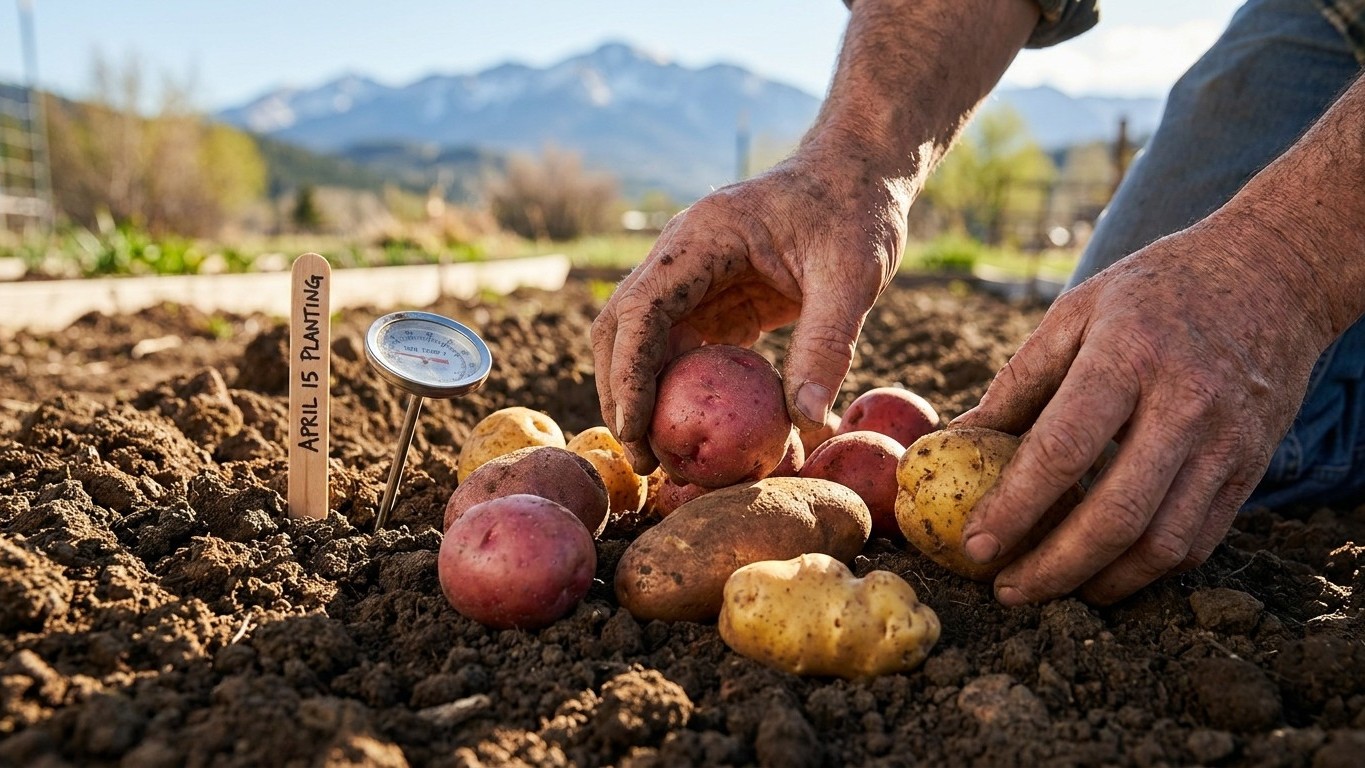

Colorado’s best potato results come from early season and mid-season varieties grown for baking or boiling, planted early enough to size up before summer heat sets in. Because the state spans nearly two miles of elevation, from the plains to mountain valleys, there’s no single answer for every garden. What actually decides your list is the length of your local frost-free window and how many days your soil spends above 90°F once summer settles in.
The short answer
For the Denver area, the reference station used by NOAA NCEI (station USW00003017, 1991-2020 Climate Normals) puts the last spring frost between May 1 and May 11. That single window drives everything else. Utah State University Extension’s potato fact sheet says potatoes go into the ground as soon as soil reaches 50°F, which lands 14 to 21 days ahead of the last frost date. At Denver’s elevation, that puts planting in mid-April for most years, not the Memorial Day date many vegetable calendars assume.
That early start matters because of what happens later in the season, not at planting. The University of Maine Cooperative Extension’s Bulletin #2077 explains that tuber set and fill shut down once soil temperatures climb past 90°F, and watering more does not reverse it. A potato planted in mid-April at Denver’s elevation has a real head start on filling its tubers before the soil bakes through July and August. A potato planted in late May is still setting tubers right as the soil crosses that ceiling.
That’s the mechanism behind the whole answer: early season varieties, the kind grown for boiling and salads with quicker turnaround, are the safer bet across most of Colorado’s lower and mid-elevation gardens, because they finish their tuber-fill work before the heat ceiling hits. Mid-season varieties, often the yellow-fleshed types used for baking and boiling both, do fine where summers stay cooler, which in Colorado usually means higher elevation gardens rather than the Front Range plains. Late season russet-type varieties, grown mainly for baking, need the longest stretch of mild soil temperatures and are the riskiest choice anywhere the 90°F ceiling shows up early or often.
None of this is a state-wide rule. The frost dates above are specific to the Denver reference station. A garden in a mountain valley, on the western slope, or at a different elevation entirely will hit both its 50°F planting mark and its 90°F ceiling on a different calendar. The mechanism is universal; the dates on your particular soil are not.
What actually decides it
Three things interact to decide which season class works in a given Colorado garden: when the soil is cold enough to plant, when it gets too hot to keep filling tubers, and how much those two dates get squeezed together by elevation.
The soil-temperature planting window
Utah State University Extension is specific here: potatoes go in the ground once soil hits 50°F, not once the calendar says spring has arrived. That threshold typically lands 14 to 21 days before the last frost date because soil warms more slowly than air. A gardener who waits for the last frost date itself to pass is usually planting two to three weeks later than necessary, and every one of those lost weeks pushes tuber fill further into the hot part of summer.
The 90°F heat ceiling
The University of Maine Cooperative Extension bulletin identifies the upper limit plainly: soil above 90°F inhibits tuber set and fill. This is not a stress the plant can be watered through. Once the ceiling is crossed, the crop’s sizing work stalls regardless of irrigation. That makes the count of hot days in a given location the real variable, more than the average summer temperature. A garden that spends three weeks above that ceiling needs a variety that has already mostly finished filling by the time those weeks arrive.
Elevation rewrites the calendar
Colorado’s elevation range means the same season class can behave completely differently forty miles apart. A garden at a much higher elevation than Denver will generally see its last frost date arrive later and its soil take longer to reach 90°F, sometimes never crossing it at all in a normal summer. That’s the trade a mountain-town gardener makes: a shorter frost-free window but a soil temperature that stays friendlier to mid-season and even late season varieties for longer. A plains garden makes the opposite trade: an earlier planting window but a soil that heats past the ceiling sooner, favoring the early season classes described above.
How to do it
- Check a soil thermometer at a two-inch to four-inch depth in the bed you intend to plant, rather than relying on the calendar or air temperature.
- Plant once the soil reads 50°F, which for a Denver-elevation garden typically falls 14 to 21 days ahead of the May 1 to May 11 last-frost window reported by NOAA NCEI for station USW00003017.
- Choose certified seed potatoes rather than pieces saved from a grocery-store potato or an uncertified source; certified seed is inspected for virus, and uncertified seed is a known way to bring virus into a home garden.
- Match season class to elevation: early season varieties for lower, hotter gardens; mid-season and late season varieties reserved for higher, cooler sites where the 90°F ceiling arrives later or not at all in most summers.
- Keep tracking soil temperature through the growing season, not just at planting, since the 90°F ceiling is what eventually calls the harvest date for tuber sizing.
- Harvest once soil temperatures push consistently past that ceiling rather than waiting for top growth to die back completely, since tuber fill has already stopped by that point.
What goes wrong
- Planting by the calendar instead of soil temperature. Waiting for a fixed date rather than checking soil at 50°F means planting too late in most years; carry a soil thermometer and let the reading, not the month, decide.
- Choosing a late season russet-type variety for a low-elevation garden. These need the longest stretch of mild soil before the 90°F ceiling arrives; on the plains that stretch often isn’t long enough, and tubers stay small. Reserve late season varieties for higher, cooler elevation gardens.
- Buying uncertified seed to save money. Uncertified seed potatoes are a common way to introduce virus into a planting, and virus problems compound in the soil for years afterward. Buy certified seed potatoes each season.
- Trying to water through a heat stall. Once soil crosses 90°F, tuber set and fill are inhibited regardless of irrigation, per the University of Maine Cooperative Extension. Extra watering at that point does not restart sizing; the fix is planting earlier next season, not watering harder this one.
- Assuming one Colorado frost date applies everywhere. The May 1 to May 11 window is tied specifically to the Denver-area reference station. Gardens at different elevations need their own local reading rather than borrowing this figure.
Common questions
Do early season potatoes taste worse than late season ones?
Neither source used here ranks season classes by flavor. The season class describes how quickly the crop matures relative to the frost-free window, and the intended use, baking or boiling, is a separate published detail tied to the flesh and skin type, not to how fast the variety finishes.
Can I plant a second, later potato crop the same summer at low elevation?
Not reliably below higher elevations where the 90°F ceiling arrives in force. Once soil crosses that mark, tuber fill stops for any potato in the ground, so a second planting timed for late summer harvest runs into the same heat problem the first crop was planted early to avoid.
Is the May 1 to May 11 frost date accurate for the whole state?
No. That figure comes from the NOAA NCEI reference station used for the Denver area. Mountain towns and the western slope have their own frost timelines that this figure does not cover; check a local soil reading rather than applying the Denver figure elsewhere.
What happens if I plant before the soil hits 50°F?
Utah State University Extension’s guidance ties planting to that soil temperature threshold specifically because colder soil slows or damages seed pieces before they can establish. Waiting for the reading, rather than guessing from air temperature, is the safer call even if it means planting a few days later than a neighbor.