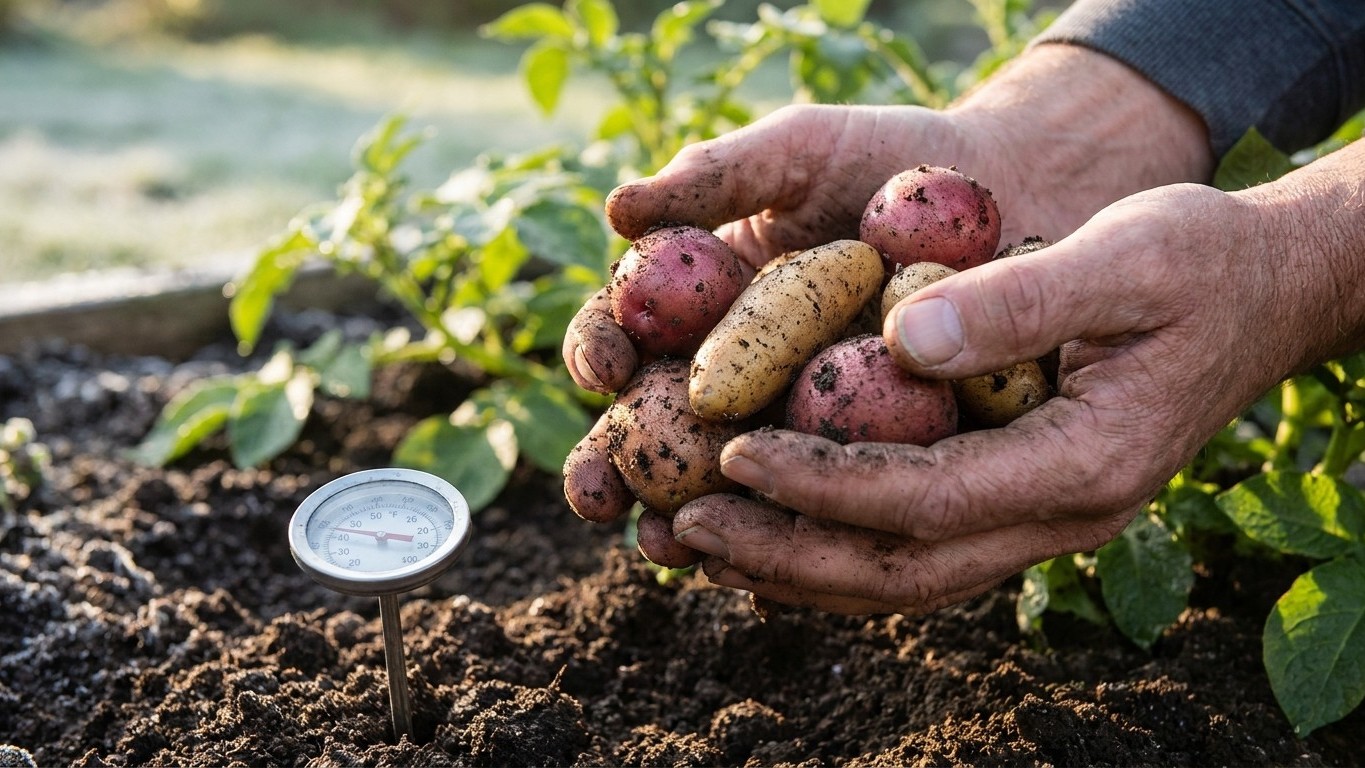

Delaware’s growing conditions favor early and mid-season potato varieties, not late ones. The reason comes down to timing: soil needs to hit 50°F before planting, roughly 14 to 21 days ahead of the last spring frost, which falls between April 3 and April 14 at the New Castle County Airport station near Wilmington (NOAA NCEI 1991-2020 Climate Normals). That narrow window shapes almost every variety decision that follows.
The short answer
Start with the number that matters: April 3 to April 14. That’s the last-spring-frost range measured at the New Castle County Airport station, according to NOAA NCEI’s 1991-2020 Climate Normals. Everything about which potato variety belongs in a Delaware garden traces back to that date, and to what happens in the months after it.
Potatoes go in the ground as soon as soil temperature reaches 50°F, which typically lands 14 to 21 days before the last frost date, per Utah State University Extension’s fact sheet on growing potatoes and the University of Maine Cooperative Extension’s Bulletin #2077. In practice, that means Delaware gardeners are often working the soil in mid-to-late March, well before the calendar says spring has settled in. The upside is real: an early start gives the crop a head start on the part of the season that actually threatens it, which is heat, not cold.
That’s where season class comes in. Early and mid-season potato varieties size their tubers and finish bulking before soil temperatures climb into the danger zone. Late-season varieties need more time in the ground, and more time in the ground in Delaware means more exposure to the stretch of summer when soil temperatures routinely climb past 90°F, the point at which tuber set and fill simply stop, according to both Extension sources. Watering more doesn’t reverse that; the plant isn’t thirsty, it’s overheated at the root zone.
So the short answer isn’t a single variety name. It’s a season class: early or mid-season potatoes planted at the earliest safe date, chosen from certified seed, give Delaware gardeners the best odds of a full harvest before the heat ceiling shuts the crop down. Late-season types aren’t off the table everywhere in the state, but they carry more risk, and that risk is worth naming plainly before anyone commits a garden bed to them.
What actually decides it
Two mechanisms run this whole decision, and once a gardener understands them, they can size up any variety or any county in Delaware without needing a chart.
Soil temperature and the planting window
Potatoes aren’t planted by the calendar. They’re planted by soil temperature, and that number is 50°F, according to Utah State University Extension. Soil warms unevenly across a state as small as Delaware. Sandy, well-drained soil near the coast can reach 50°F noticeably earlier than heavier clay soil inland, and a south-facing raised bed will warm faster than a shaded, low-lying plot. The 14-to-21-day gap before the last frost isn’t a fixed countdown; it’s the rough lag between soil warming and air warming, and a gardener who checks their own soil with a simple thermometer will know their real planting date better than any regional average can tell them.
The 90°F heat ceiling on tuber set and fill
This is the mechanism that decides the whole crop, and it’s the one gardeners tend to discover the hard way. Once soil temperature climbs above 90°F, tuber set and fill are inhibited, per Utah State University Extension and the University of Maine Cooperative Extension. Foliage can look green and healthy while underground growth has effectively paused. Delaware’s inland and southern counties log more of these hot-soil days than the immediate coast, where sea breezes moderate afternoon highs. A variety that needs a long season to finish is asking to still be filling tubers right when soil temperatures are working against it. An early or mid-season variety, planted at the earliest safe date, is usually finished, or close to it, before that window opens. That’s the entire logic in one sentence: race the heat, don’t fight it.
How to do it
- Check your own soil temperature with a probe thermometer in the planting bed, rather than relying on the regional last-frost date alone, since soil type and sun exposure shift the number county by county and even bed by bed.
- Order certified seed potatoes. Uncertified seed carries virus, and that single fact does more to protect a season’s yield than any amount of extra fertilizer or watering ever will.
- Choose an early or mid-season variety as your primary planting, since both classes are built to finish before Delaware’s soil reliably climbs past the 90°F ceiling.
- Plant once soil hits 50°F, which generally falls 14 to 21 days before the last frost date of April 3 to April 14 measured at the New Castle County Airport station, adjusted for your own soil readings.
- Hill the plants as they grow, keeping developing tubers covered and shaded from direct heat exposure at the soil surface.
- Track soil temperature through the growing season, not just at planting, so you know when the 90°F threshold is approaching and can plan harvest timing around it rather than being surprised by it.
- Harvest the early crop as soon as it matures rather than leaving it in warming soil “just in case,” since extra time underground past that heat threshold adds risk without adding size.
What goes wrong
- Uncertified seed introduces virus into the crop before it even sprouts. Buy certified seed potatoes every season rather than saving tubers from a previous harvest or picking up ungraded stock, since certification is the only safeguard both Extension sources point to.
- Planting by the calendar instead of by soil temperature delays the start of the season. A gardener waiting for a specific date on the wall calendar can miss weeks of usable soil-warming time. Check soil temperature directly and plant at 50°F, not on a fixed day.
- Choosing a late-season variety because it’s what’s available locally pushes the harvest into the hottest stretch of soil temperatures. If a late-season variety is the only option, plant it at the earliest safe date and monitor soil temperature closely, since it has the least buffer against the 90°F ceiling.
- Watering heavily once growth stalls in midsummer, assuming drought stress is the cause. If soil is above 90°F, added water does not restart tuber fill. The fix is timing the crop earlier next season, not correcting it after the fact.
- Treating the April 3 to April 14 frost window as true for the whole state. That figure is measured at one station near Wilmington. Inland and southern counties, and any low-lying or elevated garden, can see a later last frost by a week or two. Confirm local conditions before locking in a planting date.
Common questions
Can late-season potato varieties still be grown in Delaware?
They can, but they carry more risk because they need more time in the ground, which means more exposure to soil temperatures above the 90°F threshold that stalls tuber set and fill, according to Utah State University Extension and the University of Maine Cooperative Extension. Early and mid-season classes give a wider margin of safety.
How do I know when my soil has reached 50°F for planting?
Use a soil thermometer inserted a few inches into the planting bed, checked in the morning over a few consecutive days for consistency. Relying on the regional frost date alone can be misleading since soil warms at different rates depending on drainage, sun exposure, and soil type.
Why does certified seed matter so much for potatoes specifically?
Potatoes are grown from seed tubers rather than true seed, which means any virus present in the parent tuber carries directly into the new plant. Certified seed is inspected and tested to keep that risk out of the garden from the start.
Does mulching or shading help potatoes survive a 90°F soil spike?
Mulch can moderate soil temperature swings somewhat, but neither Utah State University Extension nor the University of Maine Cooperative Extension frames it as a fix for sustained heat above the threshold. The more reliable strategy is timing the crop to finish before that heat arrives, rather than managing around it once soil temperatures are already elevated.