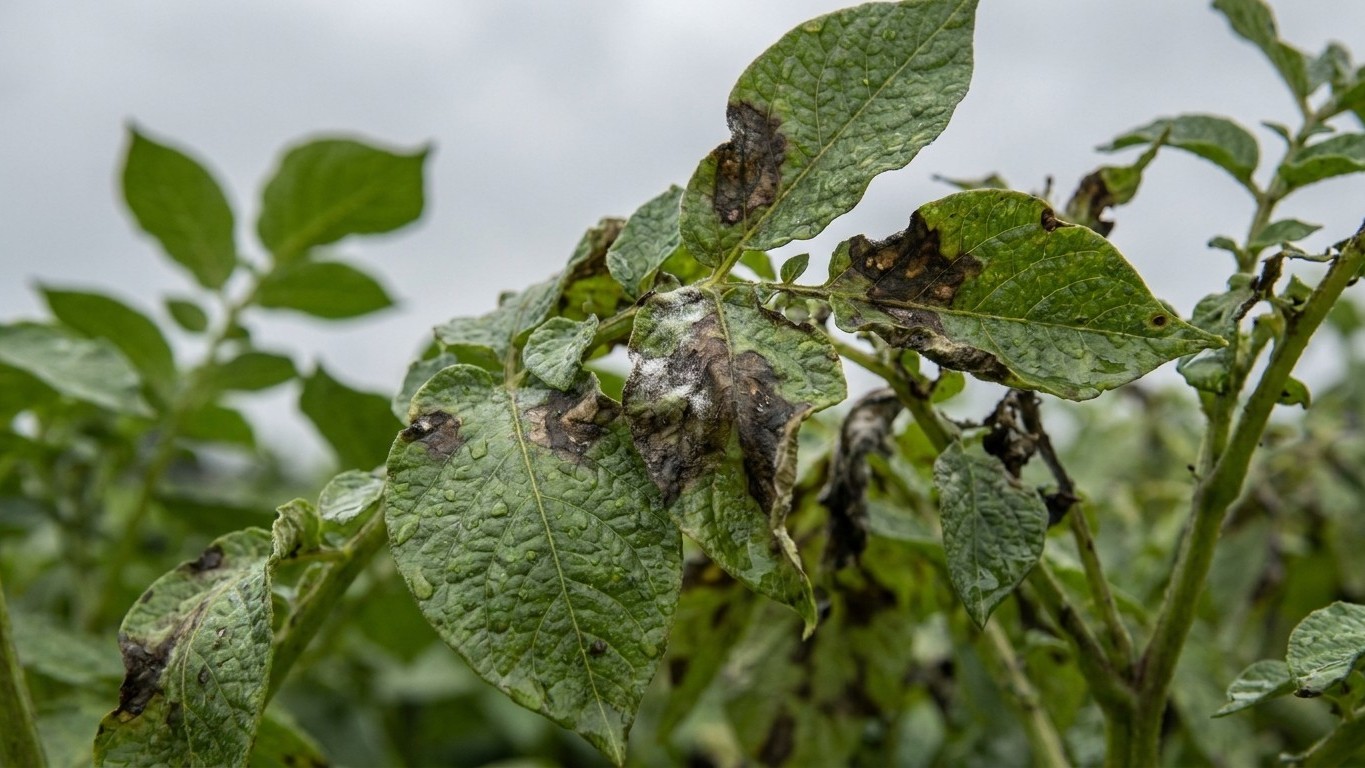

Late blight shows up as brown or black water-soaked spots on leaves and stems that enlarge rapidly, and it spreads fastest when the weather turns cool and wet. Utah State University Extension names cool, wet conditions as the trigger that favors disease development and spread. That combination, not heat or drought, is the warning sign gardeners need to watch.
The short answer
If you’re checking a potato patch after a stretch of overcast, damp days and you spot dark, greasy-looking lesions on the foliage, you’re likely looking at late blight. Utah State University Extension describes the symptom plainly: brown or black water-soaked spots on leaves and stems that enlarge rapidly. That phrase matters because it separates late blight from slower, drier leaf diseases. The lesions don’t stay small and dry. They spread across a leaflet within days, and under the right weather they can move from a handful of plants to an entire row before a gardener has time to react.
The weather link is the part most home growers underestimate. Utah State University Extension identifies cool, wet conditions as favoring both the development of the disease and its spread through a planting. This is why late blight tends to surface after a run of rain, fog, or heavy dew rather than during a dry, sunny stretch. Warm and arid weather doesn’t create the moisture film the pathogen needs on leaf surfaces to establish and multiply. Cool and wet does exactly that.
None of this means every wet week brings blight, or that every dark spot on a potato leaf is late blight. It means that cool, damp conditions are the setting where the disease finds its opening, and that the specific look, water-soaked spots that enlarge fast, is the detail that confirms it rather than a milder leaf spot disease that behaves differently. Gardeners who know this pairing, the weather condition and the visual symptom together, catch the problem earlier than those watching for just one or the other.
The practical takeaway from Utah State University Extension’s description is timing your inspections around the weather, not the calendar. A stretch of cool, overcast, humid days is the cue to walk the rows and check leaf undersides and stems closely, because that’s precisely when the pathogen has what it needs.
What actually decides it
The mechanism behind late blight is straightforward once you separate the two ingredients: moisture and temperature. The pathogen that causes late blight needs a film of water on plant surfaces to infect tissue, and it needs temperatures on the cooler side of the growing season’s range to move efficiently through that tissue. Warm, dry air evaporates leaf moisture quickly and denies the pathogen the window it needs. Cool, wet air holds that moisture in place, sometimes for days, and that’s the window Utah State University Extension points to when it names cool, wet conditions as the condition that favors both development and spread.
What decides whether a garden sees late blight isn’t just a single rainy day. It’s a pattern, extended dampness combined with lower temperatures, that lets the disease establish on one plant and then move outward. Spread happens because the lesions themselves become sources of further infection once they’re wet. A water-soaked spot on one leaf, sitting in humid air, becomes the origin point for spots on neighboring leaves and neighboring plants. This is why the disease can go from a few isolated lesions to widespread damage across a planting in a short span when the weather cooperates with it.
The detail that separates late blight from other leaf problems is the water-soaked appearance combined with rapid enlargement. Many leaf spot diseases in a potato patch create dry, papery, or ring-patterned lesions that grow slowly over a week or more. Late blight’s lesions look wet, almost greasy, and they expand fast enough that a gardener checking plants every few days can watch the damage visibly progress between visits. That combination of appearance and speed is the tell.
Understanding this mechanism changes how a gardener reads the weather forecast. A run of highs in the 60s or low 70s with overcast skies and rain isn’t just inconvenient gardening weather. Under Utah State University Extension’s description, it’s the exact setup that favors the disease taking hold. Watching the sky becomes as useful as watching the plants.
What to do about it
Utah State University Extension lays out a control approach for potato diseases including late blight, and it starts before the plants are even in the ground. Here’s the order it follows.
- Start with certified disease-free seed. Utah State University Extension’s guidance opens with using certified disease-free seed, because much of what shows up in a patch later traces back to what was planted at the start. Seed potatoes carrying dormant infection give the disease a head start no amount of later treatment can fully undo.
- Identify the problem correctly before treating anything. The published control calls for applying appropriate fungicide only after proper identification. This ordering isn’t a formality. Several leaf diseases and even insect damage on potatoes can look similar at a glance, and treating the wrong problem wastes effort while the real one continues to spread. Confirming water-soaked, rapidly enlarging lesions, the specific description Utah State University Extension gives for late blight, is the step that should happen before reaching for any treatment.
- Apply appropriate fungicide once the disease is confirmed. After identification, the extension’s guidance calls for appropriate fungicide as the treatment step. No specific product is named in the published guidance, and choosing one should follow current label guidance and local extension recommendations rather than guesswork.
- Watch conditions going forward, not just symptoms. Because cool, wet weather is what favors development and spread, continuing to monitor the forecast after treatment matters as much as the initial identification. A single fungicide application during an extended cool, damp period may need to be followed by continued vigilance as conditions persist.
The sequence matters. Skipping straight to treatment without confirming the disease, or planting uncertified seed and hoping for the best, undercuts the whole approach. Each step depends on the one before it.
What goes wrong
Home gardeners mix up late blight with several other issues that show up on potato foliage, and getting the identification wrong before treating is exactly the mistake Utah State University Extension’s guidance is built to prevent.
- Confusing it with early leaf spot diseases. Other common potato leaf diseases tend to create drier, more defined lesions that expand gradually. Late blight’s lesions are described as water-soaked and rapidly enlarging, a faster and wetter-looking symptom than the slow, papery spots of other leaf diseases.
- Mistaking weather stress for disease. Wilting or discoloration from too much or too little water can resemble early disease symptoms to an untrained eye. The distinguishing detail is the water-soaked, spreading lesion itself rather than general leaf droop or yellowing without lesions.
- Treating without confirming the trigger. Some gardeners reach for a treatment the moment they see any leaf blemish, regardless of recent weather. Since cool, wet conditions are what favor this disease’s development and spread, a blemish that appears during a hot, dry stretch is less likely to be late blight in the first place, and treating it as such wastes effort and skips real identification.
- Assuming seed source doesn’t matter. Gardeners sometimes save their own seed potatoes or use unlabeled ones from a previous season, then treat any later disease purely as a foliage problem. Utah State University Extension’s guidance starts with certified disease-free seed precisely because seed-borne issues can undercut treatment applied later in the season.
Each of these mix-ups leads to the same outcome: treatment applied to the wrong problem, or applied too late, while the actual disease keeps spreading under the cool, wet conditions it favors.
Common questions
Does late blight only appear on leaves?
Utah State University Extension describes the symptom as brown or black water-soaked spots on leaves and stems, so stems are affected along with foliage. Checking stems, not just leaflets, gives a fuller picture of how far the disease has progressed on a plant.
Can late blight develop during a hot, dry summer?
Utah State University Extension names cool, wet conditions as what favors development and spread. That doesn’t rule out any disease pressure during warmer, drier weather, but it does mean the conditions gardeners should watch most closely are the cool, damp stretches, not the hottest days of the season.
Is fungicide the first step once spots appear?
No. The published control calls for applying appropriate fungicide after proper identification, and it opens with using certified disease-free seed at planting. Identification comes before treatment in the published order.
How fast do the lesions spread once they appear?
Utah State University Extension describes the spots as enlarging rapidly. An exact rate in days or a size measurement isn’t published in this guidance, but the description points to visible growth over a short span rather than a slow, gradual change.