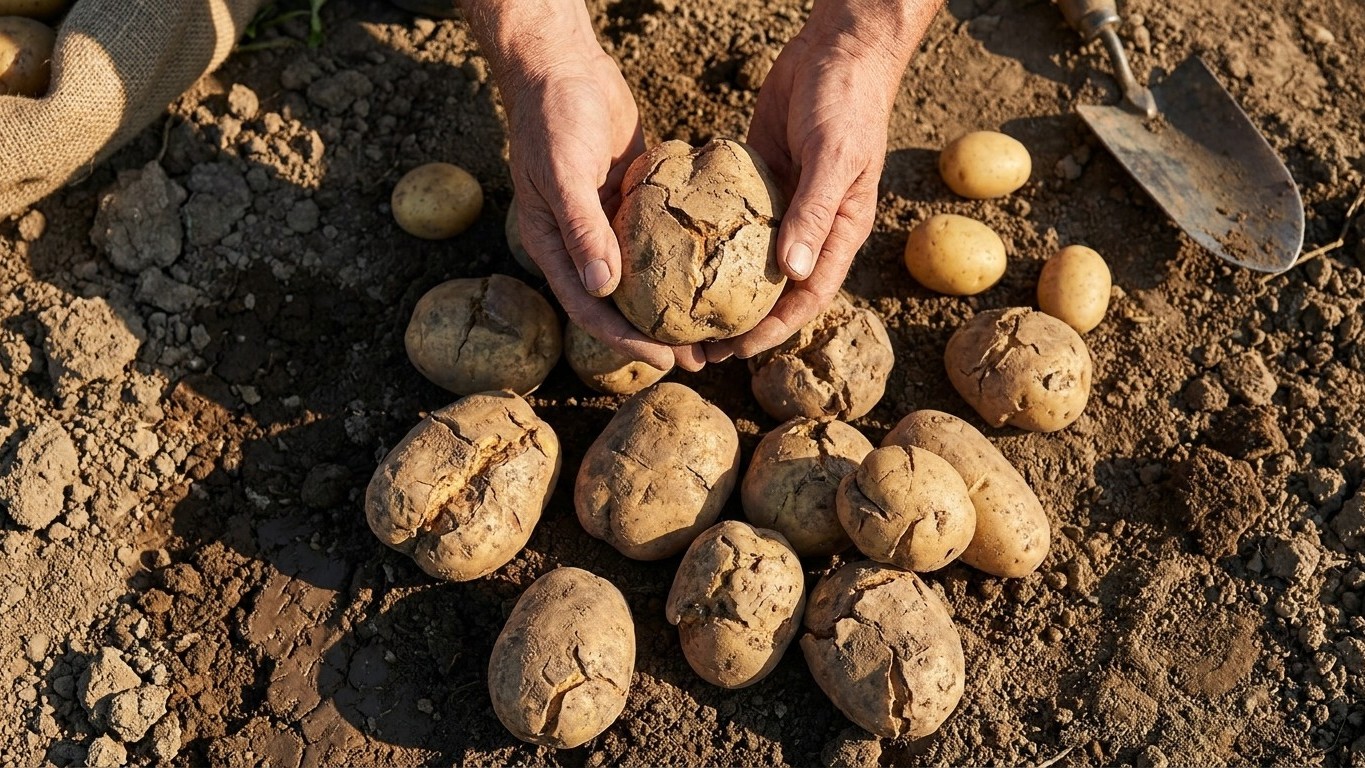

Rough, cracked skin and lumpy, irregular tubers are not a disease you missed spraying for. According to Utah State University Extension, this look, described as “rough skins; cracking; small, irregular tuber shapes,” traces back to the soil itself: uneven moisture and soil that got too hot while the tubers were forming.
The short answer
Utah State University Extension lists the symptom plainly: rough skins, cracking, and small, irregular tuber shapes. That’s the full picture gardeners report when they pull potatoes that look scarred, split, or oddly lobed instead of smooth and round. There’s no rot smell, no sticky ooze, no chewed-out tunnels. Just a tuber that grew under stress and shows it on the outside.
The cause, per the same source, is “primarily caused by wet/dry soils or high soil temperatures.” That’s two separate triggers that often show up together in a home garden. A bed that dries out between waterings, then gets soaked again, forces the tuber to stop growing and restart, and the skin can’t keep up with that stop-start rhythm. Heat does something similar from a different angle: when soil runs hot, the tuber’s growth pattern gets disrupted at the cellular level, and the result is skin that cracks or a shape that comes out lopsided instead of uniform.
This is a physiological disorder, not an infection and not a pest. Nothing is invading the tuber. The plant is simply responding to conditions in the root zone the way any stressed organism does, by growing unevenly. That distinction matters because it changes what you look for next. You’re not scouting for eggs, larvae, or fungal threads. You’re checking a soil thermometer and a moisture meter, or just your finger pushed two inches down.
It’s worth being precise about scale here. Utah State University Extension doesn’t publish a percentage of crop affected or a yield-loss figure for this disorder, and no such number should be assumed. What’s published is the symptom and the cause, not a severity scale. Gardeners should treat the presence of rough, cracked, misshapen tubers as a signal about how the bed was managed during tuber bulking, not as a diagnosis of disease pressure.
The practical takeaway from the short answer is this: if your potatoes come out looking rough or split but otherwise healthy, cut into one. If the flesh is solid, white or yellow depending on the variety, and free of discoloration or holes, you’re almost certainly looking at a moisture and heat issue, not something that spread from an infected seed piece or a soil pathogen.
What actually decides it
The mechanism comes down to how a potato tuber actually grows underground. Tubers swell by taking up water into their cells, and that process runs best when moisture in the root zone stays close to constant. When the soil swings between wet and dry, the tuber’s outer layer, the periderm, gets stretched during a wet flush after it had already started to firm up during a dry spell. Skin that has begun to set doesn’t stretch cleanly. It splits, or it thickens into the rough, scabby-looking texture described in the symptom list, even though no scab organism is present.
Heat works on a parallel track. Utah State University Extension’s threshold for potato heat stress generally sits at soil temperatures above 90 degrees Fahrenheit, the same ceiling that shows up across guidance on this crop. Above that point, the tuber’s normal growth signals get scrambled. Instead of expanding evenly in all directions, growth becomes patchy, which is exactly how you end up with the “small, irregular tuber shapes” in the published symptom description, knobby lobes, pinched necks, tubers that look like they were interrupted mid-thought.
What ties the two triggers together is timing. Both wet/dry cycling and high soil temperature do the most damage during the tuber bulking stage, when the potatoes underground are actively sizing up. A dry week followed by heavy watering during early vegetative growth, before tubers have formed, won’t produce this look. The same swing happening once tubers are golf-ball to egg sized is what shows up at harvest as rough skin and cracks.
Telling it apart from soil-borne disease
The confusion gardeners run into most is mistaking this for a fungal or bacterial problem, because “rough skin” sounds like it could be scab. The mechanism is the giveaway: disease symptoms come from an organism colonizing tissue, and that process doesn’t care whether your watering schedule was steady. A physiological crack or rough patch, by contrast, tracks directly with a watering log or a run of hot days. If you can point to a specific dry stretch followed by a soak, or a heat wave that coincided with tuber sizing, the mechanism points to soil conditions, not pathogens.
What to do about it
Correct identification comes first, and that’s not a formality. Rough skin and cracking can look similar at a glance to symptoms caused by insects feeding on tubers or by fungal organisms in the soil, and treating a physiological disorder with an insecticide or fungicide wastes money and does nothing for the actual cause. Utah State University Extension’s guidance for this disorder is about managing soil conditions, not applying a product, so confirming there’s no pest damage or disease tissue in the flesh should happen before anything else.
- Cut open a sample tuber to rule out feeding damage, tunnels, or discolored, rotting flesh before assuming this is soil-related.
- Check soil moisture consistency going back over the growing season, since the published cause points to wet/dry swings as a primary driver.
- Maintain uniform moisture conditions going forward, watering on a regular schedule rather than letting the bed dry out between heavy soakings.
- Mulch heavily over the row, which Utah State University Extension recommends specifically to regulate both soil water and soil temperature at the same time.
- Monitor soil temperature during hot stretches, since temperatures climbing above the 90 degree Fahrenheit range are tied to the same disorder.
- Reserve appropriate insecticides or appropriate fungicide for cases where the cut-open sample actually shows insect damage or disease tissue, not for rough skin or cracking on its own.
Mulch does double duty here, which is why it sits at the center of the published control. A heavy layer, straw is a common choice for potato rows, slows evaporation so the soil doesn’t swing from soaked to bone-dry, and it also shades the soil surface, keeping temperatures lower during the hottest part of the season. Neither fix requires a trip to the store for a chemical product. Both are about managing the bed itself.
What goes wrong
- Common scab: Bacterial scab produces raised, corky lesions on the skin, and it’s driven by soil pH and specific soil organisms rather than by moisture swings alone. Rough skin from moisture stress lacks the distinct corky lesion texture and doesn’t correlate with soil pH the way bacterial scab does.
- Growth cracks vs. insect entry wounds: A crack from uneven moisture typically has smooth, healed edges because the tuber’s tissue split and then scarred over as it kept growing. A wound from an insect or later mechanical damage tends to look fresher, ragged, or shows signs of feeding around the opening.
- Irregular shape vs. secondary growth (knobs): Knobby, misshapen tubers from heat or moisture stress form during the initial bulking period, while secondary growth, small new tuber growth budding off an existing tuber after a stress event, tends to appear later in the season and looks like a distinct smaller lobe attached to a larger, normally shaped tuber.
- External roughness vs. internal hollow heart: Hollow heart is an internal cavity, invisible from the outside, and it’s a separate physiological issue from the external rough skin and cracking described here. A tuber can have one without the other, so cutting into a sample is the only way to confirm which condition you’re dealing with.
Common questions
Does rough or cracked skin mean the potato is unsafe to eat?
The published symptom describes a physiological disorder tied to soil moisture and temperature, not a disease or toxin. If the flesh underneath is solid and free of rot or discoloration, the affected area can typically be trimmed away.
Can this happen even with regular watering?
Yes, if the regularity breaks down during the tuber bulking stage specifically. A single missed watering followed by a heavy soak during that window can produce the wet/dry swing that Utah State University Extension identifies as a primary cause, even if the rest of the season was managed evenly.
Is mulch enough on its own, or does watering schedule still matter?
Utah State University Extension’s guidance pairs both: maintain uniform moisture conditions and mulch heavily. Mulch helps buffer swings and moderate temperature, but it works alongside a consistent watering routine rather than replacing it.
How hot does the soil have to get before it becomes a problem?
The disorder is tied to soil temperatures above 90 degrees Fahrenheit, the same threshold referenced across guidance on this crop. Below that range, temperature alone is less likely to be the driver, and wet/dry moisture swings become the more relevant factor to check first.