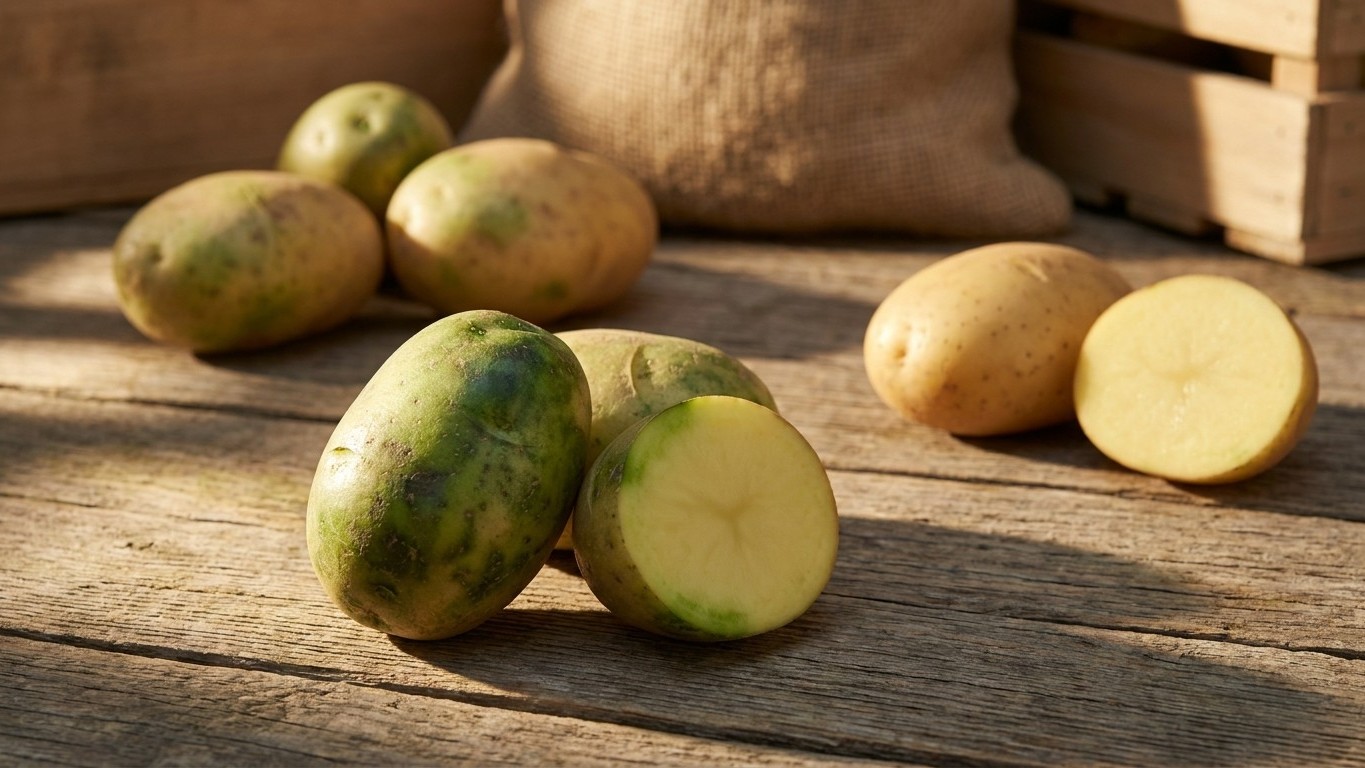

A green tinge on a potato’s skin means it was exposed to light, either in the garden bed or in storage. Utah State University Extension describes this exact symptom as the “formation of green pigments on the tuber,” and the fix has nothing to do with washing, peeling a little deeper, or waiting it out. It comes down to keeping tubers away from light, both while they’re growing and after they’re dug.
The short answer
Utah State University Extension lists green potatoes as a recognized garden problem with a clear cause and effect chain. What it looks like: “formation of green pigments on the tuber.” What causes it: “exposure of tubers to light in garden or storage.” Those two lines are the whole diagnosis. There’s no mystery pathogen, no insect, no soil deficiency behind it. It’s a physiological response, the tuber’s own tissue reacting to light the way it would if left uncovered in a windowsill.
The greening itself is only half the story. Utah State University Extension also notes that the chemicals produced, solanine among them, taste bitter. That bitterness is the practical tell for a home cook: a potato that’s gone green often tastes off before you even get a good look at the skin under bright light. The pigment and the bitter compound tend to show up together because they’re both triggered by the same exposure.
This matters because green potatoes get treated inconsistently in most kitchens. Some households scrub the surface and move on. Others cut away the green patch and cook the rest. The Extension source doesn’t rank these responses; what it does establish is the cause, and once you know exposure to light is the trigger, prevention becomes the obvious priority over damage control after the fact.
It also explains why the problem shows up unevenly on the same plant. Tubers sitting closer to the surface, or ones that pushed up through a crack in the soil, catch light while their siblings deeper in the row stay dark and unaffected. Storage greening follows the same logic on a smaller scale: a potato near a bright window or under a bare bulb greens faster than one tucked at the back of a dark bin. The mechanism is identical in the field and in the pantry; only the light source changes.
None of this is a soil-health issue or a sign of pest pressure. It’s a response tied strictly to light exposure, which is why the published control, covered in the next sections, focuses entirely on blocking light rather than adjusting fertility, watering, or spacing.
What actually decides it
Light is the single variable that decides whether a tuber greens. Not variety, not soil type, not how long the potato has been in the ground. Utah State University Extension frames the cause plainly as exposure to light “in garden or storage,” which means the same tuber can escape the problem entirely in the field and still develop it weeks later on a countertop.
In the garden, exposure usually happens because tubers form near the surface and soil settles, washes away, or was never mounded deep enough to begin with. A potato plant sets its tubers along underground stems, and as those tubers swell, they can push upward. Any tuber that breaks the soil line, even by a fraction of an inch, is now catching daylight every day it stays there. The longer that exposure continues, the more pigment develops.
In storage, the light source changes but the mechanism doesn’t. A bag left on a counter near a window, potatoes stored in a garage with a skylight, or tubers kept in a bin under a bright utility light are all functionally the same situation as an uncovered tuber in the garden. The tissue responds to light itself, not to sunlight specifically, which is why fluorescent or LED kitchen lighting can produce the same greening over time.
What this rules out is worth being clear about. Green coloring isn’t tied to how the potato was fertilized, how much it was watered, or which variety was planted, at least not according to what Utah State University Extension publishes on the subject. It also isn’t a disease process the way blight or scab are; there’s no pathogen involved, just a light-driven pigment and bitter-compound response in the tuber’s own tissue. That distinction is what separates greening from the fungal and insect problems gardeners sometimes lump it in with, covered further down.
Once a tuber has greened, the reaction has already happened. Covering it back up afterward doesn’t reverse the pigment or the bitterness that came with it. That’s the part that shifts the whole approach toward prevention rather than correction, which is exactly what the published control addresses.
What to do about it
- Keep tubers covered with soil while they’re growing. This is the first line of the published control, and it addresses the problem at its source. As plants grow, hill soil up around the base of the stems so that any tubers forming close to the surface stay buried rather than breaking into daylight.
- Check hills after heavy rain or watering. Soil settles and washes down over the course of a season, which can expose tubers that were adequately covered earlier. Re-mounding as needed keeps the coverage consistent through harvest.
- Harvest promptly once tubers mature rather than leaving them sitting in the ground longer than necessary, since every extra day a shallow tuber spends near the surface is another day of possible light exposure.
- Store tubers in a dark, cool place immediately after digging. This is the second half of the published control, and it matters just as much as the garden-side coverage. A dark pantry, cellar, or opaque bin does the job; a clear bag or an open basket near a window does not.
- Keep storage areas consistently dark rather than dark most of the time. Even occasional bright light exposure, day after day, is enough to trigger the same pigment and bitterness response described for garden-grown tubers.
None of these steps involves a pesticide or fungicide, because greening isn’t caused by an insect or a fungal pathogen. That distinction matters for a different reason too: when a gardener does see a genuine pest or disease problem on potato foliage or tubers, correct identification has to come first, since Utah State University Extension’s guidance for those separate issues points toward appropriate insecticides or an appropriate fungicide depending on what’s actually present. Treating a light-exposure problem with either would do nothing, because the cause isn’t biological pressure at all.
What goes wrong
- Mistaking greening for a nutrient or soil problem. Because the color shows up on the tuber itself, some gardeners assume it reflects something wrong in the soil. Utah State University Extension attributes it specifically to light exposure, not to soil chemistry, so amending fertility won’t change the outcome.
- Assuming a fungicide or insecticide would help. Green pigment isn’t a sign of fungal or insect damage, so treatments meant for those problems have no bearing on it. The published control is entirely about blocking light, in the garden and in storage, not about applying any product.
- Confusing bitterness with spoilage. A bitter taste in a potato can read as “gone bad” to someone expecting rot or mold. The bitterness tied to greening comes from the same light-driven chemical response that produces the pigment, not from decay, and it can show up in a tuber that otherwise looks perfectly firm and sound.
- Thinking storage greening can’t happen after a clean harvest. A tuber that was fully covered and unblemished in the garden can still green afterward if it sits somewhere lit. The exposure that matters isn’t limited to the growing season; storage lighting causes the identical reaction.
- Believing the green patch is only cosmetic. The visible pigment and the bitter-tasting compounds form together as part of the same light-triggered process, so a greened area isn’t just a surface discoloration to look past.
Common questions
Does cutting away the green part remove the bitterness?
Utah State University Extension’s guidance doesn’t address cutting or salvage methods; it describes the cause (light exposure) and the control (keeping tubers covered and stored in the dark). What’s published is that the pigment and the bitter-tasting compounds form together as part of the same reaction.
Can potatoes green in the refrigerator?
The published cause is exposure to light “in garden or storage,” without specifying particular storage conditions like temperature. What matters according to this source is light exposure itself; a dark, cool place is the recommended storage condition regardless of where that space is.
Is greening caused by a specific potato variety?
No variety-specific cause is published by Utah State University Extension for this problem. The stated cause is exposure to light, not a trait tied to a particular variety.
Should I treat green potato plants with an insecticide or fungicide?
No. Greening is a light-exposure response, not an insect or fungal problem, so those treatments don’t apply here. Utah State University Extension reserves appropriate insecticides and appropriate fungicide for separate, correctly identified pest and disease issues, which is why identifying the actual cause always comes before choosing a treatment.