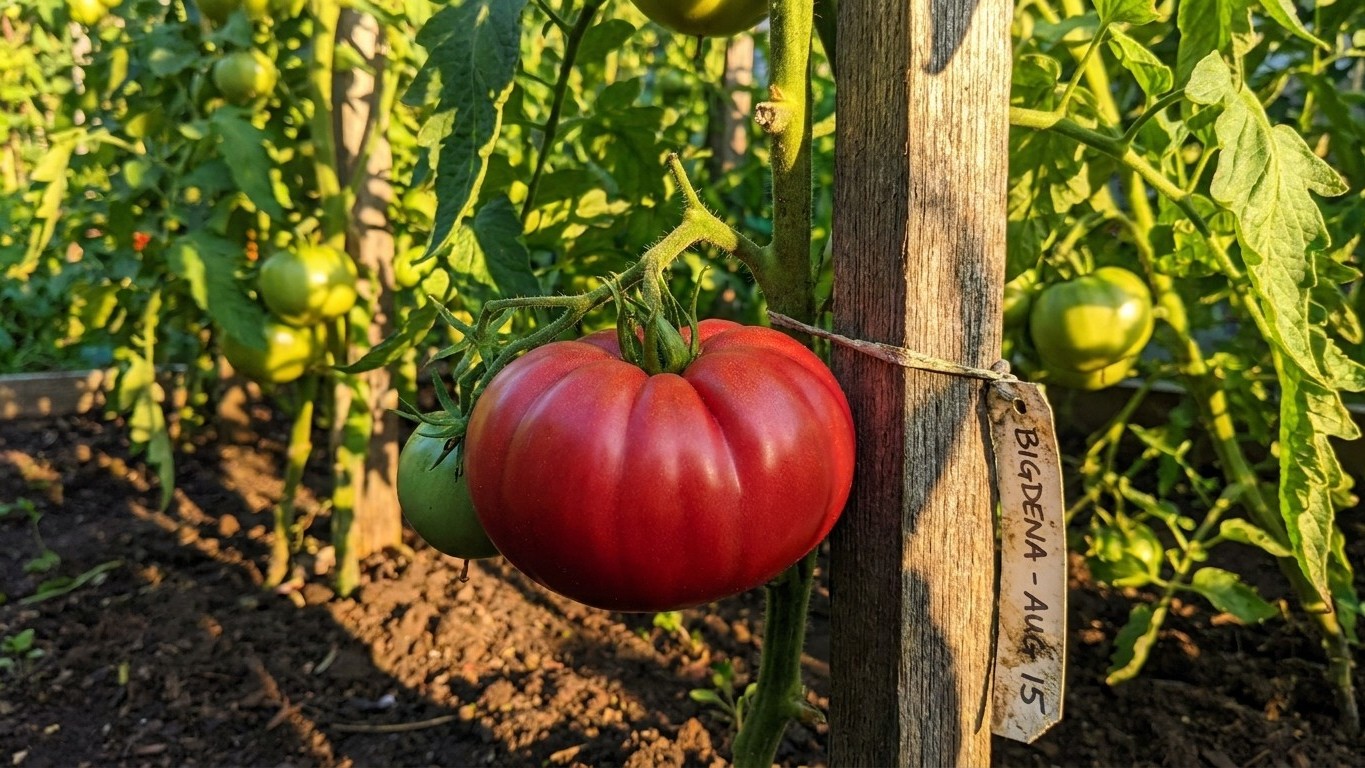

Bigdena is an indeterminate red beefsteak that reaches slicing size in about 77 days from transplant, with 8 to 12 ounce fruit and very good flavor. Whether that number works in your yard depends less on the variety itself than on how much frost-free season you actually have left once the soil warms up enough to plant it.
What Bigdena actually is
Three facts decide whether Bigdena belongs in a given garden. It is a beefsteak, grown for slicing rather than canning or sauce, with fruit running 8 to 12 ounces and red skin and flesh. It has an indeterminate habit, meaning the vine keeps growing and setting new fruit clusters until frost stops it, rather than ripening in one flush and quitting. And it needs 77 days from transplant to reach a ripe, slicing-ready fruit, a figure that comes from catalogue data and is counted from the day a seedling goes into the ground, not from the day the seed was sown indoors.
That distinction matters more than it sounds. Seed-to-transplant time for tomatoes usually runs another five to seven weeks under lights before the plant ever sees a garden bed, so anyone counting Bigdena’s 77 days from the seed packet date will come up short by close to two months when they try to plan a harvest date.
The indeterminate habit also sets the physical demands of the plant before it’s even in the ground. A vine that keeps producing through the whole season needs a tall cage or a sturdy stake from the start, not the low ring of wire that works for a compact, one-and-done variety. Flavor is graded as very good, with catalogue notes pointing to nice internal color and quality, the kind of texture and appearance growers look for when the plan is a sandwich, not a pot of sauce.
Where it ripens in time, and where it is a gamble
The 77-day figure only means something once it’s set against a real calendar. Start with the length of your frost-free window, the stretch between the last spring frost and the first fall frost. Subtract roughly two weeks, because tomato soil needs to warm past the mid-50s before a transplant will grow instead of sulk, which pushes the actual planting date later than the calendar frost date. Then subtract the 77 days Bigdena needs to ripen. Whatever is left is your margin, the number of days you actually get to pick fruit before the season closes back down.
Run the arithmetic on a hypothetical 160-day frost-free window, roughly early May to mid-October. Take off the two-week soil warm-up and you’re at about 146 usable days. Subtract 77 for maturity and there are close to 69 days left for harvest, a comfortable cushion with room to spare even if the season runs a little short or a late cold snap delays planting by a week.
That cushion shrinks fast in short-season country. A garden with a 100-day frost-free window, common in parts of the Upper Midwest, northern New England, and the high valleys of the Mountain West, loses the same two weeks to soil warm-up, leaving around 86 days. Subtract 77 for Bigdena’s maturity and the harvest window narrows to roughly nine days, barely enough for one good picking before frost, and no margin at all for a cool, cloudy stretch that slows ripening the way overcast weather routinely does.
Growers along the Gulf Coast, through most of the Southeast, and across California’s Central Valley generally work with frost-free stretches well beyond 200 days, which puts Bigdena’s 77-day clock nowhere near the edge of the season. The tighter calculation belongs to gardeners farther north and at higher elevation, where it’s worth measuring the actual local frost-free window (a county extension office or a home almanac record is the place to get that number) rather than assuming a “long-season” tomato will simply work out. This page doesn’t carry a station-by-station frost table, so treat these figures as a method to apply to your own dates, not as data for a specific town.
The two ways a season goes wrong
A frost table only measures the calendar. It says nothing about the two ways a season can fail Bigdena even inside a technically long enough window.
In the north, a frost-free stretch can be long on paper and still short on warmth. Tomatoes need accumulated heat, not just frost-free days, to push a plant from flower to ripe fruit, and a cool, cloudy summer common to parts of the northern tier can stretch that 77-day clock out further than the calendar suggests. Fruit set has its own separate threshold too: when nighttime temperatures drop below 50°F, pollen doesn’t perform well and blossoms drop without setting fruit at all, a risk that shows up at the front and back ends of a short season.
In the south, the opposite failure shows up mid-summer. Once daytime temperatures climb past roughly 86°F, tomato pollen goes sterile and flowers stop setting fruit, which is why growers in hot climates plan around a spring crop and a separate fall crop rather than one continuous season. For Bigdena specifically, that southern heat gap matters more than the northern cold-set risk, because its indeterminate habit means the vine keeps trying to flower straight through the hottest weeks of summer instead of finishing early and getting out of the way. A grower in a hot climate gets a strong spring flush, a stalled, mostly fruitless midsummer, and then a second flush once nights cool back down in early fall.
What it resists, and what it does not
Catalogue data lists Bigdena with High resistance to Verticillium Wilt, Tomato Mosaic Virus, Tobacco Mosaic Virus, Fusarium Wilt races 1 and 2, Fusarium Crown and Root Rot, and Leaf Molds A through E. Every one of those ratings is graded High, not the weaker Intermediate rating some varieties carry, which matters because Intermediate resistance only slows a disease’s progress rather than stopping it. When a rating is High across the board, as it is here, a grower can lean on it with more confidence in beds where those specific pathogens have been a problem before.
What the catalogue does not list matters just as much. There’s no published resistance to early blight, late blight, Septoria leaf spot, bacterial spot or speck, or root-knot nematodes, all common problems in home gardens. Nothing here should be read as protection against those, and a grower dealing with blight-prone soil or nematode pressure still needs the standard defenses: crop rotation away from last year’s tomato bed, mulch to keep soil-borne spores from splashing onto lower leaves, and drip irrigation instead of overhead watering. Six named resistances is a real advantage against the wilts and mosaic viruses; it’s not a blanket shield against every disease a tomato plant can catch.
Growing it without the usual mistakes
Because Bigdena is indeterminate, it needs a support plan built for a plant that keeps climbing all season, not the modest tomato cage sold for compact varieties. A stake driven at least 6 feet into the ground, or a tall, heavy-gauge cage, gives the vine somewhere to go once it’s loaded with 8 to 12 ounce fruit clusters in midsummer. Space plants at least 24 to 36 inches apart; a beefsteak this size, left to sprawl or crowded too tightly, ends up with poor airflow and more foliar disease pressure regardless of what the resistance ratings say.
Feeding follows a curve rather than a flat schedule. Heavy nitrogen early pushes healthy vine growth, but that same nitrogen kept up once flowering starts tends to produce lush foliage at the expense of fruit set, a common mistake with big indeterminate beefsteaks. Easing off nitrogen and switching to a phosphorus-and-potassium-leaning feed once the first flower clusters appear keeps the plant’s energy going into fruit rather than leaves.
The mistake this particular variety invites is under-staking early. A young Bigdena transplant looks modest for the first several weeks, which tempts gardeners to use a light support meant for a smaller plant. By the time the vine is carrying a full load of ripening beefsteaks in August, that light stake or short cage isn’t enough, and a loaded, top-heavy vine snapping at the base is a completely avoidable loss. Setting the tall stake or cage at planting time, before the vine needs it, costs nothing and prevents the problem entirely. Consistent watering matters just as much for a fruit this size, since irregular moisture on a big beefsteak is the most common cause of both blossom end rot and skin cracking right before harvest.
Common questions
How many days does Bigdena take to ripen, from transplant or from seed?
The published figure is 77 days from transplant. Add the five to seven weeks most tomato seedlings spend growing indoors before transplanting if you’re counting from the day you started seeds.
Is Bigdena resistant to blight?
No. The published resistances cover Verticillium Wilt, Tomato Mosaic Virus, Tobacco Mosaic Virus, Fusarium Wilt races 1 and 2, Fusarium Crown and Root Rot, and Leaf Molds A through E, all rated High. Early blight and late blight are not on that list, so standard blight prevention, rotation, mulch, and avoiding overhead watering, still applies.
Can I grow Bigdena in a short-season climate?
It’s possible where the frost-free window comfortably clears 77 days plus the roughly two weeks needed for soil warm-up, but the margin for error shrinks fast in regions with frost-free windows near 100 days. Check your local frost-free window before counting on a full harvest.
Does Bigdena need a cage or a stake?
Yes. It’s indeterminate, meaning it keeps growing and fruiting until frost, so it needs a tall stake or a heavy-gauge cage set up at planting time rather than added later once the vine is already loaded with fruit.