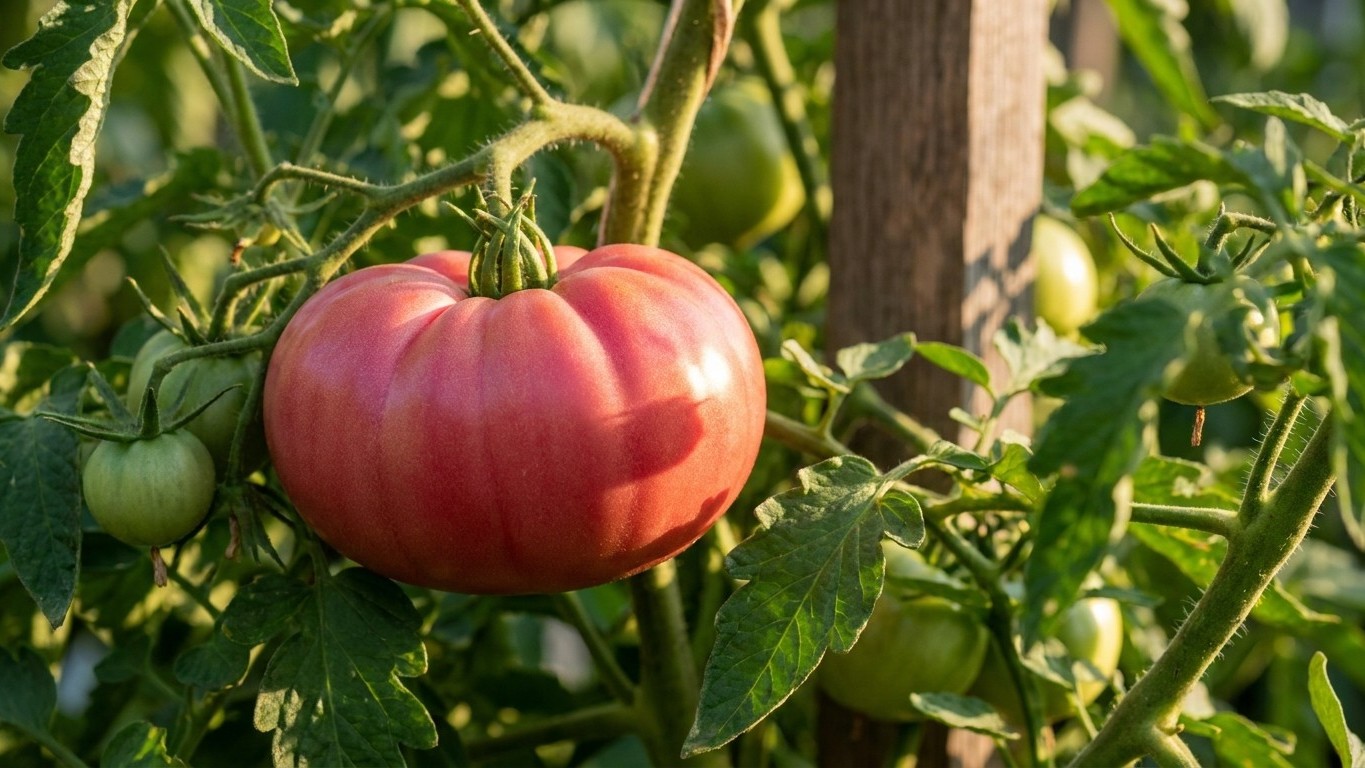

Bonbolya tomato is a pink beefsteak with an indeterminate vine, and it needs 72 days from transplant to first ripe fruit. That number decides almost everything else: whether your region gives it enough runway, whether you stake it hard enough to survive a full season of fruiting, and whether you’re picking slicing tomatoes in July or racing the first frost in October.
What Bonbolya actually is
Start with the habit, because it changes the whole plan for the season. Bonbolya is indeterminate: the vine keeps growing and setting fruit until frost stops it, rather than ripening in one flush and quitting. That means a tall cage or a sturdy stake isn’t optional gear, it’s the difference between a plant that stands up in August and one that collapses under its own fruit load.
The fruit itself is a classic pink beefsteak, running 8 to 10 ounces, described in catalog listings as strong-flavored and well balanced, with a plant that sets fruit reliably and holds that 8 to 10 ounce size consistently rather than tapering off into small, misshapen late-season tomatoes. It’s bred for slicing, which tracks with the size and the flat-shouldered beefsteak shape home cooks want on a sandwich or under a fried egg.
Days to maturity is listed at 72, and that figure is counted from transplant, not from the day you sowed seed indoors. That distinction matters more than it sounds like it should. A gardener who starts counting from seeding will think the plant is running three or four weeks behind schedule when it isn’t; it’s just further back in the process than the catalog number implies. Every calculation in the next section assumes you’re counting from the day the seedling goes into the ground, not the day the seed went into the tray.
Where it ripens in time, and where it is a gamble
The arithmetic is simple once you lay it out. Take your region’s frost-free window, subtract roughly two weeks because tomato roots don’t do much in cold soil even after the air clears, then subtract the 72 days to maturity. Whatever’s left is your actual harvest window, the stretch where the plant is producing ripe fruit rather than just growing toward it. For an indeterminate variety like Bonbolya, that leftover window matters a lot, because a single day of ripe fruit isn’t the point. The plant wants weeks of it.
USDA Plant Hardiness Zones are a rough but useful shorthand for how long that frost-free window runs. Short-season zones in the Upper Midwest and northern New England typically see a frost-free stretch in the neighborhood of 120 days. Mid-latitude zones across the Ohio Valley and the Mid-Atlantic often run closer to 170 days. Warm-winter regions along the Gulf Coast, in Florida, and in the low-elevation desert Southwest routinely see 250 days or more without a killing frost.
Run those numbers against Bonbolya’s 72-day clock and the picture gets concrete fast:
| Region type | Typical frost-free window | Minus soil-warming buffer | Minus 72-day maturity | Harvest window left |
|---|---|---|---|---|
| Upper Midwest / northern New England (short season) | ~120 days | 106 days | 72 days | ~34 days |
| Ohio Valley / Mid-Atlantic (mid season) | ~170 days | 156 days | 72 days | ~84 days |
| Gulf Coast / desert Southwest (long season) | ~250+ days | 236+ days | 72 days | ~164+ days |
A 34-day harvest window in a short-season zone isn’t nothing, but it’s tight for an indeterminate beefsteak that wants to keep producing new trusses all summer. Growers there generally need to start seed indoors on schedule, transplant the moment the soil has genuinely warmed rather than the calendar date, and accept that a hard early frost could cut the season short before the vine has given its full yield. In mid-season and long-season regions, the math stops being the constraint entirely, and the limiting factor shifts to something a frost table can’t show at all.
The two ways a season goes wrong
A long frost-free window doesn’t automatically mean a good tomato season, and this is where a lot of gardeners get burned despite doing the frost math correctly. In the north, some regions have a deceptively long frost-free count on paper but cool nights all summer, particularly along parts of the Pacific coast and in high-elevation valleys. Tomato flowers won’t set fruit once nighttime temperatures fall below 50°F, so a plant can sit there blooming for weeks without producing a single tomato, frost date be damned.
In the south, the opposite failure shows up. Once daytime temperatures push above roughly 86°F, tomato pollen turns sterile and flowering stalls out, even though the plant looks perfectly healthy. That’s why growers across the Deep South, Texas, and the low desert don’t run one long tomato season, they run two: a spring crop planted early enough to fruit before the worst heat, and a fall crop timed to catch the second cool stretch before frost.
For a 72-day indeterminate like Bonbolya, the heat cutoff is usually the tighter constraint of the two. A plant transplanted for an early harvest is already fruiting steadily by the time midsummer heat arrives in warm regions, which means it walks straight into that pollen-sterile stretch and stalls right when an indeterminate vine should be hitting its stride. The cool-night problem, by contrast, only bites in specific pocket climates, so it’s a real risk in select coastal and mountain gardens but not a nationwide concern the way summer heat is for southern growers.
What it resists, and what it does not
Catalog data for Bonbolya lists disease resistance across six traits, and every one of them is graded High, not intermediate: nematodes, verticillium wilt, tomato mosaic virus, fusarium wilt races 1 and 2, leaf molds A through E, and tomato yellow leaf curl virus. That’s a genuinely strong resistance package, and it’s worth being precise about what “high” means here versus the “intermediate” rating some other varieties carry. Intermediate resistance means the plant slows a disease down and often produces a usable crop despite infection. High resistance means the plant is bred to largely avoid the disease taking hold in the first place. Bonbolya’s ratings sit in that stronger category across the board, with no intermediate grades mixed in.
None of that resistance list touches the diseases most home gardeners actually fight every summer. Early blight, late blight, septoria leaf spot, and bacterial spot or speck aren’t on the list at all, which means Bonbolya carries no published protection against them. In practical terms, that means the usual defenses still apply here: crop rotation, mulching to keep soil-borne spores from splashing onto lower leaves, and a fungicide program if blight shows up in your area. High resistance to six named threats is a real advantage, but it’s not a shield against the diseases that actually take down most backyard tomato patches most years.
Growing it without the usual mistakes
Because Bonbolya is indeterminate, the vine treats a stake as a long-term commitment rather than temporary scaffolding. It keeps adding new growth and new fruit clusters right up until frost, so a cage or stake sized for a compact determinate variety will be outgrown by midsummer and won’t hold the plant once it’s carrying a full load of 8 to 10 ounce fruit. Go tall from the start, and plan on tying the leader as it climbs rather than hoping the original support will be enough.
The mistake this timing invites is quitting too early. A 72-day maturity means the first ripe tomatoes show up well before the season ends in most regions, and it’s tempting to treat that first flush as the harvest and ease off on feeding and watering afterward. That’s the wrong read for an indeterminate plant. The vine is just getting started; it will keep setting new trusses through summer if you keep feeding it, generally shifting from a nitrogen-heavy feed early on to something more balanced or potassium-forward once fruiting begins, since too much nitrogen late in the season pushes leafy growth at the expense of new fruit.
Spacing needs room to match that sprawl, wider than you’d give a determinate bush, with airflow between plants to keep foliage dry and reduce the leaf mold pressure the plant is already fighting off genetically. Consistent watering matters more here than with a one-flush variety too, because irregular moisture on a plant that’s setting fruit continuously for months tends to show up as blossom end rot on whichever truss is sizing up that week.
Common questions
How many days does Bonbolya tomato need from transplant to first ripe fruit?
72 days, counted from the day the seedling goes into the ground, not from seed-starting indoors.
Is Bonbolya tomato determinate or indeterminate?
Indeterminate. The vine keeps growing and fruiting until frost, which is why it needs a tall cage or stake rather than a short determinate cage.
What diseases does Bonbolya tomato resist?
Catalog listings grade it High resistance against nematodes, verticillium wilt, tomato mosaic virus, fusarium wilt races 1 and 2, leaf molds A through E, and tomato yellow leaf curl virus. It carries no published resistance to early blight, late blight, septoria leaf spot, or bacterial spot/speck.
Can Bonbolya tomato be grown in short-season climates?
Yes, but the margin is tight. In regions with roughly a 120-day frost-free window, subtracting two weeks for soil warming and 72 days to maturity leaves around a month of harvest time before frost, which favors starting seed on schedule and transplanting as soon as soil temperatures allow.