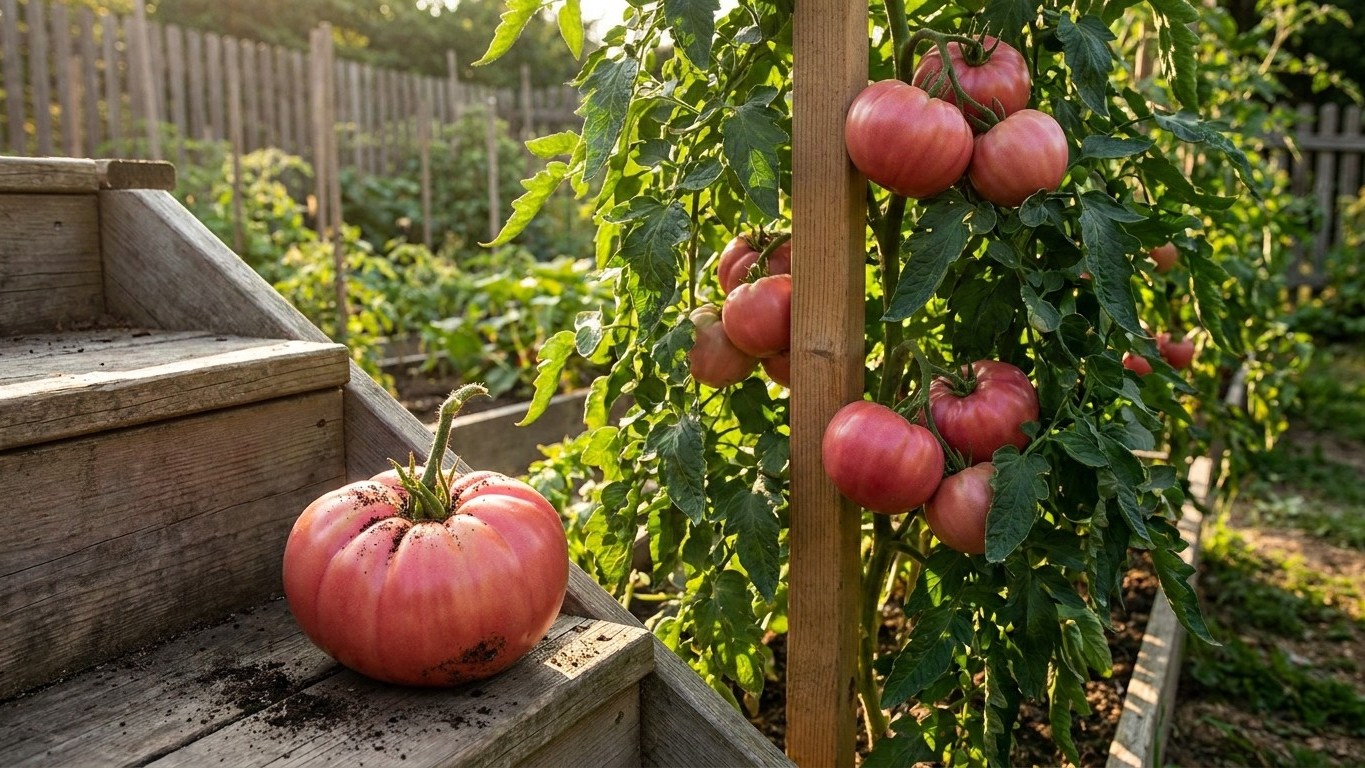

German Queen is a pink beefsteak heirloom tomato that ripens about 80 days after transplant, produces on an indeterminate vine that keeps growing until frost, and yields large, meaty slicers with a sweet, low-acid flavor. Planted after the soil has warmed, it fits comfortably into most frost-free windows longer than about 130 days, but the math gets tighter the further north a garden sits.
What Brandywine actually is
German Queen sits in the same family of large pink beefsteak heirlooms as Brandywine, and the two get confused often enough in seed catalogs that it’s worth separating fact from folklore. What matters for planning a garden isn’t the family resemblance, it’s three specific numbers: the plant needs 80 days from transplant to first ripe fruit, not from the day the seed goes into a tray indoors. That distinction changes everything about when to start seeds and when to expect the first tomato sandwich.
The habit is indeterminate, meaning the vine doesn’t stop at a fixed height or set one flush of fruit and quit. It keeps climbing, branching, and setting new blossoms until a hard frost shuts it down. That single fact dictates the whole support system: a tomato cage rated for a determinate bush won’t hold this plant past midsummer. It wants a tall stake or a heavy-gauge cage, six feet or better, and a spot where it won’t shade out shorter neighbors.
In the kitchen, the fruit is built for slicing rather than canning or sauce work. One slice is often wide enough to cover a sandwich by itself, and the low acidity paired with a dense, meaty interior makes it a favorite for eating raw with just salt. That’s a flavor profile, not a yield guarantee, and the next section is where yield actually gets decided by geography.
Where it ripens in time, and where it is a gamble
Eighty days sounds simple until it collides with a real calendar. The arithmetic every gardener needs to run for themselves goes like this: take the length of the local frost-free season, subtract roughly two weeks for the soil to warm enough to safely set out transplants without stalling the plant, then subtract the 80 days to maturity. Whatever number is left over is the harvest window, the stretch of days when ripe fruit can actually be picked before the first fall frost ends the season.
In the Deep South, along the Gulf Coast and through most of Florida and coastal Georgia, frost-free seasons commonly stretch well past 220 days. Run the math there and German Queen has a wide margin, often two months or more of picking before frost becomes a concern. Gardeners in that zone usually worry less about running out of season and more about the heat problem covered in the next section.
The picture changes moving north. Across the mid-Atlantic and much of the Ohio Valley, frost-free windows typically fall in the 180 to 200 day range. Subtract the two weeks of soil-warming and the 80 days to maturity, and there’s still a comfortable month or more of harvest, though a late spring or an early autumn cold snap can eat into that cushion fast.
The tight zones are the Upper Midwest, the interior Mountain West, and northern New England, where frost-free seasons often run closer to 120 to 140 days. Do the subtraction there and the harvest window can shrink to three or four weeks, sometimes less if the spring stays cold longer than average. That’s not impossible, but it leaves almost no room for a slow start, a cool June, or a wet spell that delays transplanting. Gardeners in those regions do better starting seed indoors early and using row cover or wall-of-water protectors to buy back some of those lost weeks, rather than assuming the printed 80-day figure will hold in a compressed season.
None of this is published as a single official chart matched to this variety. It’s a calculation every gardener has to run against their own local frost-free window, because a catalog’s 80-day figure was measured under favorable conditions, not guaranteed against a short or erratic season.
The two ways a season goes wrong
A long frost-free window looks reassuring on paper, but it doesn’t measure the two things that actually stop a tomato plant from setting fruit. The first is accumulated warmth. A region can have a technically long frost-free season and still run cool overnight for weeks at a stretch, especially at higher elevations or near large bodies of water. Tomato blossoms won’t set fruit when nighttime temperatures drop below 50°F, regardless of how many frost-free days remain on the calendar. A mountain garden in the Rockies or a coastal plot in the Pacific Northwest can have 150 nominal frost-free days and still lose weeks of fruit-set to chilly nights.
The second failure mode sits at the opposite end of the thermometer. Once daytime highs push past roughly 86°F for extended stretches, tomato pollen becomes sterile and blossoms drop without setting fruit at all. This is the reason growers across the Deep South and the desert Southwest don’t treat summer as one long tomato season. They plant early enough to get a spring crop finished before the worst heat arrives, then often start a second round in late summer for an autumn crop once temperatures ease.
For an 80-day variety like German Queen, the heat problem tends to matter more than the cold-night problem in the regions where it’s popular. Its mid-length maturity lets southern gardeners slip a spring crop in before peak heat shuts pollination down, while northern gardeners are more likely to run short on total season length than to lose fruit-set to cool nights, unless they’re gardening at elevation or near a cold coastline.
What it resists, and what it does not
Here the catalog record is short, and it’s worth stating plainly rather than glossing over: no disease resistances are published for this variety. That’s not the same as saying it’s fragile, but it does mean the plant carries none of the letter codes seed packets sometimes use, like a rating against Fusarium wilt or Verticillium wilt, that would signal built-in defense against common soil-borne diseases.
Practically, that puts more weight on garden management than on genetics. Heirloom beefsteak types in this general category are known to be vulnerable to early blight and late blight in humid, wet conditions, and without a published resistance rating, there’s no reason to assume this plant handles those pressures better than an average heirloom. Crop rotation, keeping foliage dry with drip irrigation instead of overhead watering, and spacing plants for airflow all matter more here than they would for a variety bred with strong disease-resistance codes.
It’s also worth being precise about what a resistance rating would and wouldn’t mean if one existed. Catalogs that grade resistance as intermediate are describing a plant that slows a disease’s progress, not one that escapes it entirely. Since German Queen carries no rating at all, that nuance doesn’t even apply, there’s simply no documented defense to lean on, and prevention through cultural practice is the main tool available.
Growing it without the usual mistakes
Because the vine is indeterminate, it needs a season-long plan rather than a one-time setup. A single tomato cage bought off the shelf rarely holds this plant by August; a stake driven at least a foot into the ground with soft ties added every week or two as the vine climbs works better, or a heavy welded-wire cage built to at least six feet tall. Spacing plants two to three feet apart in the row gives the sprawling growth room without crowding out airflow, which matters more here given the lack of disease resistance covered above.
Feeding schedule matters more with this habit than with a bush-type determinate. Because the plant keeps producing new growth and new blossoms until frost, it benefits from a steady, moderate feeding through midsummer rather than one heavy dose at planting. Many growers ease off nitrogen once the first fruit sets, since too much late-season nitrogen pushes leafy growth at the expense of ripening fruit, a common mistake with vigorous indeterminate plants.
The timing mistake specific to an 80-day variety is starting too late in short-season regions and expecting the plant to catch up. Because the frost-free math in the second section leaves little slack in the Upper Midwest and similar zones, transplants there benefit from being started indoors six to eight weeks before the last expected frost date, then hardened off carefully so the plant isn’t set back by cold shock right when it needs every one of those 80 days to count. In longer, hotter regions, the more useful move is timing the transplant early enough that flowering finishes before the worst of summer heat arrives, since blossom drop above 86°F costs more real harvest time than a slightly cool spring ever would.
Common questions
Is German Queen the same tomato as Brandywine?
No. They’re both large pink beefsteak heirlooms with similar sweet, low-acid flavor and meaty flesh, which is why they’re often grouped together or confused in catalogs, but they’re distinct varieties with their own seed lines.
Can I start harvesting exactly 80 days after I put the seedling in the ground?
The 80-day figure is a catalog average measured from transplant under good growing conditions. Cool nights, a slow spring, or heat stress during flowering can all push the actual first harvest later than that baseline.
Does German Queen need a special fungicide program since it has no disease resistance?
There’s no published resistance to lean on, so prevention through spacing, drip irrigation, and crop rotation carries more weight than it would for a resistant variety. Whether a fungicide program is needed depends on local disease pressure and personal preference, not on anything built into the plant.
Will it keep producing tomatoes all summer, or just once?
Because it’s indeterminate, it keeps flowering and setting new fruit continuously until frost, not in one single flush like a determinate bush variety. That’s also why it needs tall support rather than a short cage.