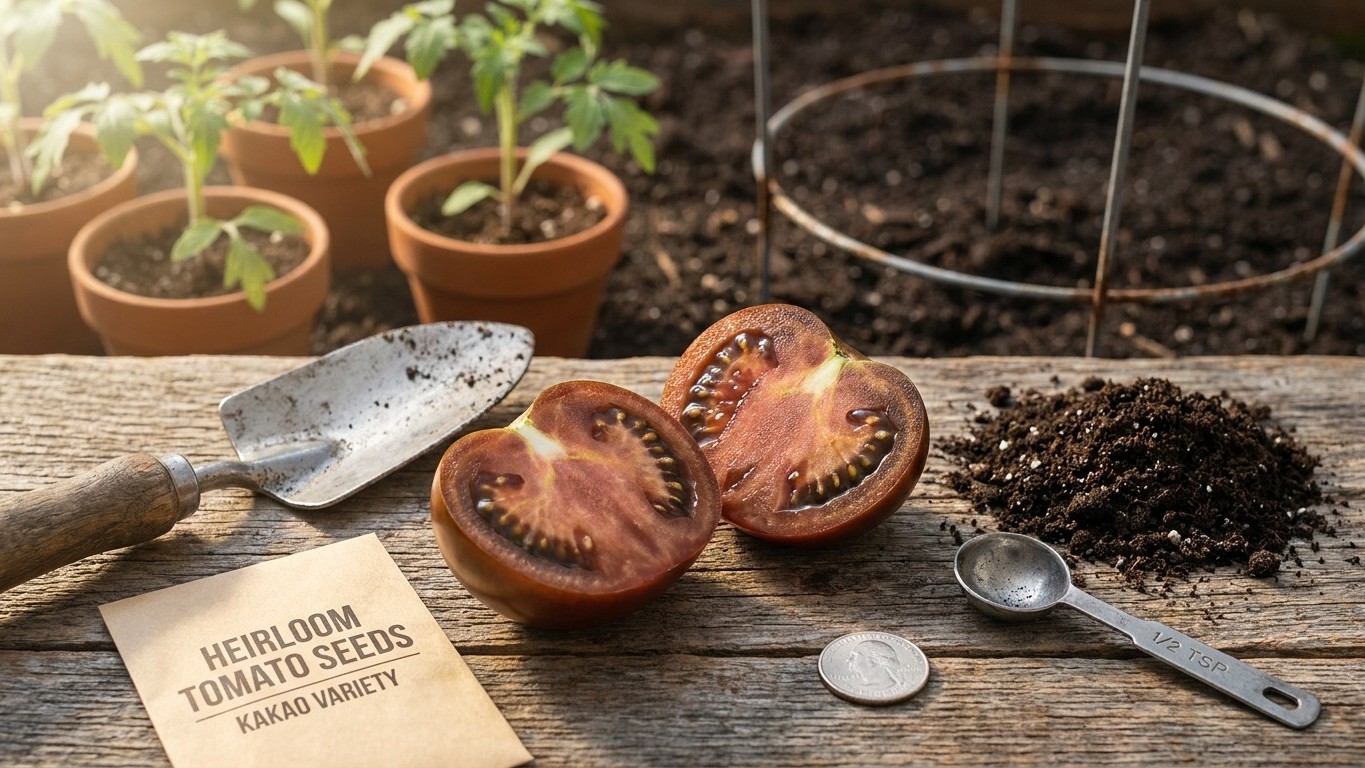

Kakao is a specialty tomato bred in a small, single-serving size: half-ounce fruit with the deep, almost cocoa-toned flesh and flavor usually found on much bigger brown tomatoes. It’s an indeterminate vine that needs about 70 days from transplant to first ripe fruit, which puts it comfortably inside most home gardens as long as the vine gets a real cage and the grower isn’t counting from seed.
What Brandywine actually is
Three facts decide whether Kakao belongs in a particular garden. First, the fruit itself: about a half ounce, small enough to eat two or three in a sitting, with the brown-tomato flavor profile scaled down rather than diluted. Second, the habit: Kakao is indeterminate, meaning the vine doesn’t stop at a set height or set a single flush of fruit and quit. It keeps extending and setting new clusters until frost or disease shuts it down, which is a different commitment than a determinate variety that ripens in one window and finishes.
Third, and the one number every seed packet leans on: 70 days to maturity, counted from transplant. That basis matters more than the number itself. Seed started indoors typically needs four to six weeks before it’s ready to go into the ground, so a gardener counting from the day they sowed seed will be disappointed when the calendar says 70 and the tomato isn’t ripe. The catalogue figure is a field measurement: the clock starts the day the seedling goes into the soil outdoors, not the day the seed packet gets opened.
Because Kakao is indeterminate and small-fruited, it behaves less like a single-harvest crop and more like a steady trickle: the first fruit lands around day 70, and after that the plant keeps producing in smaller batches as long as conditions allow. That changes how a gardener should think about season length, which is the next question.
Where it ripens in time, and where it is a gamble
A 70-day maturity window is on the shorter side for tomatoes generally, which gives Kakao more margin than a 90-day heirloom in most of the country. But margin isn’t the same as guaranteed. The arithmetic a gardener needs is simple, and it works the same way no matter where they garden: take the length of the frost-free season, subtract the two or three weeks the soil needs to warm enough for a tomato transplant to actually grow rather than sit and sulk, then subtract the 70 days to first fruit. Whatever is left over is the harvest window, the stretch of time the plant actually has to produce a crop before frost ends it.
No specific frost-date figures for named weather stations are published here, so the honest way to use this is to run the numbers for the reader’s own location rather than borrow someone else’s. A gardener can pull their local frost-free window from a county extension office or a state climate office and plug it straight into that formula. As an illustration only: a garden with a 150-day frost-free season, minus two weeks of soil-warming delay, minus 70 days to first fruit, leaves roughly 66 days of active harvest, plenty of room for an indeterminate plant to run through several waves of fruit. A garden with a 100-day frost-free season run through the same math leaves closer to 16 days, which is enough for one real harvest push before the vine gets cut short.
The practical takeaway is regional, even without naming specific stations. Long, hot-summer regions along the Gulf Coast and in the Southeast, and mild-winter regions of the Southwest and coastal California, generally carry frost-free windows well over 200 days, which gives Kakao room to produce from midsummer straight through fall with no scheduling stress. Short-season regions, think the northern tier from the Dakotas across the Upper Midwest into northern New England and the mountain West, often work with frost-free windows closer to 100 to 120 days. There, Kakao’s 70-day figure is an asset rather than a liability: it’s fast enough to still deliver a real harvest in a season that would strand a 90-day beefsteak. The gardener in a short-season zone should still start transplants indoors on schedule and get them into warmed soil promptly, because every week lost to a cold, wet spring comes straight out of the harvest window at the other end.
The two ways a season goes wrong
A frost-free window long enough on paper doesn’t guarantee a good tomato season, and this is where a lot of gardeners get blindsided. In the north, the problem isn’t always frost, it’s warmth. Tomato flowers won’t reliably set fruit once nighttime temperatures drop below 50°F, and a region can have a technically long frost-free season that still runs cool at night well into June and again by early September. A vine can be alive and green with no fruit forming, simply because the nights never got warm enough, or cooled off too early. For a 70-day variety like Kakao, this matters less than it would for a slow 90-day heirloom, since the shorter run to first fruit means less exposure to a marginal fall.
In the south, the opposite failure shows up in the middle of summer rather than at the edges of the season. Once daytime temperatures push past roughly 86°F, tomato pollen goes sterile and blossoms drop without setting fruit, even though the plant looks perfectly healthy. That’s the reason growers across the Deep South and desert Southwest typically split the year into a spring crop and a separate fall crop instead of expecting one long unbroken harvest, letting the plant coast (or get pulled) through the worst of July and August. Because Kakao reaches first fruit quickly, it fits neatly into either half of that split calendar, giving southern growers a workable spring harvest before the heat shuts pollination down, and a second run once temperatures ease in fall.
For this particular variety, the heat-sterility limit in the south is the more relevant one to plan around, precisely because the fast 70-day timeline already sidesteps most of the northern cool-night problem.
What it resists, and what it does not
Kakao’s published disease resistances are narrow and specific, and it’s worth being exact about them rather than rounding up. The variety carries High resistance to Tomato Mosaic Virus, and High resistance to Fusarium Wilt race 1. Those are the only two resistances on record for this variety, and both are graded at the high tier, not the intermediate one.
That distinction matters because seed catalogues generally use two different tiers, and they mean different things in the field. High resistance means the plant strongly suppresses the pathogen and rarely shows disease symptoms even under real pressure. Intermediate resistance, which does not apply to either of Kakao’s two listed traits, means something weaker: the plant slows disease development and may show milder symptoms, but it does not escape infection outright. Since neither of Kakao’s resistances is graded intermediate, there’s no ambiguity to manage here for these two diseases, they’re rated at the strong end.
What matters more, though, is what isn’t on the list. Kakao carries no published resistance to late blight, early blight, Septoria leaf spot, Verticillium wilt, or Fusarium wilt race 2, the diseases that account for most home-garden tomato losses in a wet or humid season. A grower who assumes a “disease-resistant” label covers everything is exposed on all of these fronts. Good airflow, drip irrigation instead of overhead watering, and mulching to keep soil-borne spores from splashing onto lower leaves stay just as necessary with Kakao as with any tomato that carries no resistance at all to those pathogens.
Growing it without the usual mistakes
Kakao’s indeterminate habit is the detail that trips up gardeners who are used to compact patio varieties. Because the vine doesn’t stop growing or fruiting on its own, it needs a tall cage, at least 5 to 6 feet, or a sturdy stake with regular tying, set in place at planting rather than added later once the plant has sprawled. A determinate tomato can get by with a short cage because it sets one flush and finishes; Kakao will keep pushing new growth past the top of an undersized cage all season, and an unsupported vine sprawling on the ground invites the soil-splash diseases discussed above.
Spacing should account for that same sprawling habit. Crowding indeterminate plants closer than about 24 to 36 inches apart cuts airflow between vines right when humidity and disease pressure are highest, which is a bigger risk for Kakao specifically since it carries no resistance to the common leaf-spot and blight pathogens.
Feeding follows the same logic as staking: because the plant fruits continuously rather than in one flush, it benefits from a lighter, more consistent feeding schedule rather than one heavy early dose. A nitrogen-heavy feeding late in the season pushes leafy growth at the expense of fruit set, a mistake that costs more with a continuous producer like Kakao than with a determinate variety that’s already finished setting its crop by the time that mistake gets made.
Because first fruit lands around day 70, the most common timing error is starting seed too early or too late relative to the local frost-free window calculated earlier. Starting transplants on schedule so they hit warmed soil right as the season opens keeps the full harvest window intact instead of losing it to a rushed or delayed start.
Common questions
Is Kakao the same as a black or brown heirloom tomato?
No. It shares the brown-toned flavor and appearance associated with larger brown tomatoes, but it’s bred as a small-fruited specialty variety at about a half ounce per fruit, not a scaled version of a specific heirloom.
Does 70 days to maturity mean the whole harvest happens at once?
No. That figure marks the first ripe fruit. Because Kakao is indeterminate, it keeps setting new fruit clusters after that point and continues producing until frost or disease ends the season.
Can Kakao be grown in a short-season northern climate?
Its relatively fast 70-day window gives it better odds than slower-maturing tomatoes in short frost-free regions, provided transplants go into warmed soil promptly rather than being delayed by a late, cold spring.
Does the resistance to Fusarium Wilt and Tomato Mosaic Virus mean the plant won’t get sick?
No. Both resistances are rated High for those two specific diseases only. Kakao has no published resistance to late blight, early blight, Septoria leaf spot, or other common tomato diseases, so standard prevention practices still apply.