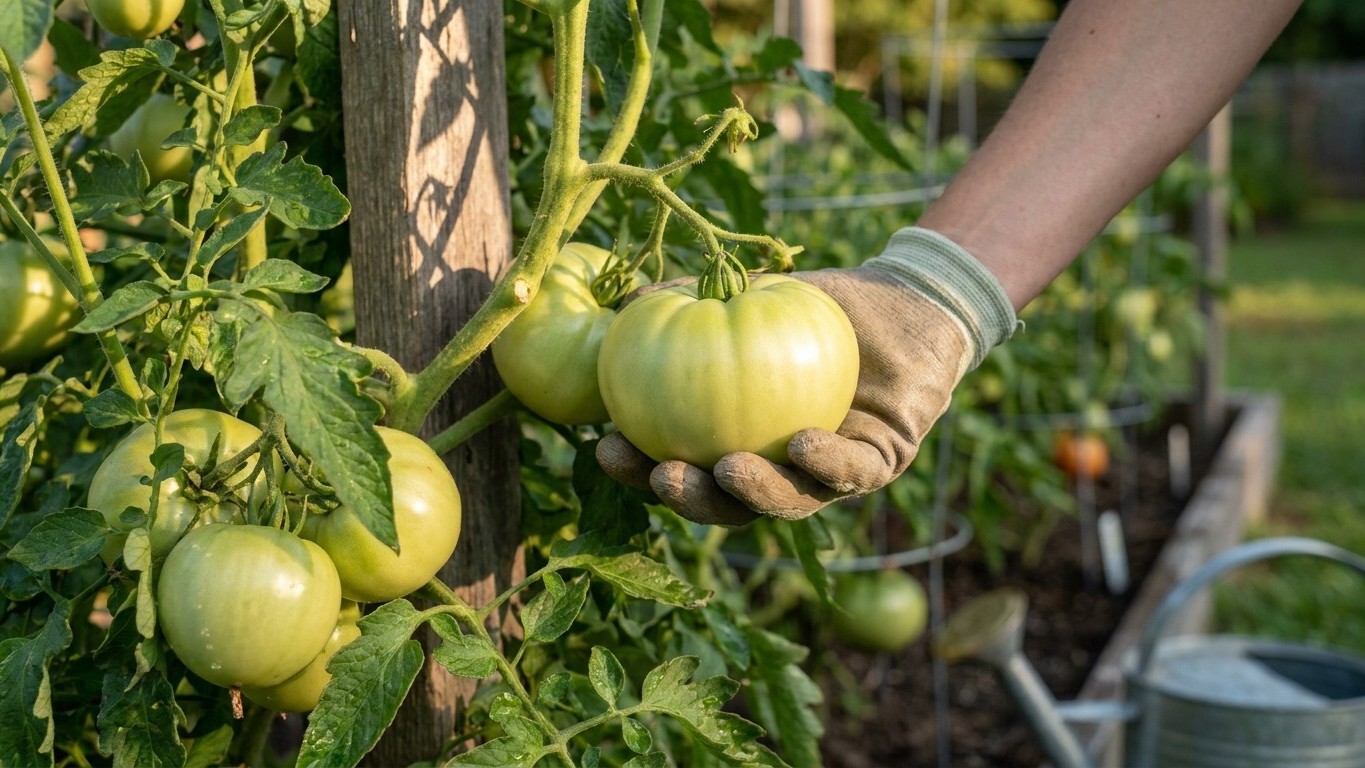

Marmalade Skies is a specialty tomato that stays green even when fully ripe, reaching 75 days from transplant with fruit built for sauce and canning. Because it never colors up, “green tomatoes” here doesn’t mean pick-before-frost fried tomatoes, it means learning to spot ripeness by feel and give rather than by hue, and knowing when your local season gives this indeterminate vine enough time to finish its full run.
What Brandywine actually is
Three numbers decide whether this variety belongs in a given garden. First, 75 days to maturity, counted from transplant, not from the day the seed goes into a starter tray. That distinction matters because gardeners who count from sowing routinely overestimate how much time they have left in the season by two to three weeks, which is exactly the margin that separates a full harvest from a frost-cut one.
Second, the growth habit: Marmalade Skies is indeterminate, meaning the vine keeps extending and setting new fruit until frost stops it, rather than ripening in one flush and quitting. That single fact drives almost every other decision about staking, feeding, and how long you can expect to keep picking.
Third, the fruit itself. Each tomato runs 7 to 8 ounces, ripening to an even green with no green shoulders lingering near the stem, the way some heirloom greens do. The catalogue describes it as ripening uniformly with an abundant harvest and a balanced, tasty flavor, which is the reason it’s grown for sauce and canning rather than fresh slicing. A tomato that colors unevenly is a headache for a canner who needs a whole batch ripe at once; one that ripens uniformly, even if that ripeness is green rather than red, solves that problem.
Where it ripens in time, and where it is a gamble
The arithmetic here is simple enough to redo on the back of a seed packet, and it’s worth doing before you commit a cage and a season to this plant. Start with your area’s frost-free window, the stretch between the average last spring frost and the average first fall frost. Subtract roughly two weeks from the front end, because soil needs time to warm after that last frost before a tomato transplant will actually take off rather than sit and sulk. Then subtract the 75 days Marmalade Skies needs to reach its first ripe fruit. What’s left over is your picking window, the number of days you actually get to harvest before the vine runs into frost again.
Run the numbers for a short frost-free season and the math gets tight fast. A window of around 100 days, once you take off two weeks for soil warming and 75 days for maturity, leaves barely more than a week of picking before the first vine-killing frost arrives. That’s workable for a determinate variety that ripens its whole crop at once, but it shortchanges an indeterminate plant like this one, whose entire appeal is a long, staggered harvest that keeps producing into fall.
A longer frost-free season changes the equation completely. Where the frost-free window stretches to 160 or 180 days, the same subtraction leaves two to three months of active picking, which is enough time for the vine to size up, set several rounds of fruit, and still be producing when a canner is ready to run a big batch through the kettle. That’s the difference between a variety that merely survives and one that earns its cage.
Specific frost-date figures for named weather stations aren’t published on this page, so the honest move is to pull your own last and first frost averages from a local extension office or a regional almanac source and run the subtraction above with your real numbers rather than a national average. The math travels; the exact dates don’t, because they vary by hundreds of miles even within a single state.
The two ways a season goes wrong
A long frost-free window on paper doesn’t guarantee a good tomato season, and this is where a lot of gardeners get burned despite doing the frost-date homework correctly. Two separate limits sit outside what any frost table measures.
In cooler regions, the problem isn’t the calendar, it’s accumulated warmth. A frost-free season can technically run 130 days and still deliver too few genuinely warm nights to push a tomato plant through bloom and fruit set at a normal pace. Tomatoes stop setting fruit when nighttime temperatures drop below 50F, regardless of how many frost-free days remain on the books. A cool, damp spring or a string of chilly nights in early summer can quietly eat into the picking window this variety needs, even where the frost dates look generous.
In hot regions, the opposite failure shows up in mid-summer. Once daytime temperatures climb past roughly 86F, tomato pollen goes sterile and blossoms drop without setting fruit, which is why growers across the Deep South and the Gulf Coast plant a spring crop, lose the plant’s productivity through the hottest weeks, and then push a second, autumn crop to catch the cooler tail end of the season rather than expecting one unbroken 75-day run.
For a 75-day variety like Marmalade Skies, the cold-night limit tends to matter more than the heat limit, simply because 75 days is short enough that a spring crop can often be harvested and largely finished before the worst of a Southern summer sets in. Gardeners in short-season northern climates should watch nighttime lows more closely than the frost calendar itself.
What it resists, and what it does not
The published resistance for Marmalade Skies covers exactly one disease: Late Blight, rated High. High resistance means the plant is bred to hold up strongly against that specific pathogen under normal pressure, which matters a great deal in regions where late blight regularly wipes out unprotected tomato patches by late summer, particularly in humid, high-rainfall areas of the Northeast and Midwest.
That’s the only resistance the catalogue lists, and no others should be assumed. It’s worth being precise about what “high” resistance means in practice: it’s not immunity. A high rating means the plant is far less likely to develop disease symptoms and, if it does, the disease progresses more slowly than in a susceptible variety. It doesn’t mean the plant can’t ever show late blight symptoms under severe, sustained pressure.
Because no other resistances are published for this variety, treat it as fully vulnerable to the other common tomato diseases, early blight, fusarium wilt, verticillium wilt, and septoria leaf spot among them. That absence of listed protection is the practical risk gardeners need to plan around: good airflow from proper staking, mulch to keep soil-borne spores from splashing onto lower leaves, and crop rotation away from last year’s tomato bed all do real work here, precisely because the variety isn’t doing that work for you through built-in resistance.
Growing it without the usual mistakes
Because Marmalade Skies is indeterminate, it needs a support plan built for a plant that keeps growing all season rather than one that tops out and stops. A flimsy tomato cage bought for a compact determinate variety won’t hold this vine by midsummer. A tall stake, at least 6 feet, or a sturdy cage of similar height, gives the plant room to keep climbing without toppling under the weight of a full load of 7-to-8-ounce fruit.
Spacing matters more here than with a determinate bush, since the vine will sprawl and fill in gaps aggressively if given the chance. Giving each plant enough room, generally 2 to 3 feet between plants in a row, keeps airflow moving through the foliage, which matters even more given the lack of published resistance to fungal diseases beyond late blight.
Feeding follows the same logic as staking: because the plant fruits continuously rather than in one flush, it draws on soil nutrients over a much longer stretch than a determinate variety does. Steady, moderate feeding through midsummer supports that ongoing production, but heavy nitrogen late in the season pushes leafy growth at the expense of fruit set, right when a gardener wants the plant concentrating on ripening rather than expanding.
The mistake its particular timing invites is impatience at harvest. Because the fruit ripens to green with no color shift to signal readiness, gardeners used to watching for red are prone to either picking too early, when the tomato is still hard and underdeveloped, or letting fruit hang too long past its peak. Learning to judge ripeness by a slight softening and a clean, easy separation from the vine, rather than by color, is the one skill this variety specifically demands that a red slicing tomato doesn’t.
Common questions
Is Marmalade Skies ever going to turn red or orange?
No. The variety’s ripe color is green by design, with no green shoulders remaining near the stem once the fruit matures. Waiting for a color change will mean picking fruit long past its prime.
Can I can or make sauce with a green-fleshed tomato?
Yes, that’s the intended use listed for this variety, which is bred for sauce and canning rather than fresh slicing, and its uniform ripening makes it easier to gather a full, evenly ripe batch for canning at once.
Does the Late Blight resistance mean I can skip crop rotation?
No. High resistance to late blight only covers that one disease, and it reduces risk rather than eliminating it. Other common tomato diseases have no published resistance for this variety, so rotation, spacing, and mulching still matter.
How long will the plant keep producing?
As an indeterminate variety, it keeps growing and setting fruit until frost kills the vine, so the real limit on your harvest is your local frost-free window minus the 75 days needed to reach first ripe fruit, not any fixed endpoint built into the plant itself.