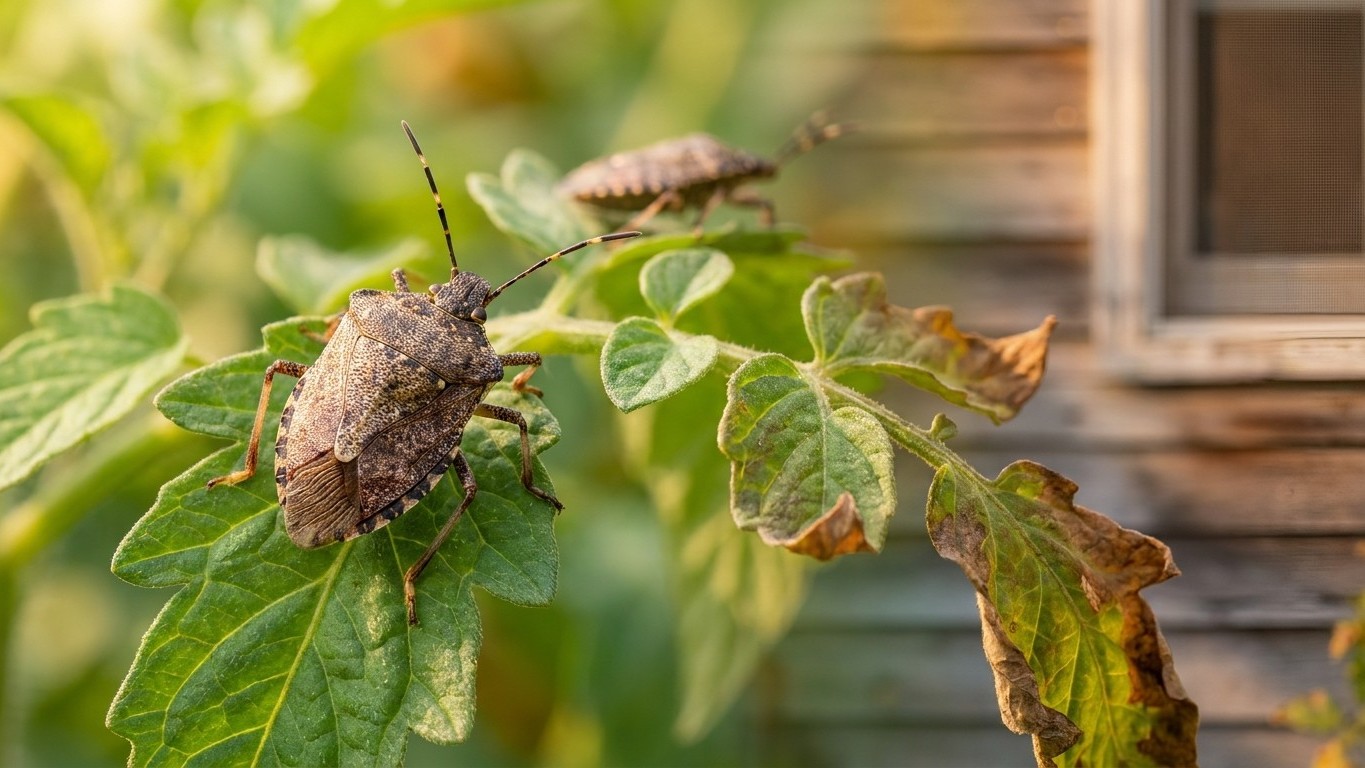

Brown Marmorated Stink Bug control only works when it matches what the insect is doing at that exact moment. A spray in July does nothing to the adults that will crawl into your siding in October. Exclusion in October does nothing to the eggs laid on your tomato leaves in June. Real control mixes four things: correct timing, physical barriers, the natural enemies already in your yard, and a targeted product only when the first three fall short.
Timing beats product

Here is the mistake that wastes the most money and effort: treating Halyomorpha halys as if it behaves the same way all season. It doesn’t. This insect runs through egg, five nymph stages, and adult, and each stage reacts to a completely different set of tools. A product that stops young nymphs feeding on a peach may barely touch a hardened adult. Physical exclusion that keeps adults out of a wall void in September does nothing about the eggs a female already laid on a leaf in your garden back in June.
Why the calendar controls the outcome
The insect most homeowners meet is the overwintering adult, the one that shows up on window screens and attic insulation as the weather turns, looking for a dry crack to spend the cold months in. By the time it’s inside the house, the pest-control conversation has already changed. You’re not managing crop damage or garden feeding anymore. You’re managing an indoor nuisance, and the tools that work outdoors in summer, from row covers to natural predators, are irrelevant to a bug already behind your siding.
This is exactly why the life-cycle page has to come first, before any control decision. It lays out what the insect looks like and what it’s doing at each stage, egg cluster, nymph instar, or adult, and matches that to the window when action actually does something. Skipping that step is the single most common reason a treatment “doesn’t work”: it was aimed at the wrong bug at the wrong time, not a failure of the method itself.
Emergence dates, the number of generations in a season, and the point at which adults start seeking overwintering sites all shift by region and by year’s weather. That’s not a detail to guess at. It’s the reason the timing question always routes back to a state-specific source rather than a single national date.
What works without a product
Several tactics reduce Brown Marmorated Stink Bug pressure with no label, no mixing, and no re-entry interval. They ask for labor and attention instead, and being honest about that labor is part of using them well.
- Barriers and row covers: Fine mesh over vulnerable vegetables and fruit works only if it goes on before adults start laying and stays sealed at the edges. Once nymphs are already feeding underneath, the cover is trapping the problem, not stopping it.
- Hand removal: Knocking adults and nymphs into a bucket of soapy water is tedious but genuinely effective on small plantings, especially in the morning when the insects are sluggish and less likely to take flight.
- Trap crops: Sunflowers, millet, and sorghum planted at field edges pull feeding pressure away from the main crop. They only help if they’re established and attractive before the main crop becomes a target, meaning the planting date has to lead the pest, not follow it.
- Timing of planting: Shifting susceptible crops so their most vulnerable stage doesn’t line up with peak adult activity reduces exposure without touching a sprayer at all.
- Cleanup: Removing plant debris and fallen fruit late in the season takes away overwintering cover near the house and garden, cutting down the population that shows up again next spring.
None of these methods is a single fix on its own. Stacked together, and timed against the life stage the insect is actually in, they cut pressure substantially before a product ever enters the conversation.
The allies you already have
The most consequential natural enemy working against Brown Marmorated Stink Bug in North America is a tiny parasitic wasp called Trissolcus japonicus, often referred to as the samurai wasp. It attacks the egg stage, laying its own eggs inside stink bug egg masses so the wasp develops instead of the stink bug. It arrived on its own in parts of the country and has since been the subject of ongoing research and release efforts by USDA and university partners, documented through the multi-state research consortium at stopbmsb.org. In areas where it’s established, it can meaningfully reduce egg survival year over year.
Generalist predators matter too. Birds, spiders, and predatory insects will feed opportunistically on nymphs and adults, and a yard with diverse plantings and undisturbed edges tends to hold more of them.
Why a broad-spectrum spray backfires
This is the part that gets skipped in most advice, and it matters: a broad-spectrum insecticide applied against stink bugs does not distinguish between the pest and the wasp working the same egg masses, or the spiders and beetles that were quietly suppressing the population before you sprayed. Kill the pest and you also kill its enemies. The stink bugs that survive, or migrate in from an untreated area next door, now face far less natural pressure. That’s how a manageable problem this month turns into a worse one next month, without a single new bug arriving from outside. Protecting these allies means limiting broad sprays to real need, choosing the narrowest option available, and avoiding blanket treatments on plants that are only lightly infested.
When a product is the answer
There’s an honest case for a product when nymph populations are heavy on a valuable crop or ornamental, when hand removal and exclusion have clearly failed to keep pace, or when an infestation inside a structure needs more than sealing and vacuuming to knock down. In those situations, a targeted treatment aimed at active nymphs, before they mature into the harder-bodied, more mobile adult stage, is far more effective than spraying adults that are already dispersing or heading indoors.
Why this site won’t name a product here
What’s labeled for Brown Marmorated Stink Bug, at what rate, and under what restrictions, differs from state to state and changes as registrations are reviewed and updated. A product cleared for use on ornamentals in one region may carry different restrictions elsewhere, and residential-use options are governed separately from agricultural ones. Naming a specific product or rate here would mean guessing at rules that your state’s regulators and extension entomologists actually set and revise.
The reliable move is checking with your state’s extension service, which tracks current degree-day thresholds, action levels, and locally permitted products for this pest. This site carries a dedicated state-by-state control page that links directly to the extension office covering your territory, so the guidance you act on reflects what’s actually approved and current where you live, not a national average that may not apply to your county at all.
Common questions
Does killing stink bugs indoors reduce the outdoor population?
No. Indoor adults are overwintering individuals that have already stopped feeding and reproducing for the season. Removing them protects your home from a nuisance but has essentially no effect on next year’s outdoor population, which depends on how many eggs survive to hatch in spring and summer.
Do stink bugs bite or sting?
No. Brown Marmorated Stink Bug has no capacity to bite or sting people or pets. Its defense is a strong odor released when it’s crushed or disturbed, which is where the “stink” name comes from.
Will sealing my house completely stop them from getting in?
Sealing cracks around windows, doors, siding, and utility penetrations significantly reduces entry, but a house doesn’t need to be airtight for stink bugs to find their way in through very small gaps. Sealing works best combined with exterior cleanup and reduced outdoor lighting near entry points, which cuts the number of adults congregating on the siding in the first place.
Are the same control methods used on all crops and plants?
The principles are the same, timing against life stage, barriers before egg-laying, protecting natural enemies, but the specifics shift by crop. A row cover strategy that works on backyard tomatoes isn’t practical on an orchard, and threshold levels that justify a product on a commercial crop differ from what’s reasonable on a few ornamental shrubs. That’s another reason state extension guidance, tailored to the crop and region, matters more than a one-size answer.