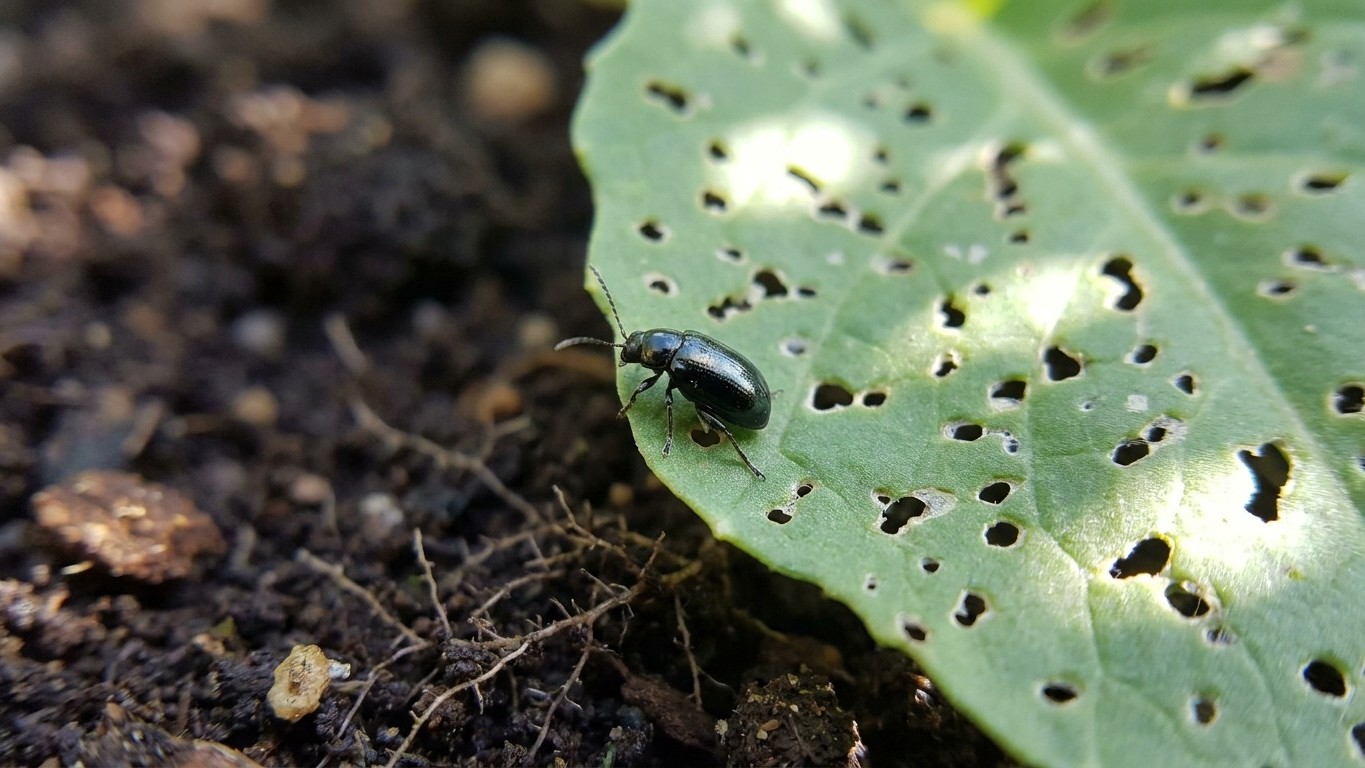

Flea beetles cycle through four life stages, but only the adult truly matters to a gardener: it’s the tiny, jumping beetle that chews the shotgun-hole pattern into leaves. The eggs, larvae, and pupae all develop out of sight, in the soil. Adults emerge once the ground warms enough, and depending on the species and the region, that emergence can mean one wave of damage per year or several.
The stages, in order

Flea beetles (family Chrysomelidae, subfamily Alticinae) start as eggs laid in the soil, usually right at the base of a host plant or tucked into surface debris. A female can scatter dozens of eggs over her lifetime, and she picks spots close to food for the larvae that will hatch days later.
Those larvae are the part of the life cycle almost no gardener ever sees. They’re small, pale, worm-like grubs that live underground, feeding on roots and root hairs. On some crops, especially potatoes and other tuber vegetables, root-feeding larvae cause more economic damage than the adults do, tunneling shallow scars into developing tubers. But because they never surface, they get blamed far less often than they should.
Pupation happens in the soil too, in a small earthen cell near where the larva fed. This stage is brief and purely transitional, no feeding, no movement, just a body reorganizing itself for a few days to a couple of weeks depending on soil temperature.
The stage that does the visible damage
Then comes the adult, and this is the insect people actually notice. Adult flea beetles are small, dark, often shiny beetles, some with a bronze or striped sheen, rarely more than an eighth of an inch long. They get their name from their oversized hind legs, which let them spring away the instant a leaf is disturbed, a habit that makes them almost impossible to catch by hand.
Adults feed on foliage, and their signature mark is a scattering of small round or irregular holes, sometimes called “shot-hole” damage, concentrated on young leaves. Seedlings and transplants take the worst of it. A plant with only two or three true leaves can lose a meaningful share of its leaf surface in a single afternoon of feeding, which is why flea beetle damage often looks worse, proportionally, on the smallest, most vulnerable plants in a bed.
When it appears, and why that varies
Flea beetle emergence isn’t tied to a date on the calendar. It’s tied to accumulated warmth in the soil and air, the kind of gradual heat buildup that entomologists track as degree-days. Overwintered adults stay dormant until the ground and surrounding air cross a biological threshold specific to the species, then they emerge over a matter of days, not all at once but in a wave that builds as temperatures climb.
That mechanism is exactly why the same pest shows up weeks apart in different parts of the country. A stretch of unusually warm days in early spring can push emergence forward by a week or more, while a cold snap can stall it just as easily. Two gardens three states apart, both technically “in spring,” can be at completely different points in the flea beetle’s schedule depending on how much cumulative warmth each location has actually banked.
Why there’s no single answer here
This is also why no single date, or even a single degree-day number, works as a nationwide answer. Degree-day thresholds for flea beetle emergence are calculated and published on a territory-by-territory basis by university extension services, because they’re built from local soil temperature data and local pest monitoring, not from a fixed biological constant that applies everywhere equally.
The practical move is to treat emergence as a moving target tied to your own local conditions rather than a fixed week you can circle on a calendar. Extension offices track this every season and adjust their guidance as the weather actually plays out, which is a more reliable signal than any generic planting-calendar rule of thumb. If this site carries a dedicated life-cycle page for your state or region, that’s where the specific degree-day threshold and expected emergence window for your area will be posted, since that number changes both by location and by season.
One generation or several
This is the detail that determines how long a gardener actually needs to stay alert. A pest with a single generation per year gives you one damage window and then it’s done for the season, aside from lingering root feeding from larvae already in the ground. A pest with multiple overlapping generations keeps producing fresh waves of adults right through summer, which means the threat never fully closes.
Flea beetles fall on a spectrum here rather than fitting one clean answer. In cooler regions with a short growing season, many flea beetle species manage only one full generation a year: adults emerge in spring, feed, mate, lay eggs, and the resulting larvae and pupae simply carry the population through to the following spring without a second adult wave that same year. In warmer regions with a longer frost-free stretch, several of the flea beetle species common in vegetable gardens, those attacking eggplant, potato, and various brassicas, complete two or more generations before the season ends.
What that means for how long you watch
Practically, that means a gardener in a northern climate can reasonably expect the worst of the pressure to ease once the initial spring wave of adults dies down, with only background root damage from larvae continuing quietly underground. A gardener farther south, or anywhere the season runs long and warm, should assume a second and sometimes third generation of adults will appear later in summer, often catching a second planting of susceptible vegetables just as it reaches the seedling stage, which is the most vulnerable point in the entire cycle.
That difference also changes how monitoring should be scheduled. A single-generation situation rewards concentrated attention during one identifiable window early in the season. A multi-generation situation calls for spot-checking new growth periodically through summer, since a clean-looking planting in June offers no guarantee against a fresh beetle emergence hitting a August-planted crop.
Where it spends the winter
Overwintering is the piece that makes next year’s outbreak somewhat predictable, and it’s also the reason fall garden cleanup matters more than it might seem. Adult flea beetles are the stage that survives winter, not eggs or larvae. They tuck themselves into protected spots as temperatures drop: leaf litter, loose soil clods, garden debris left on the surface, mulch, and the base of grassy or weedy field edges all serve as shelter.
Some species also overwinter in wild host plants growing along fence lines, ditches, or woodland edges near cultivated fields, using those plants as a bridge population when cultivated crops aren’t available. This is part of why a garden bordered by weedy, uncultivated ground often sees earlier and heavier flea beetle pressure than one surrounded by mowed lawn or bare soil, the adjacent vegetation is functioning as a winter refuge and an early spring food source before crops even go in the ground.
Why cleanup timing has a real effect
Removing crop debris and reducing weedy cover near beds in fall does two things at once: it strips away some of the physical shelter that overwintering adults rely on, and it removes plant material that would otherwise let a small local population feed and build strength before spring planting even begins. Tilling exposed soil in late fall can also disrupt sheltering adults directly, since a beetle relying on loose surface cover for insulation has far less protection once that layer is turned under.
None of this eliminates the population outright, flea beetles are mobile enough to fly or hop in from neighboring properties regardless of what happens in a single yard. But reducing local overwintering sites lowers the size of the population that’s ready and waiting the moment spring temperatures cross that emergence threshold, which is a meaningful head start against the first wave of the season.
Biological control also plays a quiet but real role here. Ground beetles and certain parasitic wasps attack flea beetle eggs and larvae in the soil, and general predators like spiders and birds pick off adults above ground. None of these natural enemies eliminate an outbreak on their own, but populations of ground beetles and other soil predators are noticeably reduced by frequent tilling and broad-spectrum treatments, so preserving some undisturbed ground cover, mulch, or a permanent border planting can keep those predator numbers higher going into the following season.
Common questions
Do flea beetles bite people or pets?
No. Flea beetles feed exclusively on plant foliage and roots. Despite the name, they have no interest in animals or humans and pose no bite risk indoors or outdoors.
Can I tell flea beetle damage from other leaf-hole pests?
The shot-hole pattern, small, round to irregular holes scattered across young leaves rather than concentrated chewing along the edges, is fairly distinctive. Seeing the beetles themselves confirms it: they’re tiny, dark, and jump rather than fly when disturbed.
Does one bad flea beetle year predict another?
Often, yes, because the overwintering population that survives in soil, debris, and nearby weedy cover becomes the source of the following spring’s adults. A heavy fall population combined with light cleanup tends to carry forward into a stronger start the next season.
Should I worry about larvae if I never see adults?
It’s still worth checking root crops. Larvae feed underground on roots and tubers without ever producing visible adults on nearby foliage in some situations, so root scarring on potatoes or similar crops can appear even when leaf damage looks minimal.